The ability to focus has become one of the most valuable skills in the modern workplace. Yet for many professionals, maintaining concentration feels harder than ever. Constant notifications, overflowing inboxes, instant messages, virtual meetings, and endless streams of information compete for attention throughout the day. As a result, people often spend hours being busy without making meaningful progress on their most important work.
This is where deep work becomes a competitive advantage.
Deep work is the practice of dedicating uninterrupted time to cognitively demanding tasks that require concentration, creativity, and problem-solving. Instead of constantly switching between emails, chats, and administrative tasks, deep work allows you to devote your full mental energy to activities that create the greatest value.
In today’s knowledge economy, success is increasingly tied to the ability to learn complex skills, generate original ideas, and produce high-quality work. Whether you’re a marketer developing a strategy, a software developer writing code, a designer creating user experiences, a researcher analyzing data, or a business leader making critical decisions, your best results often come from periods of focused, distraction-free effort.
The challenge is that modern work environments are often designed for communication and responsiveness rather than concentration. Open office layouts, collaboration tools, and always-on digital communication make it easy to stay connected but difficult to stay focused. Many professionals spend their days reacting to incoming requests instead of proactively working on their highest-value priorities.
Building unbreakable focus does not mean eliminating collaboration or ignoring responsibilities. It means creating intentional systems that protect your attention and allow you to spend more time on work that truly matters. Deep work helps you improve productivity, strengthen expertise, produce better results, and gain greater satisfaction from your work.
In this guide, you’ll learn what deep work is, how it differs from shallow work, why it matters in today’s workplace, and how to create routines that help you consistently perform at your highest level.
What Is Deep Work?

Deep work is the ability to perform professional activities in a state of intense concentration without distractions. It involves focusing your attention on demanding tasks that require significant mental effort and produce meaningful results.
Unlike routine activities that can be completed while multitasking, deep work requires complete engagement. During a deep work session, your attention is directed toward a single objective, allowing you to think critically, solve complex problems, and create work of higher quality.
The concept is especially relevant in knowledge-based professions where value is created through thinking, learning, analysis, creativity, and innovation. In these environments, the quality of output often depends less on the number of hours worked and more on the ability to concentrate deeply on important tasks.
Deep work typically has several defining characteristics:
It Requires Intense Cognitive Effort
Deep work challenges your brain. It involves activities that push your skills, require careful thought, and demand sustained attention. Because these tasks are mentally demanding, they often cannot be performed effectively while checking messages, attending meetings, or switching between multiple projects.
It Creates High-Value Results
Not all work contributes equally to business outcomes. Deep work focuses on activities that generate significant value, such as strategic planning, product development, research, writing, design, analysis, and innovation. These tasks often have a lasting impact on projects, organizations, and careers.
It Improves Skills and Expertise
Deep concentration accelerates learning. When you dedicate focused time to challenging work, your brain forms stronger connections and develops expertise more efficiently. Over time, this leads to higher performance and increased professional capability.
It Requires Distraction-Free Attention
Deep work is difficult to achieve when interruptions are constant. Every notification, email alert, or unexpected conversation can break concentration and force the brain to restart its focus process. Successful deep work sessions are typically protected from unnecessary distractions.
It Produces Work That Is Hard to Replicate
As automation and artificial intelligence continue to transform the workplace, routine tasks are becoming easier to automate. Deep work strengthens uniquely human capabilities such as creativity, strategic thinking, judgment, and complex problem-solving—skills that remain highly valuable across industries.
Think about the difference between spending two hours responding to emails versus spending two hours developing a new business strategy. Both activities may feel productive, but the latter often generates significantly greater long-term value. Deep work prioritizes the activities that move projects, careers, and organizations forward.
Rather than measuring productivity by how busy you are, deep work encourages measuring productivity by the meaningful results you create.
Deep Work vs. Shallow Work
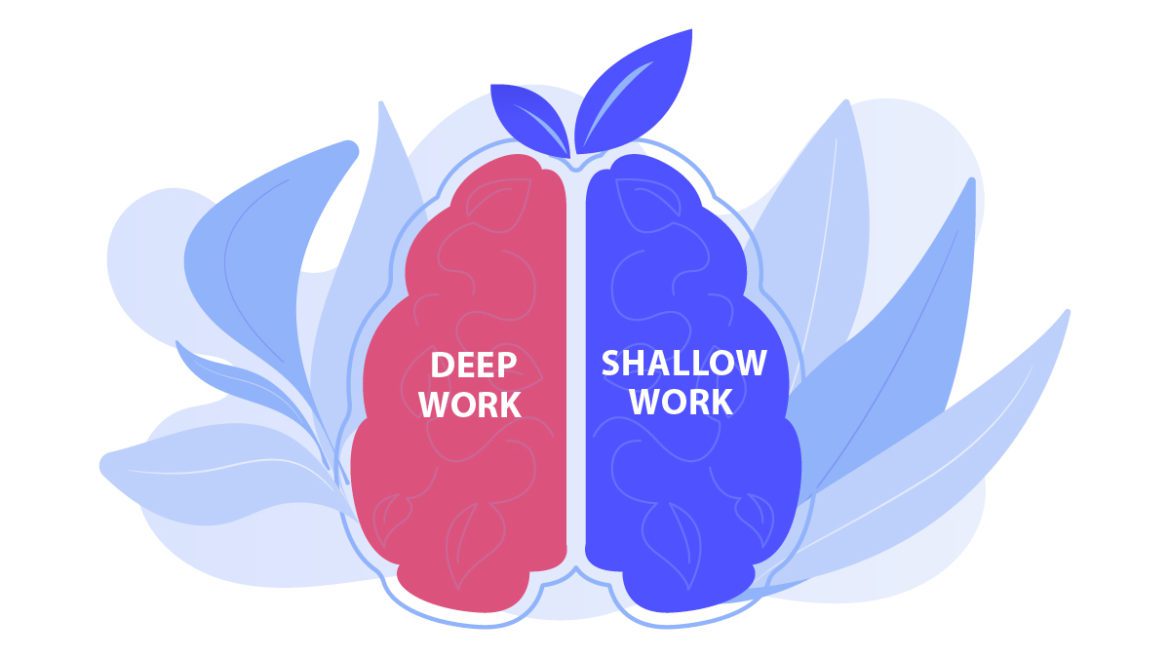
Understanding the difference between deep work and shallow work is essential for improving productivity. Most professionals perform both types of work every day, but the balance between them often determines how much meaningful progress they make.
Deep work and shallow work are not enemies. Both serve important functions. However, problems arise when shallow work consumes the majority of available time and leaves little room for focused, high-impact activities.
What Is Deep Work?
Deep work consists of demanding tasks that require concentration, expertise, and sustained mental effort. These activities often contribute directly to business growth, innovation, skill development, and long-term success.
Deep work generally:
- Requires uninterrupted focus
- Produces significant value
- Improves expertise and skills
- Involves problem-solving and creativity
- Creates lasting outcomes
Because deep work demands mental energy, it can feel challenging and uncomfortable. However, it is often the source of an individual’s most meaningful accomplishments.
What Is Shallow Work?
Shallow work consists of routine, logistical, or administrative tasks that require relatively little mental effort. These activities are often necessary for keeping operations running smoothly but typically do not create substantial long-term value.
Shallow work generally:
- Can be performed while distracted
- Requires limited concentration
- Is easier to replicate or automate
- Produces short-term outputs
- Focuses on coordination and communication
Many shallow tasks create the illusion of productivity because they keep people busy throughout the day. However, completing dozens of small tasks does not always translate into meaningful progress on important goals.
Examples of Deep Work
The specific activities that qualify as deep work vary by profession, but common examples include:
- Writing a research report
- Developing a marketing strategy
- Designing a product roadmap
- Coding a complex software feature
- Creating a business plan
- Conducting data analysis
- Building financial models
- Writing long-form content
- Developing training programs
- Solving technical engineering problems
- Creating original designs
- Learning advanced professional skills
- Preparing a major presentation
- Conducting academic research
- Strategic decision-making and planning
These activities often require uninterrupted periods of focus ranging from 60 minutes to several hours.
Examples of Shallow Work
Shallow work typically includes routine tasks that support daily operations:
- Responding to emails
- Attending status meetings
- Updating project records
- Scheduling appointments
- Organizing files
- Reviewing notifications
- Managing calendars
- Completing administrative paperwork
- Posting routine social media updates
- Tracking task progress
- Following up on approvals
- Processing standard requests
- Data entry tasks
- Monitoring communication channels
- Handling routine reporting
While these tasks are necessary, they rarely require the highest level of cognitive performance.
The Key Difference
The simplest way to distinguish deep work from shallow work is to ask a single question:
Does this activity create significant long-term value, require focused concentration, and improve my professional capabilities?
If the answer is yes, it is likely deep work.
If the task mainly involves coordination, communication, administration, or maintenance, it is probably shallow work.
High-performing professionals and organizations do not eliminate shallow work entirely. Instead, they consciously minimize unnecessary shallow activities and protect dedicated time for deep work. This balance enables them to produce better outcomes, develop expertise faster, and make meaningful progress on their most important objectives.
Why Deep Work Matters for Productivity and Focus

In a world where attention is constantly fragmented, the ability to focus deeply has become a significant professional advantage. Most knowledge workers spend their days switching between emails, messages, meetings, notifications, and multiple projects. While this level of connectivity can improve collaboration, it often comes at the cost of concentration.
Deep work helps reverse this trend by creating dedicated periods of uninterrupted focus. Instead of reacting to every incoming request, you intentionally direct your mental energy toward the tasks that create the greatest value.
The benefits extend far beyond getting more work done. Deep work improves the quality of your output, accelerates learning, strengthens problem-solving abilities, and helps create a greater sense of accomplishment in your professional life.
Produce Higher-Quality Output
One of the biggest advantages of deep work is the quality of results it produces.
Complex tasks rarely benefit from divided attention. Whether you’re writing a report, developing a marketing strategy, designing a product, analyzing data, or solving a technical problem, your best ideas typically emerge when you have enough uninterrupted time to think deeply.
Frequent interruptions create what researchers often refer to as an “attention residue” effect. When you switch from one task to another, part of your attention remains focused on the previous activity. This makes it harder to fully engage with the new task and reduces overall cognitive performance.
Deep work minimizes this problem by allowing your brain to remain immersed in a single challenge for an extended period.
When you focus deeply, you can:
- Think more critically
- Identify patterns and connections
- Solve complex problems more effectively
- Generate more creative ideas
- Catch errors that might otherwise be missed
- Make better strategic decisions
This is why many of the most valuable professional activities require uninterrupted concentration. The quality difference between work completed during focused attention and work completed amid constant distractions can be substantial.
Rather than producing more output, deep work often helps you produce better output.
Build Valuable Skills Faster
Modern careers increasingly depend on the ability to learn new skills and adapt to changing technologies.
Deep work plays a critical role in skill development because meaningful learning requires concentration. Whether you’re mastering data analytics, learning a programming language, developing leadership capabilities, or improving your writing, progress occurs when your brain is fully engaged with difficult material.
Shallow attention leads to shallow learning.
When people attempt to learn while simultaneously checking messages, browsing social media, or multitasking across several activities, information retention decreases and mastery takes longer to achieve.
Deep work creates the conditions necessary for deliberate practice, which is one of the most effective ways to improve performance in any field.
During deep work sessions, professionals can:
- Absorb complex information more effectively
- Strengthen problem-solving abilities
- Improve memory retention
- Build expertise faster
- Develop specialized knowledge
- Adapt more quickly to industry changes
As artificial intelligence, automation, and digital transformation continue to reshape industries, the ability to learn difficult things quickly is becoming increasingly valuable. Deep work helps professionals stay competitive by accelerating that learning process.
Create More Meaningful Work
Beyond productivity and skill development, deep work often leads to greater professional satisfaction.
Many people end their workday feeling busy but unfulfilled. They may have responded to dozens of emails, attended multiple meetings, and completed numerous small tasks, yet still feel like they made little meaningful progress.
This experience is common because shallow work tends to focus on maintenance rather than creation.
Deep work, on the other hand, is often associated with activities that move projects forward, solve important problems, and create lasting value.
When professionals spend more time in deep work, they often experience:
- Greater sense of accomplishment
- Stronger connection to their goals
- Higher engagement with their work
- Increased confidence in their abilities
- Improved motivation
- More visible career progress
There is a unique satisfaction that comes from completing challenging work that requires your full attention and expertise. Deep work allows professionals to spend more time contributing at their highest level rather than simply reacting to incoming demands.
In many cases, the most rewarding achievements in a career are the direct result of sustained focus and concentrated effort.
The Four Rules of Deep Work by Cal Newport
Building deep work into your daily routine requires more than good intentions. Modern distractions are designed to capture attention, making focused work increasingly difficult.
To address this challenge, productivity author Cal Newport introduced four practical rules that help individuals develop deeper concentration and reduce distractions. These principles provide a framework for creating an environment where meaningful work can thrive.
Rule #1: Work Deeply
Deep work does not happen by accident.
Most people assume they will find time for focused work somewhere between meetings, emails, and daily responsibilities. In reality, deep concentration usually requires deliberate planning and structure.
Working deeply means creating systems that make focused work easier and distractions harder.
This may include:
- Scheduling dedicated focus blocks
- Creating distraction-free environments
- Setting clear goals for each work session
- Establishing consistent routines
- Eliminating unnecessary interruptions
- Defining start and end times for focused work
Many successful professionals treat deep work appointments the same way they treat important meetings. The time is reserved in advance and protected from competing demands.
Rituals can also help signal to the brain that it is time to focus. Some people work in a specific location, follow a consistent schedule, or begin each session with a predefined planning process.
The key idea is simple: if deep work is important, it should be intentionally designed into your schedule rather than left to chance.
Rule #2: Embrace Boredom
One of the biggest obstacles to deep work is the modern habit of seeking constant stimulation.
Whenever people experience a brief moment of boredom, they often reach for their phones, check notifications, browse social media, or search for new information. Over time, this conditions the brain to expect continuous entertainment and makes sustained concentration more difficult.
Deep work requires the ability to stay focused even when tasks become challenging or mentally demanding.
Embracing boredom means resisting the urge to immediately seek distraction whenever your attention starts to wander.
Practical ways to develop this skill include:
- Taking breaks from digital stimulation
- Avoiding unnecessary phone checking
- Scheduling specific times for communication
- Practicing sustained reading
- Working through difficult problems without interruption
- Allowing moments of quiet reflection
The goal is to train your brain to tolerate periods of concentration without constantly seeking novelty.
Just as physical endurance improves through exercise, mental endurance improves through repeated periods of focused attention.
Rule #3: Quit Social Media
Social media platforms provide benefits, but they can also become major sources of distraction.
Many platforms are intentionally designed to maximize engagement through notifications, infinite scrolling, and personalized content feeds. While each interaction may seem brief, the cumulative impact on attention can be substantial.
The principle behind this rule is not necessarily to eliminate social media entirely. Instead, it encourages people to critically evaluate whether a platform provides enough value to justify its attention costs.
Consider questions such as:
- Does this platform significantly support my personal or professional goals?
- How much time do I spend using it?
- Does it improve my work or primarily distract from it?
- Would my life or career be negatively affected if I stopped using it?
Many professionals discover that reducing social media usage creates more time for learning, focused work, and meaningful activities.
Even small reductions in digital distractions can create additional opportunities for deep concentration throughout the week.
Rule #4: Drain the Shallows
Shallow work will always exist, but it should not dominate your schedule.
Many professionals spend most of their day responding to requests, attending meetings, managing communication, and completing administrative tasks. While these activities are often necessary, excessive shallow work can prevent meaningful progress on important goals.
Draining the shallows means intentionally reducing low-value activities whenever possible.
This can include:
- Limiting unnecessary meetings
- Streamlining communication processes
- Automating repetitive tasks
- Setting boundaries around availability
- Delegating routine responsibilities
- Prioritizing high-impact work
A useful approach is to regularly audit your calendar and identify activities that consume time without generating significant value.
The objective is not to eliminate shallow work entirely but to ensure it supports deep work rather than replacing it.
Professionals who consistently create space for focused, high-value work often achieve greater results than those who remain trapped in a cycle of constant busyness.
Four Deep Work Scheduling Philosophies
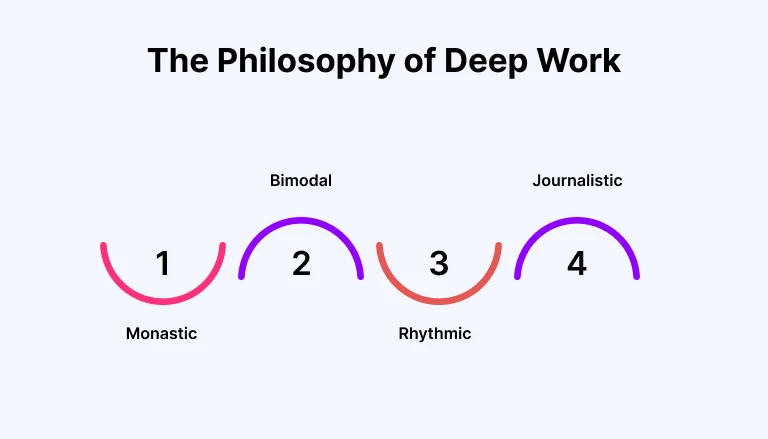
Different people work best under different conditions. Recognizing this, deep work can be scheduled using several distinct approaches depending on your profession, responsibilities, and lifestyle.
These scheduling philosophies provide flexible frameworks for incorporating deep work into daily and weekly routines.
Monastic Philosophy
The monastic approach involves eliminating or dramatically minimizing distractions to maximize deep work.
People who follow this philosophy prioritize focused work above nearly everything else. They intentionally reduce communication, meetings, and external obligations to protect concentration.
This approach is most common among:
- Researchers
- Authors
- Academics
- Scientists
- Independent creators
The primary advantage is the ability to achieve extremely high levels of focus. The challenge is that many professionals cannot completely disconnect from communication and collaboration requirements.
Bimodal Philosophy
The bimodal philosophy divides time between deep work and other responsibilities.
Instead of attempting to focus deeply every day, individuals dedicate large blocks of time to concentrated work while reserving separate periods for meetings, communication, and routine tasks.
For example:
- Several days per week may be dedicated to deep work.
- Certain hours each day may be reserved exclusively for focused work.
- Entire weeks may be set aside for major projects.
This approach works well for professionals who need substantial focus time but still have ongoing collaborative responsibilities.
Rhythmic Philosophy
The rhythmic philosophy turns deep work into a consistent habit.
Rather than relying on motivation or inspiration, individuals schedule deep work at the same time each day. The routine becomes automatic, making it easier to maintain focus over the long term.
Examples include:
- Working deeply from 8:00 a.m. to 10:00 a.m. every weekday
- Reserving the first two hours of each morning for focused work
- Scheduling recurring focus blocks throughout the week
This is often considered the most practical approach for knowledge workers because it creates predictable habits while accommodating regular workplace responsibilities.
Journalistic Philosophy
The journalistic philosophy involves fitting deep work into available opportunities whenever they arise.
Similar to how journalists may need to write under unpredictable conditions, this approach requires the ability to switch into deep focus quickly when time becomes available.
For example:
- Using an unexpected free hour for focused work
- Taking advantage of canceled meetings
- Blocking concentrated work between scheduled commitments
This method offers flexibility but requires strong focus skills and experience. It is often more challenging for beginners because deep work must be initiated without extensive preparation or routine.
For many professionals, a combination of the rhythmic and bimodal approaches provides the best balance between focus, collaboration, and adaptability.
How to Build a Deep Work Routine at Work

Understanding deep work is important, but the real challenge is turning it into a consistent habit. In today’s workplace, focus is constantly under attack from notifications, meetings, emails, chat messages, and unexpected requests. Without a deliberate system, even the most motivated professionals can find themselves spending entire days reacting instead of creating.
The key to deep work is building routines that make focused work the default rather than the exception.
Build a Repeatable Deep Work Ritual
High performers rarely rely on willpower alone. Instead, they create rituals that help them enter a focused state more easily.
A deep work ritual is a predefined process that signals to your brain that it is time to concentrate.
Your ritual might include:
- Starting work at the same time each day
- Choosing a dedicated workspace
- Turning off notifications
- Closing unnecessary browser tabs
- Setting a timer for focused work
- Reviewing priorities before beginning
The more consistently you follow the ritual, the easier it becomes to transition into deep concentration.
The goal is to reduce decision fatigue and make focus automatic.
Prioritize the Work That Deserves Deep Focus
Not every task requires deep work.
One of the most common productivity mistakes is treating all work as equally important. Before scheduling deep work sessions, identify the activities that generate the greatest value.
These typically include:
- Strategic planning
- Writing and content creation
- Research and analysis
- Product development
- Problem-solving
- Learning complex skills
- Process improvement
- High-level decision-making
Administrative tasks, routine updates, and status checks can often be completed during lower-energy periods.
Reserve your peak focus hours for work that truly benefits from concentrated attention.
Block Deep Work on Your Calendar First
If deep work is not scheduled, shallow work usually takes over.
Many professionals fill their calendars with meetings and leave focused work to whatever time remains. Unfortunately, that often means deep work never happens.
Instead, schedule focus blocks before other commitments.
For example:
- 8:00 AM – 10:00 AM: Strategy development
- 10:00 AM – 11:00 AM: Communication and email
- 1:00 PM – 3:00 PM: Project execution
- 3:00 PM – 4:00 PM: Meetings and collaboration
Treat deep work sessions as non-negotiable appointments.
When colleagues see protected focus blocks on your calendar, it also creates visibility around your availability and helps reduce interruptions.
Track How You Actually Spend Your Time
Many people overestimate how much focused work they accomplish each day.
Time tracking helps reveal where attention is really going.
For one week, record how you spend your working hours.
You may discover that:
- Meetings consume more time than expected
- Email occupies several hours daily
- Frequent task switching reduces productivity
- Interruptions break concentration repeatedly
Once you understand where your time goes, it becomes easier to identify opportunities for deeper work.
The objective is not perfection but awareness.
Small adjustments often create significant improvements in focus.
Reduce Context Switching Across Tools
Every time you switch between applications, projects, or communication channels, your brain pays a cognitive cost.
This phenomenon is known as context switching.
For example:
- Checking email while writing a report
- Responding to chat messages while analyzing data
- Jumping between multiple project platforms
- Switching between unrelated tasks throughout the day
Although each switch may seem minor, the cumulative effect can significantly reduce productivity.
To minimize context switching:
- Batch similar tasks together
- Consolidate information where possible
- Process communications at designated times
- Complete one priority before starting another
The fewer mental transitions you make, the more energy remains available for meaningful work.
Protect Your Energy, Not Just Your Schedule
Deep work depends on mental energy as much as available time.
Even a perfectly planned schedule will fail if you attempt cognitively demanding work when your energy is depleted.
Pay attention to your natural performance patterns.
Ask yourself:
- When do I think most clearly?
- When am I most creative?
- When do I solve problems most effectively?
For many people, morning hours provide the highest concentration levels. Others perform best later in the day.
Protect these high-energy periods for deep work and reserve routine tasks for lower-energy windows.
In addition, support focus through:
- Adequate sleep
- Regular exercise
- Healthy nutrition
- Strategic breaks
- Reduced multitasking
Sustainable deep work requires sustainable energy management.
Turn Meetings into Async Updates When Possible
Meetings are one of the biggest threats to deep work.
While collaboration is important, many meetings exist primarily to share information that could be communicated asynchronously.
Instead of scheduling a meeting, consider:
- Project updates
- Shared documents
- Recorded video messages
- Team dashboards
- Status reports
- Collaborative workspaces
Async communication allows people to consume information when convenient rather than interrupting productive work.
Organizations that embrace asynchronous workflows often create more opportunities for uninterrupted focus.
Define a Clear Outcome for Each Focus Block
Deep work sessions become more effective when they have a specific objective.
Before starting a focus block, define exactly what success looks like.
Examples include:
- Complete the first draft of a proposal
- Analyze customer survey results
- Finish a product requirements document
- Solve a technical issue
- Create a campaign strategy
A clear target provides direction and helps maintain momentum throughout the session.
Rather than simply “working on a project,” you are working toward a concrete outcome.
This clarity improves both focus and productivity.
What Prevents Deep Work in the Modern Workplace

Despite its benefits, deep work remains difficult for many professionals because modern workplaces are often optimized for responsiveness rather than concentration.
Several common obstacles make sustained focus challenging.
Constant Notifications
Emails, chat alerts, mobile notifications, and software updates create a continuous stream of interruptions.
Even brief distractions can disrupt concentration and make it difficult to regain momentum.
Excessive Meetings
Many organizations unintentionally overload calendars with recurring meetings.
When focus time is fragmented across the day, meaningful work becomes difficult to complete.
Always-On Communication Culture
Some workplaces encourage immediate responses to every message.
This expectation can create a reactive work environment where employees struggle to dedicate uninterrupted time to important projects.
Tool Fragmentation
Teams frequently work across multiple platforms for projects, communication, documents, client management, reporting, and collaboration.
Constantly switching between systems increases cognitive load and reduces focus.
Multitasking
Although multitasking feels productive, research consistently shows that switching between tasks reduces efficiency and increases errors.
Deep work requires sustained attention on a single objective.
Lack of Prioritization
When priorities are unclear, people naturally focus on urgent requests rather than important work.
Without intentional planning, shallow work tends to dominate the day.
The modern workplace is full of distractions, but awareness is the first step toward overcoming them. Organizations that actively protect focus time often see improvements in productivity, work quality, and employee satisfaction.
How Corexta Helps You Protect Deep Work
Deep work is difficult when information is scattered across multiple tools and employees spend large portions of the day searching for updates, managing workflows, and switching between systems.
This is where Corexta can help.
Corexta is an all-in-one business management platform that combines project management, client management, HR, finance, payroll, recruitment, asset management, and collaboration tools within a single workspace. By reducing operational complexity, it helps teams spend less time managing software and more time doing meaningful work.
Reduce Context Switching Across Multiple Platforms
One of the biggest barriers to deep work is constantly moving between disconnected tools.
Corexta centralizes projects, tasks, clients, reporting, communication, and operational workflows in one platform. This reduces the need to jump between multiple applications throughout the day and helps teams maintain focus on high-priority work.
Create Better Visibility Around Priorities
Deep work requires clarity.
Corexta provides project tracking, task management, project roadmaps, milestones, time tracking, and progress visibility so team members always know what requires attention next. Instead of wasting time searching for information, teams can focus on execution.
Automate Repetitive Administrative Work
Routine administrative tasks often consume time that could be used for deep work.
Corexta includes workflow automation capabilities that help reduce manual updates, repetitive processes, notifications, reporting activities, and other forms of operational busywork. By minimizing repetitive work, teams can dedicate more energy to strategic initiatives and creative problem-solving.
Improve Collaboration Without Constant Interruptions
Deep work does not mean eliminating collaboration.
Corexta helps teams coordinate projects, share updates, manage tasks, and track progress through a centralized workspace. This creates greater transparency while reducing unnecessary back-and-forth communication that often interrupts focused work.
Support Better Time Management
With built-in task tracking, project visibility, timesheets, and workload management, Corexta helps teams understand how time is being spent and where productivity improvements can be made. Better visibility makes it easier to schedule and protect deep work sessions.
The ultimate goal of deep work is to spend more time creating value and less time managing complexity. By consolidating workflows into a single platform, Corexta helps organizations build an environment where focused work becomes easier to achieve.
If your team is struggling with constant interruptions, fragmented tools, and scattered workflows, exploring Corexta may be a practical step toward creating more protected focus time. Start a free trial, book a demo, and see how a unified workspace can help your team accomplish more meaningful work with less distraction.
Frequently Asked Questions
How many hours of deep work can you realistically do per day?
For most knowledge workers, one to four hours of true deep work per day is realistic and highly productive.
Deep work is mentally demanding and requires significant cognitive energy. While some experienced professionals may occasionally sustain longer periods, most people experience diminishing returns after several hours of intense concentration.
The focus should be on quality rather than quantity. Two hours of uninterrupted deep work often produce more meaningful results than an entire day of fragmented attention.
What is the difference between deep work and flow state?
Deep work and flow state are related but not identical concepts.
Deep work refers to the intentional practice of focusing on cognitively demanding tasks without distractions.
Flow state is a psychological condition in which a person becomes fully immersed in an activity and experiences heightened concentration, enjoyment, and performance.
Deep work creates the conditions that make flow more likely, but not every deep work session results in flow. Similarly, flow can occur in activities that are not necessarily considered deep work.
Can project management tools help with deep work, or do they create more distractions?
The answer depends on how the tools are used.
Poorly configured systems can create additional notifications, interruptions, and complexity.
However, well-designed project management platforms help protect deep work by:
- Clarifying priorities
- Organizing information
- Reducing task ambiguity
- Improving visibility
- Minimizing unnecessary communication
- Automating repetitive processes
The best tools support focus by reducing operational friction rather than increasing it.
What is the deep work formula Cal Newport recommends?
A commonly referenced concept associated with deep work is:
High-Quality Work Produced = Time Spent × Intensity of Focus
The formula highlights an important principle: productivity is not simply about working longer hours.
Meaningful output depends on both the amount of time invested and the level of concentration applied during that time.
Increasing focus often produces greater results than simply increasing working hours. This is why deep work has become such an important skill for professionals seeking higher productivity, stronger expertise, and more meaningful achievements.
Read More: Website Project Management: Plan, Build, Launch on Time