Every successful marketing campaign starts with a clear goal. Whether you’re launching a new product, growing your audience, generating leads, or increasing revenue, your marketing efforts need direction. Without defined goals, it’s difficult to know what success looks like, which strategies deserve more investment, and where improvements are needed.
Marketing goals provide that direction. They help businesses align marketing activities with broader business objectives, prioritize resources, and measure performance effectively. Instead of chasing vanity metrics or experimenting without purpose, teams can focus on outcomes that contribute to long-term growth.
The challenge is that many organizations set goals that are too vague, unrealistic, or disconnected from measurable business results. Goals like “get more customers” or “grow our brand” sound good on paper, but they don’t provide enough clarity for execution. Effective marketing goals are specific, measurable, and tied to meaningful outcomes.
As marketing channels continue to evolve in 2026, businesses have access to more data, automation, and analytics than ever before. This creates new opportunities for growth, but it also makes strategic goal-setting more important. Teams need clear targets to cut through the noise, track progress accurately, and adapt quickly when market conditions change.
What are Marketing Goals?

Marketing goals are specific outcomes a business wants to achieve through its marketing efforts within a defined timeframe. They serve as a roadmap for marketing teams, helping them focus on activities that support larger business objectives such as increasing revenue, acquiring customers, improving retention, or expanding market share.
Think of marketing goals as the destination, while your marketing strategy represents the route you take to get there.
For example:
- A marketing goal might be to increase qualified leads by 25% within six months.
- The strategy could include content marketing, SEO, email campaigns, and paid advertising.
- The tactics would be the individual actions used to execute that strategy.
Marketing goals help answer critical questions such as:
- What are we trying to achieve?
- How will we measure success?
- When should results be delivered?
- Which metrics matter most?
Why Marketing Goals Matter
Organizations that set clear marketing goals are better positioned to make informed decisions and achieve sustainable growth. Well-defined goals help teams:
- Align marketing activities with business priorities
- Improve accountability across departments
- Allocate budgets more effectively
- Measure campaign performance accurately
- Identify successful initiatives and eliminate ineffective ones
- Maintain focus on high-impact opportunities
Without clear goals, teams often struggle to prioritize work, justify marketing investments, and demonstrate return on investment (ROI).
Marketing Goals vs. Marketing Objectives
Although the terms are often used interchangeably, marketing goals and marketing objectives are not exactly the same.
Marketing Goal:
A broad outcome you want to achieve.
Example:
Increase brand awareness in a new market.
Marketing Objective:
A specific, measurable milestone that supports the goal.
Example:
Increase branded search volume by 20% and grow social media reach by 30% within the next quarter.
In simple terms, goals define the destination, while objectives define the measurable steps required to reach it.
Common Types of Marketing Goals
Marketing goals typically fall into several categories:
- Brand awareness
- Lead generation
- Website traffic growth
- Customer acquisition
- Revenue growth
- Customer retention
- Search engine visibility
- Social media engagement
- Brand authority
- Customer lifetime value optimization
The right goals depend on your business stage, industry, audience, and overall growth strategy.
How To Set SMART Marketing Goals
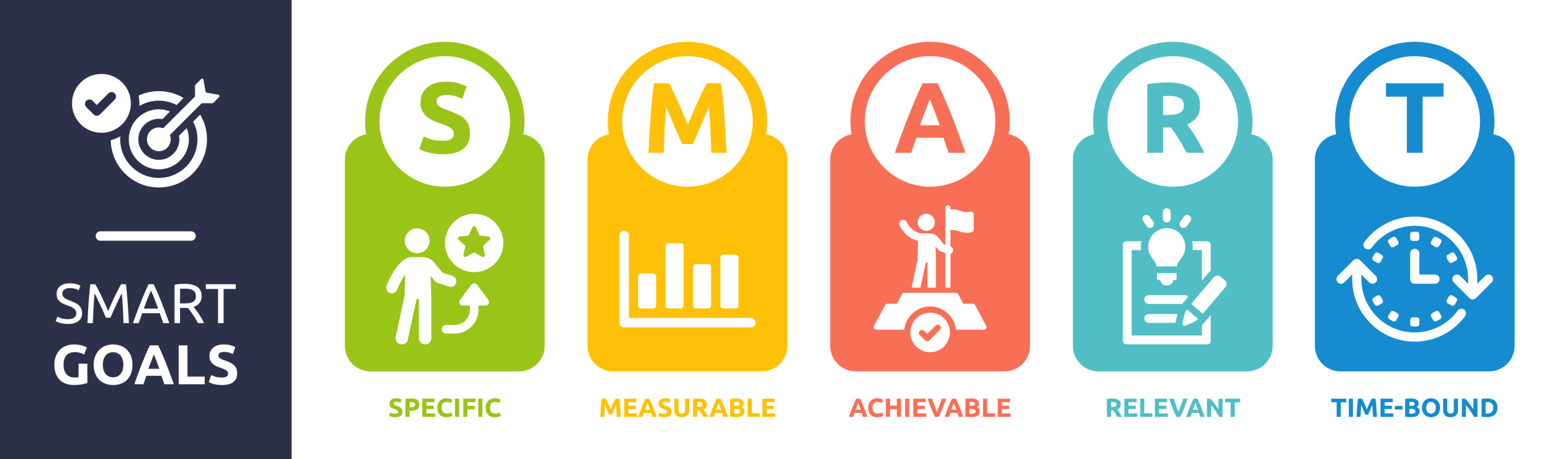
One of the most effective frameworks for creating successful marketing goals is the SMART methodology. SMART goals provide structure and clarity, making it easier to track progress and achieve meaningful results.
SMART stands for:
- Specific
- Measurable
- Achievable
- Relevant
- Time-bound
Instead of setting vague goals, the SMART framework transforms ideas into actionable plans that teams can execute and measure.
S — Specific
A goal should clearly define what you want to accomplish.
Vague goals create confusion and make it difficult to determine whether success has been achieved. Specific goals provide a clear target for the entire team.
Instead of:
Increase website traffic.
Try:
Increase organic website traffic from search engines by 30%.
The more precise the goal, the easier it becomes to develop strategies and allocate resources effectively.
Ask yourself:
- What exactly do we want to achieve?
- Who is responsible?
- Which marketing channels are involved?
- What outcome are we targeting?
M — Measurable
If you can’t measure a goal, you can’t evaluate progress.
Every marketing goal should have at least one key performance indicator (KPI) attached to it. Measurable goals allow teams to track performance, identify trends, and make data-driven decisions.
Examples of measurable KPIs include:
- Website sessions
- Conversion rates
- Lead volume
- Revenue generated
- Customer acquisition cost
- Social media engagement
- Email open rates
- Search rankings
Instead of:
Generate more leads.
Try:
Generate 500 qualified leads per month.
A measurable goal removes ambiguity and establishes clear expectations.
A — Achievable
Goals should be ambitious enough to drive growth but realistic enough to be attainable.
Setting impossible targets can demotivate teams and lead to poor decision-making. On the other hand, goals that are too easy may not encourage improvement.
To determine whether a goal is achievable, consider:
- Historical performance
- Available budget
- Team resources
- Market conditions
- Industry benchmarks
- Existing technology and tools
For example, a business generating 10,000 monthly visitors may reasonably target 15,000 visitors within six months. Targeting 1 million visitors in the same period may not be realistic without significant investment.
R — Relevant
Every marketing goal should support a broader business objective.
Marketing teams often track dozens of metrics, but not all of them contribute to meaningful business outcomes. Relevant goals focus attention on activities that create measurable value.
Ask:
- Does this goal support company growth?
- Will it contribute to revenue, customer acquisition, or retention?
- Is it aligned with current business priorities?
For example, increasing social media followers may not be relevant if the company’s primary objective is improving customer retention. In that case, customer engagement or loyalty metrics may be more valuable.
When goals align with business priorities, marketing efforts become more strategic and impactful.
T — Time-Bound
Every goal needs a deadline.
Without a timeframe, goals can be delayed indefinitely and progress becomes difficult to evaluate.
A time-bound goal creates urgency and accountability.
Instead of:
Increase email subscribers.
Try:
Increase email subscribers by 20% within the next three months.
Examples of common marketing timelines include:
- Monthly goals
- Quarterly goals
- Six-month goals
- Annual goals
The appropriate timeline depends on the complexity of the initiative and the expected pace of results.
SMART Marketing Goal Example
Here’s how a complete SMART marketing goal might look:
“Increase organic website traffic by 35% over the next six months by publishing two SEO-optimized articles per week, improving technical SEO performance, and earning high-quality backlinks.”
This goal is:
- Specific: Organic traffic growth
- Measurable: 35% increase
- Achievable: Based on available resources
- Relevant: Supports lead generation and growth
- Time-bound: Six-month deadline
When every marketing goal follows this framework, teams gain greater clarity, accountability, and confidence in their ability to deliver measurable business results.
Top 10 Marketing Goals Examples for Your Next Strategy Session

Setting marketing goals becomes much easier when you can see real-world examples in action. The best goals are tied to business outcomes, supported by measurable KPIs, and aligned with your company’s growth stage.
Whether you’re focused on brand visibility, lead generation, customer retention, or revenue growth, the following examples can help shape a more effective marketing strategy.
1. Increase Brand Awareness
Brand awareness measures how familiar your target audience is with your business, products, or services. Before customers can buy from you, they first need to know you exist.
This goal is especially important for startups, businesses entering new markets, and companies launching new products.
Increasing brand awareness can help:
- Expand market reach
- Generate more branded searches
- Improve trust and credibility
- Create future sales opportunities
- Strengthen competitive positioning
Common tactics include:
- Content marketing
- Social media campaigns
- Public relations initiatives
- Influencer partnerships
- Video marketing
- Podcast appearances
- Industry event sponsorships
Key metrics to track:
- Brand mentions
- Social reach and impressions
- Share of voice
- Direct website traffic
- Branded search volume
- Media coverage
Example SMART Goal:
Increase branded search traffic by 25% and social media reach by 40% within the next six months.
2. Generate Qualified Leads
Lead generation remains one of the most common marketing objectives because it directly supports sales growth. However, modern marketing teams focus less on lead quantity and more on lead quality.
A qualified lead is someone who matches your target customer profile and has demonstrated genuine interest in your offering.
Generating better-qualified leads can:
- Improve sales conversion rates
- Reduce acquisition costs
- Shorten sales cycles
- Increase marketing ROI
Popular lead generation strategies include:
- SEO-driven content marketing
- Landing pages and lead magnets
- Webinars and virtual events
- Email marketing campaigns
- Paid search advertising
- Account-based marketing (ABM)
Useful KPIs include:
- Marketing-qualified leads (MQLs)
- Sales-qualified leads (SQLs)
- Conversion rates
- Cost per lead
- Lead-to-customer ratio
Example SMART Goal:
Generate 300 marketing-qualified leads per month while maintaining a cost per lead below the established target.
3. Increase Website Traffic
Website traffic is often the foundation of digital marketing success. More qualified visitors typically create more opportunities for conversions, sales, and customer engagement.
However, traffic alone isn’t enough. The focus should be on attracting the right audience rather than simply increasing visitor numbers.
Website traffic growth can support:
- Lead generation
- E-commerce sales
- Brand visibility
- Content performance
- Search engine authority
Effective traffic-generation methods include:
- Search engine optimization (SEO)
- Content marketing
- Email newsletters
- Paid advertising
- Social media promotion
- Referral partnerships
Key metrics to monitor:
- Organic traffic
- Total website sessions
- New visitors
- Traffic source breakdown
- Bounce rate
- Time on site
Example SMART Goal:
Increase organic website traffic by 35% within six months through content creation, technical SEO improvements, and backlink acquisition.
4. Boost Brand Engagement
Audience engagement measures how actively people interact with your brand across digital channels.
An engaged audience is more likely to trust your business, recommend your products, and become long-term customers.
Strong engagement often indicates that your messaging resonates with your target audience.
Ways to improve engagement include:
- Creating interactive content
- Encouraging community participation
- Responding to customer feedback
- Publishing educational resources
- Hosting live events and webinars
- Building customer communities
Common engagement metrics include:
- Comments
- Shares
- Reactions
- Click-through rates
- Email engagement
- Video watch time
- Community participation
Example SMART Goal:
Increase social engagement rates by 20% and email click-through rates by 15% over the next quarter.
5. Increase Revenue
While many marketing goals focus on awareness and acquisition, revenue growth is often the ultimate business objective.
Revenue-focused goals help marketing teams demonstrate their direct contribution to company performance.
Instead of measuring activity alone, these goals focus on financial outcomes.
Strategies that support revenue growth include:
- Improving conversion rates
- Upselling and cross-selling
- Optimizing marketing funnels
- Reducing customer acquisition costs
- Enhancing customer experiences
- Launching targeted campaigns
Important KPIs include:
- Marketing-generated revenue
- Return on marketing investment (ROMI)
- Customer acquisition cost (CAC)
- Conversion rates
- Average order value
Example SMART Goal:
Increase marketing-attributed revenue by 20% during the next two quarters while maintaining profitability targets.
6. Grow Customer Lifetime Value
Customer Lifetime Value (CLV) represents the total revenue a customer generates throughout their relationship with your business.
Many organizations spend heavily on customer acquisition but overlook the opportunity to increase value from existing customers.
Growing CLV often delivers higher returns than constantly pursuing new customers.
Methods for increasing customer lifetime value include:
- Loyalty programs
- Personalized experiences
- Subscription models
- Product recommendations
- Upselling campaigns
- Customer education initiatives
Metrics to track include:
- Customer lifetime value
- Average order value
- Repeat purchase rate
- Revenue per customer
- Upsell conversion rate
Example SMART Goal:
Increase average customer lifetime value by 15% within 12 months through retention and upsell initiatives.
7. Establish Brand Authority
Brand authority refers to the level of trust, expertise, and credibility your company has within its industry.
Today’s buyers conduct extensive research before making purchasing decisions. Businesses that consistently demonstrate expertise often earn more trust and attract higher-quality prospects.
Building authority can help:
- Improve conversion rates
- Increase media opportunities
- Generate organic backlinks
- Support thought leadership efforts
- Strengthen competitive differentiation
Strategies include:
- Publishing original research
- Producing educational content
- Speaking at industry events
- Guest posting on respected websites
- Sharing expert insights
- Participating in professional communities
Useful KPIs include:
- Backlink growth
- Media mentions
- Speaking invitations
- Content shares
- Industry citations
Example SMART Goal:
Earn 50 new high-authority backlinks and secure five industry speaking opportunities within the next year.
8. Improve Customer Retention
Acquiring a customer is only the beginning. Long-term growth depends on keeping customers engaged and satisfied over time.
Retention-focused marketing helps businesses maximize customer relationships while reducing the cost of acquiring new buyers.
High retention rates often lead to:
- Increased profitability
- Higher customer lifetime value
- More referrals
- Stronger brand loyalty
- More predictable revenue
Retention strategies may include:
- Customer onboarding programs
- Email nurturing campaigns
- Loyalty rewards
- Customer success initiatives
- Personalized communication
- Feedback collection programs
Metrics to monitor:
- Customer retention rate
- Churn rate
- Repeat purchase rate
- Net promoter score (NPS)
- Customer satisfaction score (CSAT)
Example SMART Goal:
Reduce customer churn by 10% and increase repeat purchases by 15% within the next 12 months.
9. Improve Search Engine Rankings
Search visibility remains one of the most valuable long-term marketing assets. Higher rankings can generate consistent, high-intent traffic without relying heavily on paid advertising.
As search algorithms continue evolving, businesses must focus on creating high-quality content, delivering excellent user experiences, and demonstrating expertise.
Improving rankings can result in:
- Increased organic traffic
- Lower acquisition costs
- Better lead quality
- Stronger brand credibility
- Sustainable growth
SEO initiatives may include:
- Technical optimization
- Keyword targeting
- Content creation
- Internal linking improvements
- Backlink development
- User experience enhancements
Important KPIs include:
- Keyword rankings
- Organic traffic
- Organic conversions
- Click-through rate (CTR)
- Domain authority indicators
Example SMART Goal:
Achieve first-page rankings for 20 high-value industry keywords within nine months.
10. Strengthen Social Media Presence
Social media is no longer just a branding channel. It plays an important role in customer engagement, community building, lead generation, and customer support.
A strong social media presence helps businesses remain visible where their audience spends time online.
Benefits include:
- Increased brand awareness
- Better audience engagement
- Community growth
- Customer feedback opportunities
- Enhanced customer relationships
Effective social media strategies often involve:
- Consistent publishing schedules
- Short-form video content
- User-generated content campaigns
- Influencer collaborations
- Community engagement
- Social listening initiatives
Key metrics include:
- Follower growth
- Reach and impressions
- Engagement rate
- Click-through rate
- Social conversions
- Share of voice
Example SMART Goal:
Increase social media engagement by 30% and grow qualified followers by 25% within six months.
The most successful marketing teams don’t pursue every goal at once. Instead, they identify a small number of goals that align closely with business priorities, define clear KPIs, and consistently measure progress. By focusing on outcomes rather than activities, marketers can build strategies that contribute directly to sustainable business growth.
How To Track and Measure Marketing Goals

Setting marketing goals is only the first step. To drive real business growth, you need a system for tracking progress, measuring results, and making adjustments when necessary.
Without proper measurement, even the best marketing strategies can become guesswork.
Modern marketing teams rely on data, reporting, and performance visibility to ensure their goals stay connected to business outcomes. The more accurately you track performance, the easier it becomes to identify what’s working and where improvements are needed.
Choose One KPI Per Goal
One of the most common mistakes marketers make is tracking too many metrics for a single goal.
While multiple data points can provide useful insights, every goal should have one primary Key Performance Indicator (KPI) that defines success.
For example:
| Marketing Goal | Primary KPI |
|---|---|
| Increase website traffic | Organic sessions |
| Generate qualified leads | Marketing-qualified leads (MQLs) |
| Improve retention | Customer retention rate |
| Increase revenue | Marketing-attributed revenue |
| Boost engagement | Engagement rate |
Choosing a primary KPI helps teams stay focused and prevents reporting from becoming overly complicated.
Supporting metrics can still be monitored, but one KPI should serve as the main performance benchmark.
Set a Reporting Cadence
Tracking data occasionally is not enough. Successful marketing teams follow a consistent reporting schedule that keeps everyone aligned and accountable.
A reporting cadence creates regular opportunities to evaluate performance, identify issues, and adjust strategies before problems become larger.
Common reporting schedules include:
- Weekly campaign reviews
- Monthly performance reports
- Quarterly strategy reviews
- Annual marketing evaluations
For example:
- Social media campaigns may require weekly reviews.
- SEO initiatives often benefit from monthly analysis.
- Revenue and customer retention goals are commonly reviewed quarterly.
Consistency is more important than frequency. The goal is to create a predictable rhythm for measuring progress.
Centralize Your Data (or Accept Chaos)
Modern marketing teams use multiple channels and tools simultaneously.
Data often comes from:
- Google Analytics
- CRM platforms
- Email marketing software
- Social media platforms
- Paid advertising networks
- SEO tools
- Customer support systems
When this information is scattered across different systems, reporting becomes slow, inconsistent, and error-prone.
Centralizing marketing data allows teams to:
- Access performance metrics faster
- Reduce reporting errors
- Improve decision-making
- Create unified dashboards
- Gain a complete view of customer journeys
A centralized reporting system provides a single source of truth for the entire organization.
Instead of manually collecting data from multiple platforms, teams can focus on analyzing insights and improving results.
Automate Status Updates
Manual reporting consumes valuable time and often leads to outdated information.
Automation helps marketing teams maintain visibility without spending hours creating reports every week.
Automated updates can include:
- Campaign performance summaries
- Goal progress tracking
- Team notifications
- Dashboard refreshes
- Scheduled reports
Automation improves:
- Accuracy
- Efficiency
- Team alignment
- Leadership visibility
Instead of chasing updates across spreadsheets, teams receive real-time progress information automatically.
This allows marketers to spend more time optimizing campaigns and less time managing reports.
Review and Adjust
Marketing goals should not remain static throughout the year.
Consumer behavior changes, algorithms evolve, competitors adapt, and business priorities shift. Teams that regularly review performance are better equipped to respond to these changes.
A goal review process should include:
- Performance analysis
- KPI evaluation
- Resource assessment
- Market trend review
- Strategy optimization
Ask questions such as:
- Are we on track to achieve this goal?
- Which channels are delivering the strongest results?
- What obstacles are slowing progress?
- Should we adjust timelines or targets?
Regular reviews create opportunities to improve performance before small issues become major setbacks.
The most effective marketing teams treat goal tracking as an ongoing process rather than a one-time activity.
Keep Your Marketing Goals Visible With Corexta
Marketing goals are most effective when they remain visible, measurable, and connected to daily work.
Many teams struggle because goals are documented during planning sessions but quickly disappear into spreadsheets, presentations, or disconnected reporting tools. As campaigns become more complex, visibility becomes a major challenge.
This is where Corexta can help.
Corexta provides an all-in-one workspace that helps businesses manage projects, campaigns, tasks, reporting, team collaboration, and operational workflows from a centralized platform. Instead of juggling multiple tools, marketing teams can organize planning, execution, and performance tracking in one system.
For marketing teams, Corexta supports:
- Campaign planning and project management
- Task assignment and deadline tracking
- Marketing workflow management
- Team collaboration
- Time tracking
- Performance visibility
- Real-time reporting dashboards
Using project boards, timelines, task views, and reporting tools, teams can connect marketing goals directly to daily activities. This creates greater accountability and helps ensure strategic goals stay aligned with execution.
Corexta also helps reduce operational complexity by centralizing information that would otherwise be spread across multiple platforms. Teams gain better visibility into campaign progress, project status, resource allocation, and business performance without constantly switching between tools.
As marketing operations grow, having a single source of truth becomes increasingly important. With centralized dashboards, workflow automation, project tracking, and collaboration features, Corexta helps marketing teams keep goals visible and measurable from planning through execution. Try Corexta free today!
Frequently Asked Questions About Marketing Goals
What’s the difference between marketing goals and marketing objectives?
Marketing goals are broad outcomes a business wants to achieve, such as increasing brand awareness or generating more revenue. Marketing objectives are the specific, measurable actions that help achieve those goals. In simple terms, goals define the destination, while objectives define the milestones used to get there.
How many marketing goals should a team focus on at once?
Most marketing teams should focus on three to five primary goals at a time. Too many goals can divide attention, create reporting challenges, and reduce overall effectiveness. Prioritizing a small number of high-impact goals helps teams stay focused and allocate resources more efficiently.
How often should you revisit your marketing goals?
Marketing goals should be reviewed regularly to ensure they remain aligned with business priorities and market conditions. Monthly performance reviews are useful for tracking progress, while quarterly reviews provide opportunities to evaluate strategy, adjust targets, and reallocate resources when necessary.
Read More: How to Write Procedures in 7 Clear Steps