If you’re researching POS software development cost in 2026, you’ve probably run into one of two problems: articles that give you a vague “it depends” answer, or vendor-biased content that quietly pushes you toward their product.
This guide does neither.
Custom POS software development costs between $20,000 and $750,000+ in 2026, depending on features, complexity, integrations, and where your development team is located. Small businesses building their first custom system typically land between $20,000 and $80,000. Mid-tier restaurant and retail POS platforms range from $50,000 to $150,000. Enterprise-grade, multi-location systems regularly exceed $250,000 — and full-scale SaaS POS platforms can top $750,000.
SaaS alternatives like Square or Toast start at $0–$300/month per terminal and work fine for businesses with standard needs. But they come with real limitations: transaction fees, vendor lock-in, restricted customization, and no data ownership.
This guide covers everything you need to make an informed decision:
- Full cost breakdown by development type and complexity
- Cost factors most businesses overlook (PCI compliance, QA, infra)
- Pricing by business vertical — retail, restaurant, enterprise
- Build vs. buy ROI analysis with a 5-year cost comparison
- The top POS systems compared
- 2026 AI and technology trends shaping POS costs
- Practical strategies to reduce development costs without sacrificing quality
Let’s start with the numbers.
POS Software Development Cost in 2026 — Quick Overview
Before diving into the details, here’s a high-level snapshot of what businesses typically spend:
| Development Type | Estimated Cost Range | Best Suited For |
|---|---|---|
| SaaS / Off-the-shelf POS | $0–$300/month per terminal | Startups, single-location small businesses |
| Basic Custom POS (MVP) | $20,000–$50,000 | Early-stage startups, pilots, single-store retail |
| Mid-Tier Custom POS | $50,000–$150,000 | Growing restaurants, multi-feature retail stores |
| Advanced Custom POS | $150,000–$300,000 | Multi-location businesses, complex integrations |
| Enterprise Custom POS | $300,000–$750,000+ | Enterprise retailers, SaaS POS builders, omnichannel platforms |
These are realistic ranges informed by 2026 market data. Your actual number will depend on the factors we break down in the next section — but at least you now have a ballpark to work from.
Already have a project in mind? Corexta’s custom POS development team can give you a scoped estimate based on your actual requirements — no guesswork.
What Factors Determine POS Software Development Cost?
No two POS projects cost the same. But the variables that move the number aren’t mysterious — they’re predictable once you know what to look for. Here are the eight primary cost drivers in 2026.
1. Project Complexity and Feature Set
The feature list is usually the single biggest cost driver. Basic POS systems — sales processing, payment collection, receipt generation, simple reporting — sit at the lower end of the range. The moment you add inventory forecasting, loyalty programs, multi-location dashboards, or AI-powered analytics, development hours multiply fast.
Here’s a feature-level cost reference:
| Feature / Module | Estimated Development Cost Add-On |
|---|---|
| Basic sales processing + billing | Included in base |
| Inventory management (basic) | $5,000–$12,000 |
| Advanced inventory + demand forecasting | $12,000–$30,000 |
| Customer loyalty program | $5,000–$15,000 |
| Multi-location management dashboard | $10,000–$25,000 |
| Kitchen Display System (KDS) | $8,000–$20,000 |
| Online ordering integration | $10,000–$25,000 |
| Mobile POS app (iOS + Android) | $20,000–$60,000 |
| AI-powered sales analytics | $15,000–$40,000 |
| Offline mode / edge computing | $8,000–$20,000 |
| ERP / CRM integration | $10,000–$30,000 |
| Custom reporting dashboard | $5,000–$15,000 |
| Self-checkout / kiosk interface | $15,000–$35,000 |
| Biometric authentication | $10,000–$25,000 |
Most businesses building a real-world custom POS will need at least 4–6 of these modules, which is why final costs regularly land above $80,000 even for “mid-tier” builds.
2. Development Team Location and Hourly Rates
Geography is one of the most controllable cost levers you have. Developer hourly rates vary dramatically by region — and the variance in total project cost is often two to four times the base.
| Region | Avg. Hourly Rate (2026) | Estimated 6-Month Project Cost |
|---|---|---|
| United States / Canada | $100–$180/hr | $150,000–$400,000 |
| Western Europe | $70–$120/hr | $100,000–$250,000 |
| Eastern Europe | $40–$80/hr | $60,000–$160,000 |
| Latin America | $30–$60/hr | $45,000–$120,000 |
| South / Southeast Asia | $20–$50/hr | $30,000–$100,000 |
A few important caveats here. Lower hourly rates don’t automatically mean lower quality. Many Eastern European and Southeast Asian development firms deliver production-grade software for global markets. The key is vetting the team rigorously — checking portfolio depth, communication standards, and project management discipline.
A hybrid model — US-based project management with offshore developers — often delivers the best combination of cost efficiency and quality oversight. It’s the model used by many leading POS development companies, including Corexta.
3. Frontend and Backend Development Scope
UI/UX design is often underestimated. A polished, intuitive POS interface requires significant design hours — especially for restaurant POS systems where speed and minimal friction at checkout are non-negotiable.
Backend complexity depends on architecture choices. An offline-first architecture (which ensures POS functions even without internet — critical for retail and restaurants) adds significant engineering complexity vs. a purely cloud-dependent build. Similarly, real-time data syncing across multiple terminals and locations requires robust backend infrastructure.
Budget 10–15% of total development cost for design alone and 25–35% for backend development.
4. Cloud Infrastructure and Hosting Costs
Cloud infrastructure is an ongoing cost, not a one-time expense. Once your POS is live, you’ll pay monthly for hosting, data storage, uptime guarantees, and scalability.
Typical monthly cloud costs in 2026:
| Business Scale | Monthly Cloud Infrastructure Cost |
|---|---|
| Single-location (low volume) | $100–$500/month |
| Mid-size business (2–10 locations) | $500–$2,000/month |
| Enterprise (50+ locations) | $2,000–$10,000+/month |
AWS, Google Cloud, and Microsoft Azure are the dominant options. Cloud-native architectures on these platforms provide automatic scaling, disaster recovery, and 99.9%+ uptime SLAs — but the cost grows with transaction volume and data storage.
5. PCI DSS Compliance and Payment Security
This is the most commonly overlooked cost factor in custom POS development — and one of the most important.
Any system that processes payment card data must comply with the Payment Card Industry Data Security Standard (PCI DSS). In 2026, businesses are required to adhere to PCI DSS v4.0, which introduced stricter requirements around web-facing applications and payment page security.
Here’s what compliance actually costs:
| Organization Size | PCI DSS Compliance Cost (2026) |
|---|---|
| Small business (low transaction volume) | $5,000–$20,000 |
| Mid-market (moderate volume) | $20,000–$75,000 |
| Large enterprise (high volume / Level 1) | $50,000–$200,000+ |
Annual maintenance of compliance adds $3,800–$10,000/year for documentation, training, quarterly vulnerability scans, and penetration testing. Non-compliance is not a gamble worth taking — fines range from $5,000 to $100,000 per month following a breach.
When building a custom POS, PCI compliance isn’t optional. It’s a development phase in its own right, requiring secure coding practices, tokenization, encryption, and formal audit documentation. Budget for it from day one.
6. Third-Party Integrations
Modern POS systems don’t operate in isolation. They connect with payment gateways, accounting platforms, CRM tools, delivery apps, loyalty programs, and inventory suppliers. Each integration requires custom API development, testing, and ongoing maintenance.
Estimated integration development costs:
| Integration Type | Estimated Development Cost |
|---|---|
| Payment gateway (Stripe, Square, PayPal) | $3,000–$10,000 |
| Accounting software (QuickBooks, Xero) | $4,000–$12,000 |
| ERP system (SAP, Oracle, NetSuite) | $10,000–$35,000 |
| CRM platform (Salesforce, HubSpot) | $8,000–$20,000 |
| Delivery platforms (Uber Eats, DoorDash) | $5,000–$15,000 |
| E-commerce platform (Shopify, WooCommerce) | $6,000–$18,000 |
| Loyalty / rewards program | $5,000–$15,000 |
The more integrations your POS needs out of the gate, the higher your development budget. Prioritize must-have integrations in V1 and phase non-critical connections into later releases.
7. QA Testing and Security Auditing
A POS system handles real financial transactions. Bugs aren’t just embarrassing — they’re costly, legally exposing, and trust-destroying. Quality assurance testing should consume 15–20% of your total development budget.
This includes functional testing (does every feature work as expected?), load testing (can the system handle peak traffic without crashing?), security penetration testing (can it withstand simulated attacks?), and payment flow testing (are transactions processed accurately across all scenarios?).
Skimping on QA to save money upfront is one of the most common — and most expensive — mistakes in custom POS development.
8. Ongoing Maintenance and Support
Building the system is only the beginning. Once your POS goes live, it requires regular maintenance, security patches, feature updates, and technical support.
The industry standard for annual POS software maintenance is 15–20% of the original development cost.
| Initial Build Cost | Annual Maintenance Budget |
|---|---|
| $50,000 | $7,500–$10,000/year |
| $100,000 | $15,000–$20,000/year |
| $250,000 | $37,500–$50,000/year |
| $500,000 | $75,000–$100,000/year |
Factor this into your 3–5 year total cost of ownership before committing to a budget.
Not sure which cost factors apply to your specific project? Talk to a Corexta POS development specialist for a no-obligation scope review.
POS Software Development Cost by Business Type
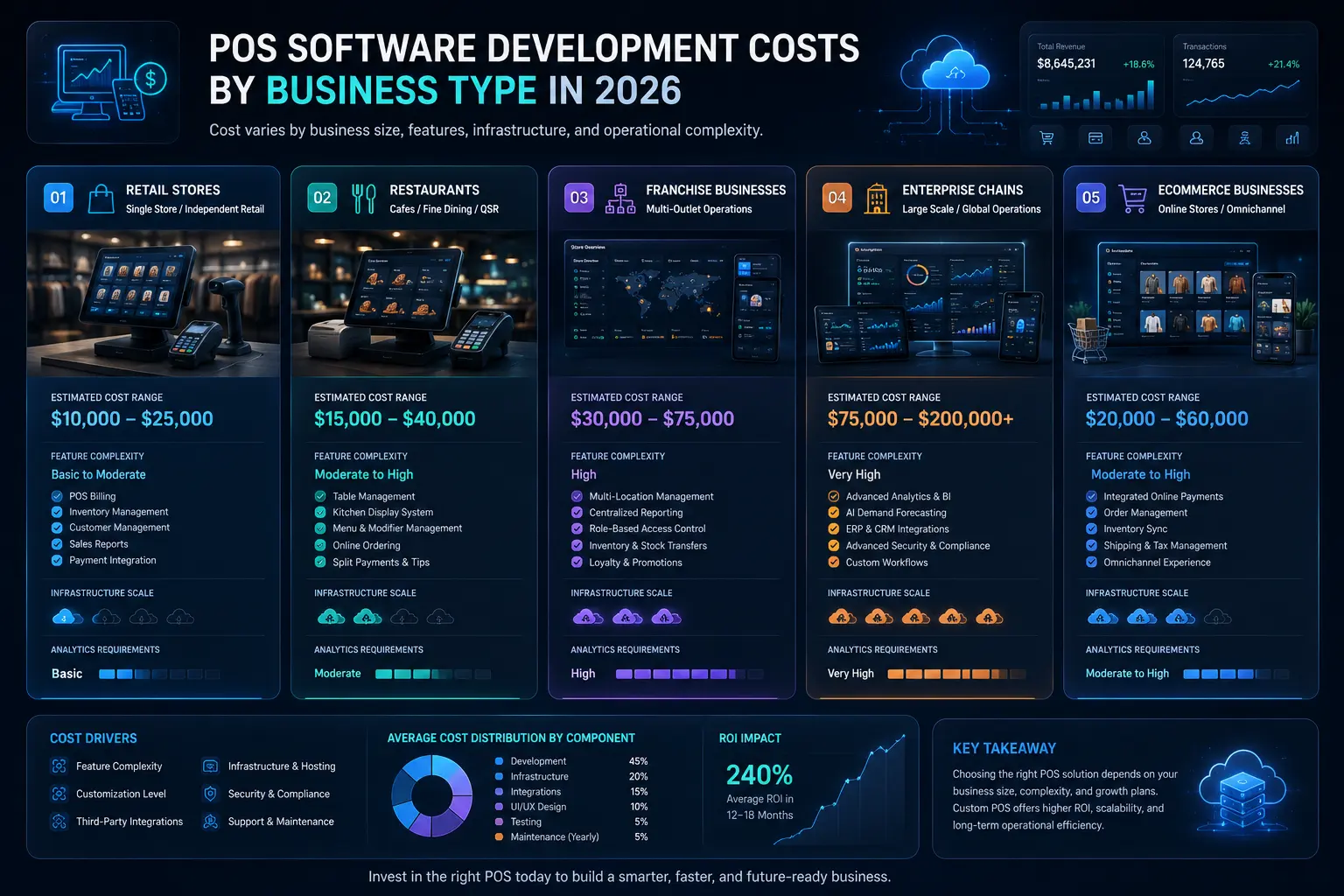
The right POS budget depends heavily on your industry vertical. A restaurant POS has fundamentally different requirements from a retail POS — and an enterprise retailer needs capabilities that would be overkill for a single-location café. Here’s what each type realistically costs.
POS Software Cost for Small Businesses
Small businesses are often best served by starting lean. A functional custom POS for a single-location operation with core features — sales processing, basic inventory, staff management, and reporting — can be built for $20,000–$60,000.
If budget is a constraint, starting with a SaaS POS ($50–$150/month) while your business scales is a reasonable path. The break-even point where custom becomes more cost-effective than SaaS is typically 3–5 years for growing operations.
When does custom make sense for a small business?
- Your workflow doesn’t fit standard SaaS features
- You need specific integrations your current provider can’t support
- Transaction fee savings from owning your own system would offset development cost within 3 years
- You’re planning to scale to multiple locations within 18 months
Restaurant POS Software Development Cost
Restaurant POS systems are among the most complex in the category. They need to manage table layouts, kitchen display systems, order routing, split billing, tip management, online ordering integrations, and fast-turn checkout — all under real-time pressure during peak service.
Custom restaurant POS cost range: $40,000–$120,000
Key cost drivers specific to restaurant builds:
- Kitchen Display System (KDS) integration: $8,000–$20,000
- Table management module: $5,000–$15,000
- Online ordering / delivery platform integration: $10,000–$25,000 per platform
- Reservation system integration: $5,000–$12,000
- Menu management with modifiers and variations: included in base, complex menus add $5,000–$10,000
For restaurants managing multiple locations — think quick-service chains or franchise groups — costs scale to $150,000–$300,000+ to accommodate centralized menu management, consolidated reporting, and location-specific configuration.
Retail POS Software Development Cost
Retail POS systems need to be strong on inventory — particularly for businesses with large SKU counts, multiple product variants (size, color, material), supplier management, and barcode scanning workflows.
Custom retail POS cost range: $35,000–$150,000
Key cost drivers for retail builds:
- Advanced inventory management: $12,000–$30,000
- Barcode scanner integration: $3,000–$8,000
- Purchase order and supplier management: $8,000–$18,000
- Multi-location inventory sync: $10,000–$25,000
- E-commerce platform bridge (connect in-store and online inventory): $6,000–$18,000
Businesses building a unified retail + e-commerce POS — what’s now called an omnichannel platform — will find development complexity and cost increases significantly. Corexta specializes in exactly this type of build through our retail and e-commerce software development services.
Enterprise and Multi-Location POS Cost
Enterprise POS platforms are in a different league. They need to support dozens or hundreds of locations, centralized dashboards for regional managers and executives, real-time analytics across all stores, role-based access controls, and deep integration with ERP and CRM systems.
Enterprise custom POS cost range: $150,000–$750,000+
What drives cost at this level:
- Centralized multi-location management: $30,000–$80,000
- Enterprise-grade security and compliance architecture: $25,000–$60,000
- Real-time analytics and custom BI dashboard: $20,000–$50,000
- ERP integration (SAP, Oracle, NetSuite): $20,000–$50,000
- Dedicated DevOps and cloud infrastructure setup: $15,000–$40,000
- Load testing and performance engineering for high-volume transactions: $10,000–$25,000
For enterprises building their own SaaS POS platform to license to other businesses, budget $500,000–$750,000+ and plan for 12–18 months of development.
Custom POS Software vs. SaaS POS — Which Is Right for You?
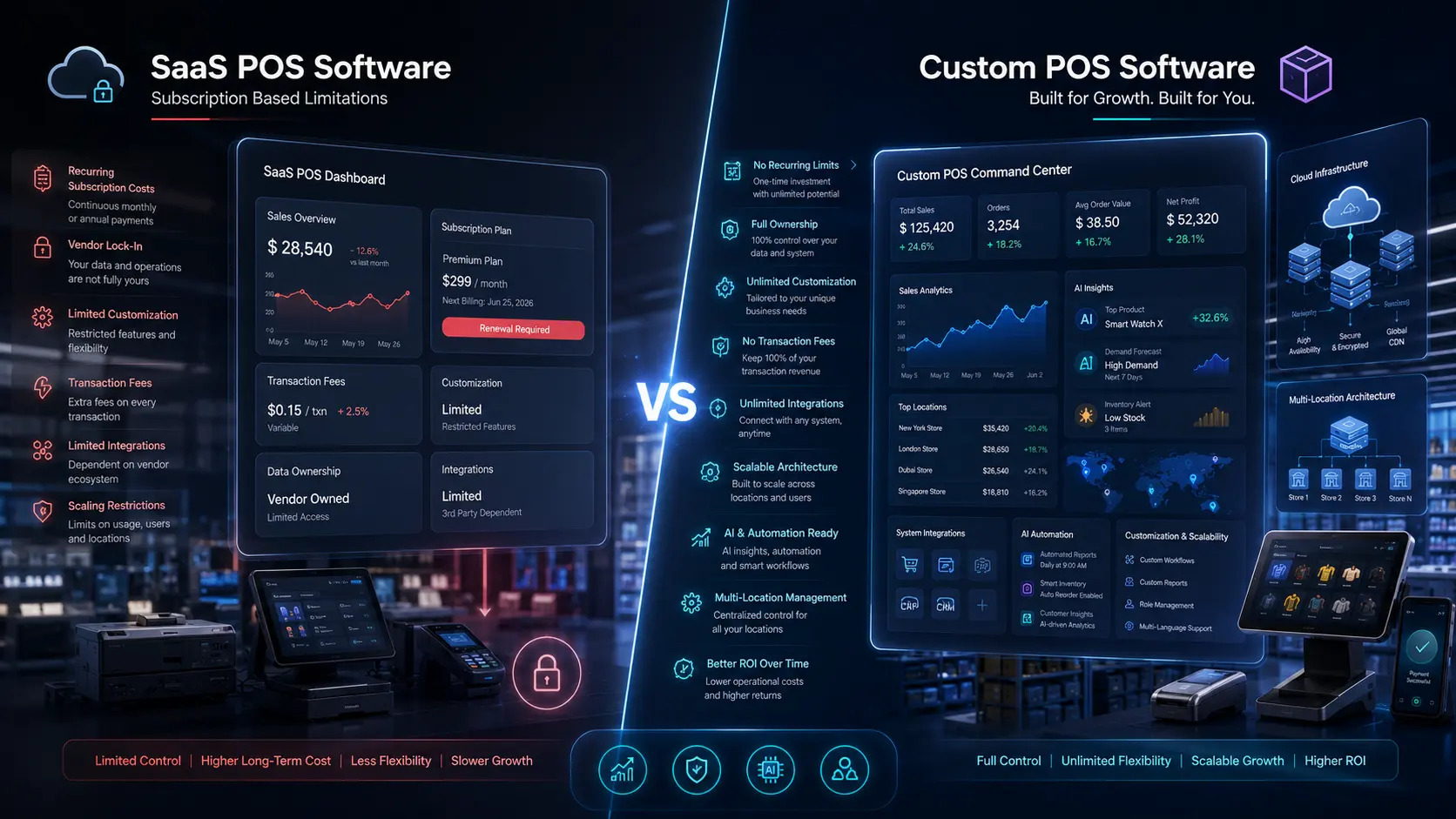
This is the most important decision in the entire process. Both paths are legitimate — the right answer depends entirely on your business model, growth trajectory, and long-term goals.
Here’s an honest comparison:
| Factor | SaaS POS (e.g., Square, Toast, Lightspeed) | Custom POS Software |
|---|---|---|
| Upfront Cost | Low ($0–$500 setup) | High ($20K–$750K+) |
| Monthly Cost | $50–$300/terminal | Cloud hosting only ($100–$2,000) |
| Transaction Fees | 2.4%–2.9% per transaction | None (use any processor) |
| 5-Year Total Cost | $3,600–$108,000+ | $50,000–$900,000+ |
| Customization | Limited to vendor’s roadmap | Unlimited |
| Data Ownership | Vendor owns your data | You own everything |
| Scalability | Vendor-dependent | Fully in your control |
| Integrations | Limited to approved API partners | Any integration possible |
| PCI Compliance | Vendor handles it | Your responsibility |
| Feature Updates | Automatic (sometimes unwanted) | On your schedule |
| Vendor Lock-in | High | None |
| Time to Launch | Days to weeks | 3–12 months |
The 5-year break-even reality:
Consider a restaurant processing $500,000/year in card transactions on Toast’s standard plan (2.49% + $0.15 per transaction). Over 5 years, transaction fees alone total approximately $62,250–plus software fees. A custom-built restaurant POS for $80,000 with $15,000/year maintenance over 5 years totals $155,000 — but you pay zero transaction fees, own your data, and have a system built exactly for your workflow.
For high-volume businesses, the math often favors custom within 3–4 years. For lower-volume small businesses, SaaS wins on simplicity and total cost.
The honest answer: SaaS if you’re small and standard. Custom if you’re growing, complex, or fed up with what SaaS can’t do.
Ready to explore whether custom POS makes financial sense for your business? Explore Corexta’s custom POS development services →
POS Hardware Costs in 2026 — What You Also Need to Budget
Software development gets most of the attention in cost conversations, but hardware is a real line item — especially for retail and restaurant setups with multiple terminals.
| Hardware Component | Budget | Mid-Range | Premium |
|---|---|---|---|
| POS Tablet / Terminal | $100–$300 | $300–$600 | $600–$1,200 |
| Card Reader / mPOS | $20–$50 | $50–$150 | $150–$300 |
| Receipt Printer | $80–$150 | $150–$300 | $300–$500 |
| Barcode Scanner | $30–$100 | $100–$250 | $250–$500 |
| Cash Drawer | $30–$80 | $80–$150 | $150–$300 |
| Customer Display Screen | $80–$150 | $150–$350 | $350–$700 |
| Kitchen Display System (KDS) | $200–$500 | $500–$900 | $900–$1,800 |
| Complete Terminal Setup (est.) | $300–$800 | $800–$1,700 | $1,700–$3,500 |
For a 3-terminal retail setup, a complete mid-range hardware kit runs approximately $2,400–$5,100. Multi-location deployments multiply this by the number of terminals per location.
Hardware is a one-time cost with a typical replacement cycle of 3–5 years. When building a custom POS, ensure your software development team accounts for hardware compatibility — particularly for receipt printers and barcode scanners — during the build phase.
How Much Does POS Software Cost Per Month?
Monthly cost depends entirely on which model you choose. Here’s a clear breakdown of what you can expect to pay on a recurring basis.
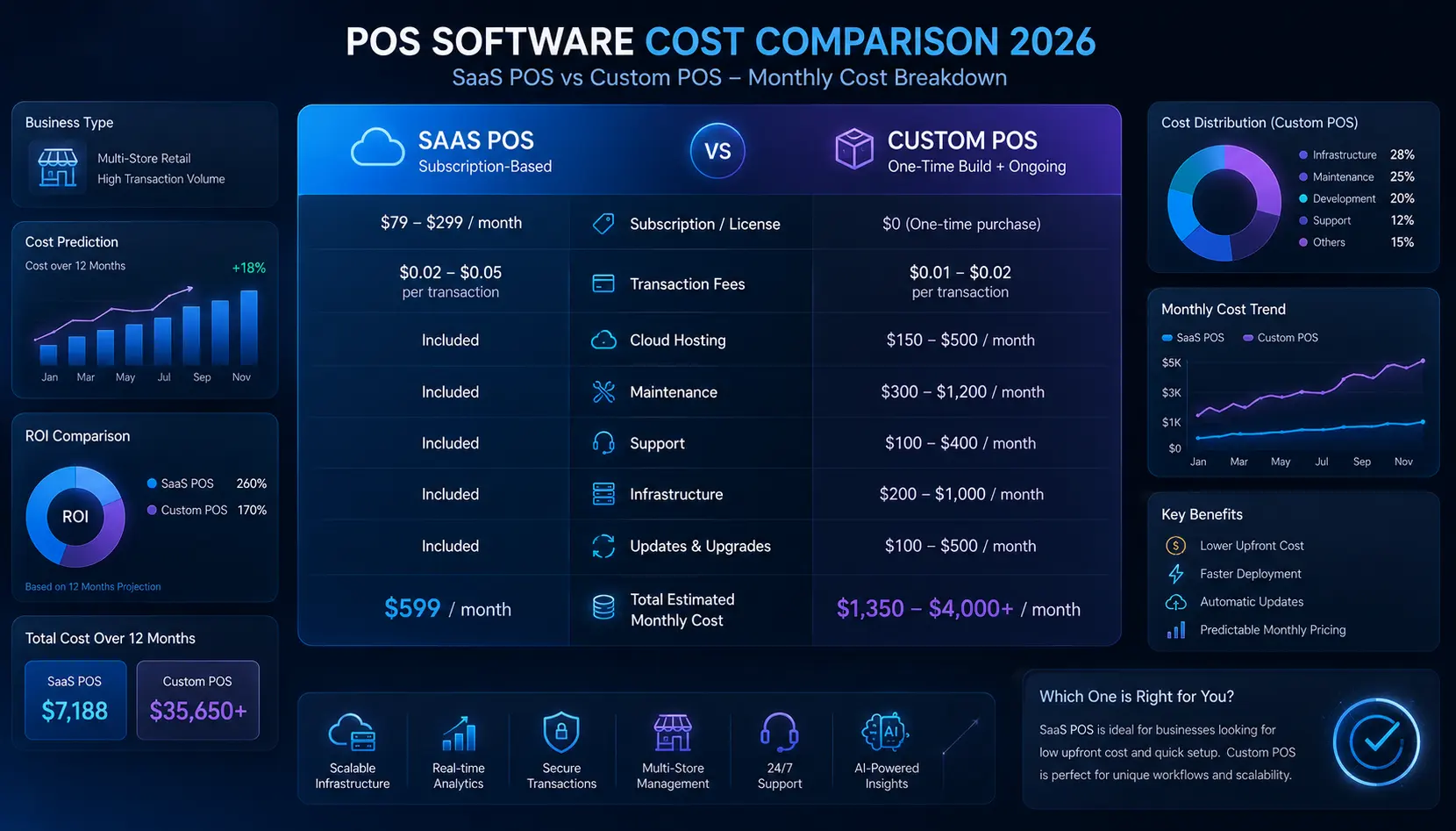
SaaS POS Monthly Cost by Tier:
| Tier | Monthly Cost (Per Terminal) | What You Get |
|---|---|---|
| Free / Starter | $0 (transaction fees apply) | Basic sales, limited inventory, standard reports |
| Small Business | $50–$100 | Full inventory, customer management, basic analytics |
| Professional | $100–$200 | Advanced features, multi-user, priority support |
| Enterprise | $200–$300+ | Multi-location, advanced analytics, API access |
Custom POS Monthly Operational Cost:
Once your custom system is built and deployed, your ongoing POS software development cost shifts into recurring operational expenses like hosting, maintenance, security monitoring, and payment infrastructure.
| Cost Component | Monthly Estimate |
|---|---|
| Cloud infrastructure (hosting, storage) | $100–$2,000 |
| Maintenance and support contract | $625–$1,667 (at 15%/yr on $50K–$200K build) |
| Payment gateway fees (pass-through) | Transaction-based only |
| Security monitoring | $100–$500 |
| Total Monthly (custom, mid-tier) | $825–$4,167 |
For businesses processing $1M+ per year in transactions, the elimination of 2.5% SaaS transaction fees (~$25,000/year) can offset custom POS operational costs entirely — and then some.
POS Software Development Cost in the USA — 2026 Pricing
If you’re based in the US and planning a custom POS project, your cost landscape has some specific characteristics worth understanding.
US-based development firms bill between $100 and $180 per hour for mid-to-senior developers in 2026. A full development team for a POS project — typically 1 project manager, 2 backend developers, 1 frontend developer, 1 UX designer, and 1 QA engineer — working for 6 months produces a burn rate of approximately $150,000–$350,000 at US rates.
That number frightens many business owners into purely offshore development — but the reality is more nuanced. US-based development offers advantages that have real value: timezone-aligned communication, deep familiarity with US compliance requirements (PCI DSS, state-level data privacy laws), and easier accountability.
A widely adopted middle path is the nearshore-offshore hybrid model: US-based technical leadership and project management paired with Eastern European or Latin American developers. This structure typically reduces total project cost by 40–60% while preserving quality oversight and communication efficiency.
Businesses that get the best outcomes are those who evaluate a development partner on track record and technical depth — not just hourly rate. A $50/hour team that requires 3x the hours of a $120/hour team isn’t cheaper. It’s more expensive.
What’s Included in POS Software Development? Key Features and Their Costs
Understanding what you’re actually paying for at each tier helps you scope intelligently and avoid paying for functionality you don’t yet need.
Core POS Features (Included in Base Development)
Every custom POS build, regardless of budget, should include:
- Sales processing — multi-payment type support (card, cash, mobile wallet, split payments)
- Receipt generation — digital and print
- Basic inventory tracking — product catalog, stock levels, low-stock alerts
- Staff / user management — role-based login, basic permissions
- Daily / weekly sales reports — revenue, refunds, transaction counts
- Tax calculation and application — configurable by product category and location
These core features represent the foundational 30–40% of development effort. Everything else is additive.
Advanced Features and Their Cost Implications
As covered in the cost factors section, advanced features stack onto the base. The key principle: be honest about what you actually need in V1. Businesses that try to build everything at once routinely go over budget and over schedule.
The smarter approach is a phased build strategy:
- V1 (MVP): Core features + 2–3 business-critical modules. Launch, gather user feedback.
- V2 (3–6 months post-launch): Add integrations, advanced reporting, loyalty features.
- V3+: AI analytics, predictive inventory, advanced automation.
This approach reduces initial risk, controls upfront spending, and lets you build based on actual operational data rather than assumptions.
The POS Software Development Process — Timeline and Cost by Phase
Understanding how development costs are distributed across project phases helps you set realistic expectations and manage budgets effectively.
| Development Phase | Typical Timeline | % of Total Budget |
|---|---|---|
| Discovery & Requirements Gathering | 2–4 weeks | 5–8% |
| UI/UX Design & Prototyping | 3–6 weeks | 10–15% |
| Frontend Development | 6–12 weeks | 18–25% |
| Backend Development | 8–16 weeks | 25–35% |
| API Integrations (payment, ERP, etc.) | 4–8 weeks | 10–15% |
| QA Testing & Security Audit | 3–6 weeks | 10–15% |
| Deployment & Launch Preparation | 1–2 weeks | 3–5% |
| Post-Launch Support (Year 1) | Ongoing | 15–20% of build cost/yr |
Total timeline for a mid-tier custom POS: 5–9 months from kickoff to launch.
Total timeline for an enterprise platform: 10–18 months.
One of the most common budget overruns in POS development comes from inadequate discovery. Teams that rush through requirements gathering build the wrong thing — and rebuilding is always more expensive than building right the first time. Invest in a thorough discovery phase.
Top 5 POS Systems in 2026 — Compared
If you’re not yet sure whether to build custom or buy off-the-shelf, understanding the leading SaaS platforms helps frame the decision. Here are the five most widely used POS systems in 2026 and what they actually cost.
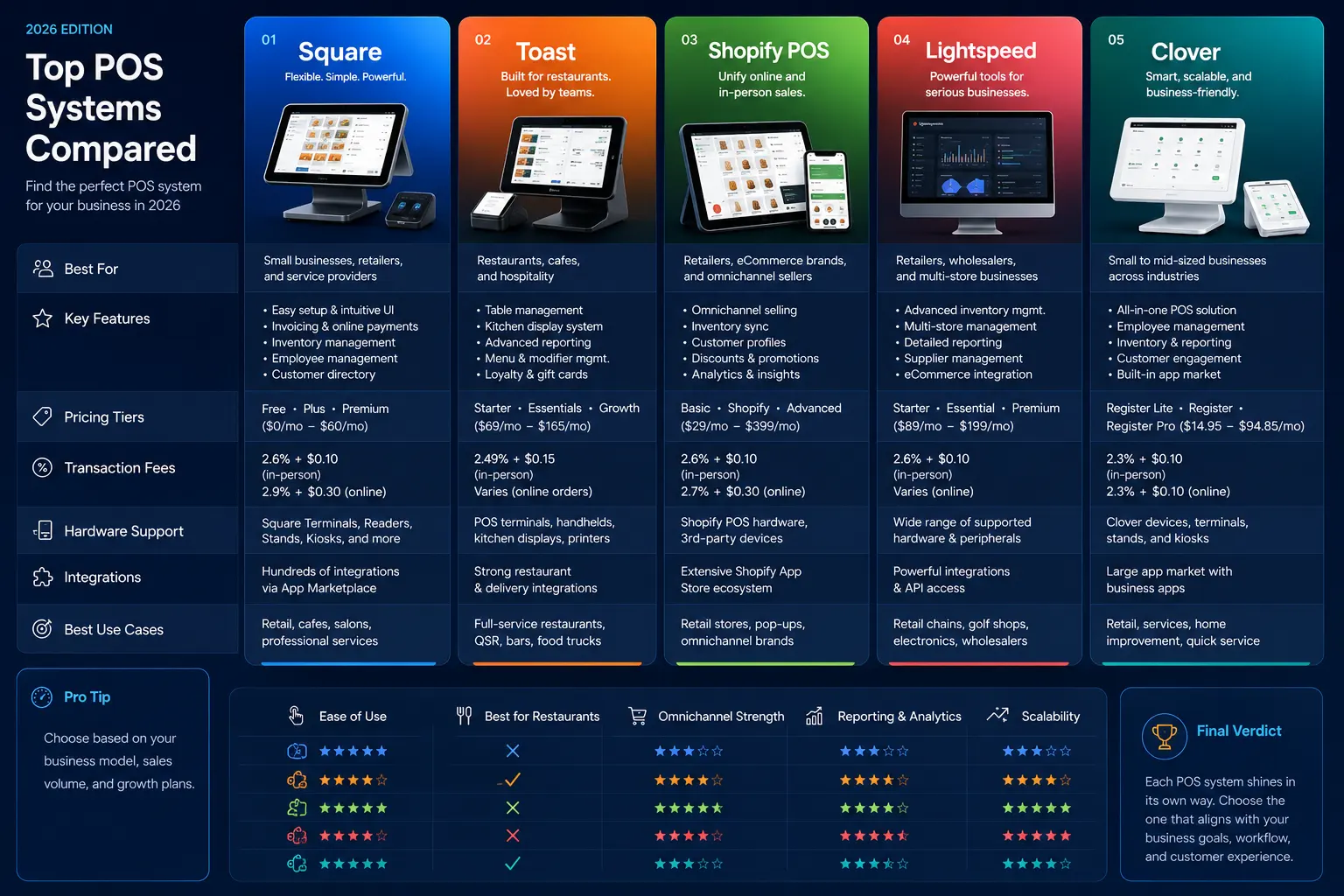
| POS System | Best For | Starting Monthly Price | Transaction Fee | Key Limitation |
|---|---|---|---|---|
| Square POS | Small businesses, startups | $0 (free tier) | 2.6% + $0.10 | Limited customization; fees scale fast |
| Toast POS | Restaurants (dine-in + online) | $0 (Starter) / $69 (Standard) | 2.49% + $0.15 | Restaurant-only; limited retail features |
| Lightspeed POS | Specialty retail, complex inventory | $109/month (Basic) | 2.6% + $0.10 | High cost; complex for small teams |
| Shopify POS | Online-first businesses adding retail | $39/month + $89 POS Pro | 2.6% + $0.10 | Shopify-centric; poor offline capability |
| Clover POS | Quick-service restaurants, small retail | $0 and up (hardware-based pricing) | 2.5% + $0.10 | Vendor lock-in; opaque pricing |
What none of these can do:
None of the above systems can be meaningfully customized beyond their feature roadmap. They can’t integrate with arbitrary third-party systems. They don’t give you data ownership. And for high-volume businesses, their transaction fees represent a substantial ongoing tax on revenue.
When your business needs features that sit outside these platforms’ capabilities — or when transaction fee savings justify the investment — custom POS development becomes the logical path.
How Much Does POS Software Development Cost in 2026 USA?
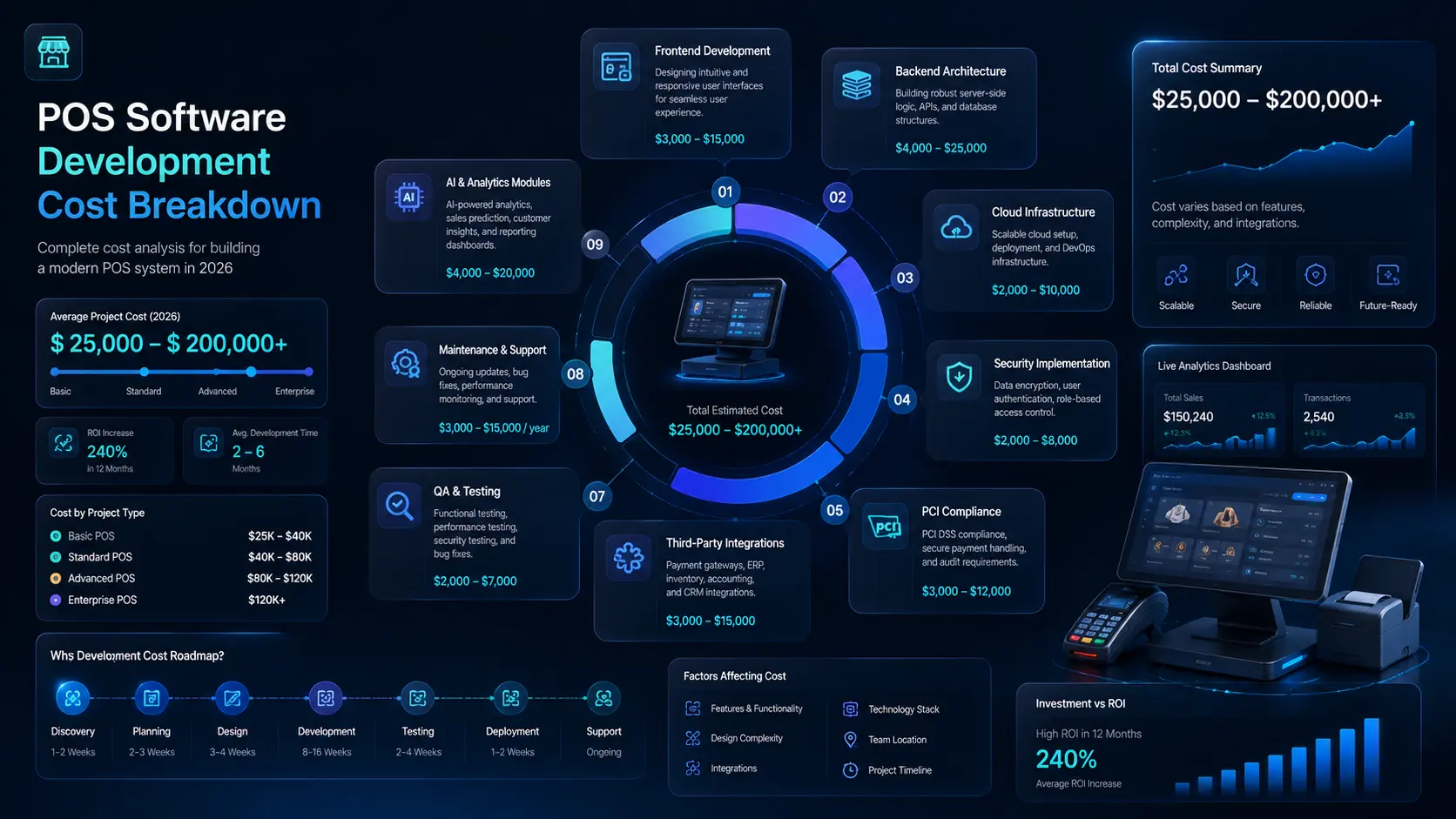
For US-based businesses, here’s a practical cost summary by project tier:
| Project Type | US Dev Team Cost | Offshore Dev Team Cost | Hybrid Model Cost |
|---|---|---|---|
| Basic Custom POS (MVP) | $80,000–$150,000 | $20,000–$50,000 | $40,000–$80,000 |
| Mid-Tier Custom POS | $200,000–$400,000 | $50,000–$120,000 | $100,000–$200,000 |
| Enterprise POS Platform | $500,000–$1M+ | $150,000–$350,000 | $250,000–$500,000 |
The IBISWorld US POS software development market is valued at $4.7 billion in 2026, with 148 US-based development firms and a sector CAGR of 11.5% between 2020–2025. Demand for specialized POS developers — particularly those with experience in PCI compliance, cloud architecture, and retail/restaurant workflows — is growing faster than supply, which is gradually pushing US rates upward.
For US businesses, the hybrid development model — with US-based project oversight and offshore engineering — represents the most cost-effective path that doesn’t sacrifice quality or communication.
The Future of POS Systems in 2026 and Beyond
The POS system of 2026 is nothing like the cash register of a decade ago. It’s the central nervous system of a modern retail or restaurant business — and it’s evolving fast. Here are the five technology trends actively reshaping POS development costs and capabilities.
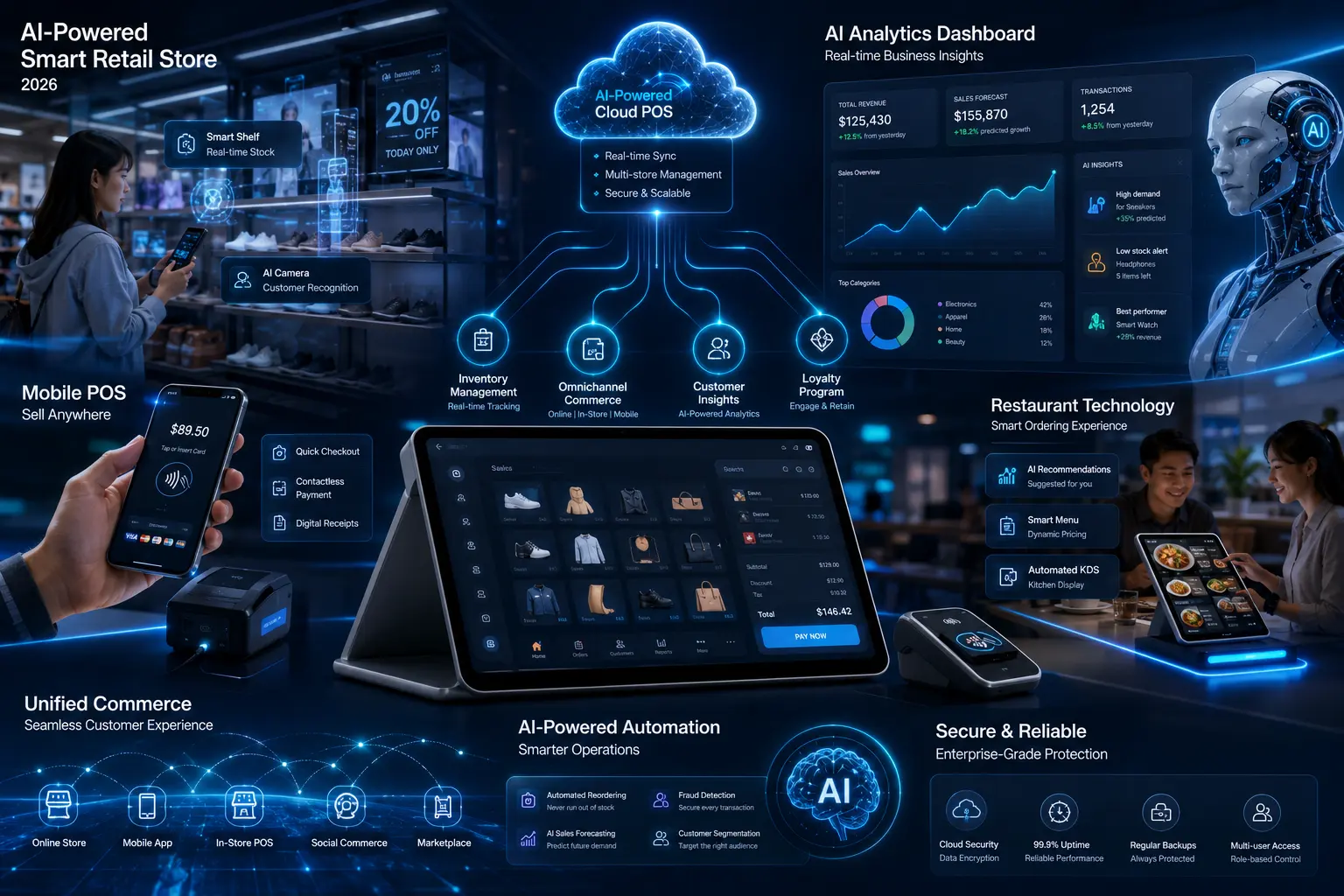
1. AI-Powered Analytics and Demand Forecasting
AI and machine learning are becoming standard in mid-to-premium POS systems. In 2026, AI-powered POS can automatically reorder inventory before stockouts occur, identify your highest-margin products by time of day and customer segment, and generate demand forecasts that reduce waste. A McKinsey analysis found that restaurants using unified, data-driven order management reduce order errors by up to 65%.
Building AI functionality into a custom POS adds $15,000–$40,000 to development cost but delivers measurable ROI for businesses with sufficient transaction volume.
2. Omnichannel and Unified Commerce Architecture
Customers expect to browse online, buy in-store, return anywhere, and earn loyalty points across every channel. Omnichannel POS — which unifies in-store, e-commerce, mobile, and marketplace sales in a single platform — is no longer a premium differentiator. It’s a baseline requirement for serious retailers.
Building a true omnichannel POS is complex and costly ($100,000–$300,000+ for the integration layer), but it eliminates the operational nightmare of managing inventory across disconnected systems. Corexta builds these exact systems through our omnichannel retail and e-commerce development services.
3. Cloud-Native and Edge Computing Architecture
The cloud-based POS market is projected to grow at a CAGR of 19% from 2026 to 2033 — the fastest segment in the entire POS market. Cloud-native POS enables multi-store management, automatic updates, remote access, and disaster recovery without on-premise servers.
Edge computing is emerging as a complementary layer — processing transactions locally at the terminal even when internet connectivity is interrupted, then syncing to the cloud when connection resumes. This architecture is becoming the standard for reliability-critical deployments in restaurants and retail.
4. Contactless Payments and Digital Wallet Integration
Contactless is no longer a bonus feature — it’s the baseline expectation. NFC payments, QR-code checkout, Apple Pay, Google Pay, biometric authentication, and wearable payments are all standard requirements for a 2026 POS build. Supporting all major payment methods adds $5,000–$15,000 to development cost but is non-negotiable for any customer-facing system.
5. Headless POS and API-First Architecture
Forward-thinking businesses are building headless POS systems — separating the frontend experience (what staff and customers see) from the backend logic (transaction processing, inventory, reporting). This architecture allows the same backend to power a tablet POS, a self-checkout kiosk, a mobile app, and an e-commerce storefront simultaneously. API-first design adds development complexity upfront but dramatically reduces the cost of extending the system later.
The global POS software market is projected to grow from approximately $26 billion in 2025 to over $100 billion by 2035 — a CAGR of 14.27%. Businesses investing in custom POS infrastructure today are building on a platform that will appreciate in value as competitors scramble to catch up.
How to Reduce POS Software Development Costs Without Sacrificing Quality
A large development budget isn’t the only path to a great POS system. Here are six strategies that consistently deliver better outcomes per dollar spent.
1. Start with an MVP, then expand. Build only the core features needed to operate and validate your system in production. Real user feedback from your first three months of operation is more valuable than theoretical feature planning. Launch lean, learn fast, invest in V2 based on evidence.
2. Use open-source components strategically. Payment processing libraries, authentication frameworks, and reporting tools all have mature open-source versions. A skilled development team can integrate these to reduce custom engineering hours significantly — without introducing security or compliance risk when handled correctly.
3. Choose a cloud-native architecture from the start. Building cloud-native eliminates on-premise server hardware costs, reduces IT overhead, and enables automatic scaling. Attempting to migrate a legacy on-premise POS to the cloud later is significantly more expensive than building cloud-first.
4. Phase your integrations. Don’t try to connect your POS to every platform on day one. Identify the two or three integrations that are truly critical for launch (typically a payment gateway + accounting software) and schedule secondary integrations for V2.
5. Define requirements precisely before development begins. Scope creep — adding features mid-development — is the number one cause of budget overruns in software projects. Invest in a thorough discovery and specification phase (2–4 weeks) before a single line of code is written. Every requirement you add mid-build costs 3–5x what it would have cost if specified upfront.
6. Work with a specialized POS development partner. A team that has built POS systems before brings reusable components, established compliance processes, and fewer trial-and-error hours than a generalist development shop. Specialization reduces both cost and risk.
Frequently Asked Questions About POS Software Development Cost
How much does POS software development cost in 2026?
Custom POS software development costs between $20,000 and $750,000+ in 2026. A basic custom POS for a single-location small business typically runs $20,000–$50,000. Mid-tier systems for restaurants or retailers with advanced features cost $50,000–$150,000. Enterprise-grade, multi-location platforms range from $150,000 to $750,000 or more depending on scope and complexity.
How much does POS software cost per month?
SaaS POS systems cost $0–$300 per terminal per month, depending on the provider and feature tier. Custom-built POS systems have minimal monthly software costs — typically $100–$2,000/month for cloud hosting, plus an amortized maintenance budget of 15–20% of the original build cost annually. High-volume businesses often find custom POS cheaper per month than SaaS once transaction fees are factored in.
How much is a POS system for a small business?
For a small business using SaaS POS, expect to pay $50–$150/month plus 2.4%–2.9% per transaction. A complete hardware setup runs an additional $300–$800 per terminal. If a small business opts for custom development, a functional MVP-level POS starts at approximately $20,000–$50,000, with hardware as a separate cost.
How much does POS software cost for a restaurant?
Restaurant-specific custom POS systems typically cost $40,000–$120,000 to build, depending on features like kitchen display systems, online ordering integration, and table management. SaaS alternatives like Toast start at $0 for a basic plan but charge 2.49%–3.09% per transaction. Growing restaurant groups with multiple locations typically find custom development cost-effective within 3–4 years.
Is it better to build or buy a POS system?
It depends on your volume and growth trajectory. SaaS POS is faster to launch, requires no upfront development investment, and is well-suited for businesses with standard workflows. Custom POS delivers full flexibility, data ownership, and zero transaction fees — making it more cost-effective for high-volume or complex operations over a 3–5 year horizon. The break-even point varies by transaction volume and monthly subscription cost.
How long does it take to build custom POS software?
A basic custom POS MVP takes approximately 3–5 months from discovery to launch. A mid-tier system with multiple integrations and advanced features takes 5–9 months. Enterprise-grade platforms typically require 10–18 months of development. Timeline depends heavily on feature scope, team size, and the thoroughness of the initial requirements phase.
What is the annual maintenance cost for custom POS software?
Plan for 15–20% of your original development cost annually. A POS system built for $100,000 requires approximately $15,000–$20,000/year for security patches, feature updates, bug fixes, and technical support. Cloud infrastructure costs are separate and typically run $100–$2,000/month depending on scale.
What is the future of POS systems?
POS systems are evolving from simple transaction tools into full business intelligence platforms. Key trends for 2026 and beyond include AI-powered demand forecasting and sales analytics, unified omnichannel commerce (in-store + online + mobile), cloud-native and edge computing architecture, contactless and biometric payments, headless API-first design, and deep ERP/CRM integration. Businesses building custom POS systems today are investing in infrastructure that will compound in value as these capabilities mature.
Can a startup afford custom POS development?
Yes — through an MVP-first approach. Startups can build a functional, market-ready POS system for $20,000–$50,000 by limiting scope to core features and expanding post-launch based on traction. This strategy keeps initial investment manageable while preserving the flexibility and ownership advantages of custom software.
Ready to Build Your Custom POS System? Let’s Talk.
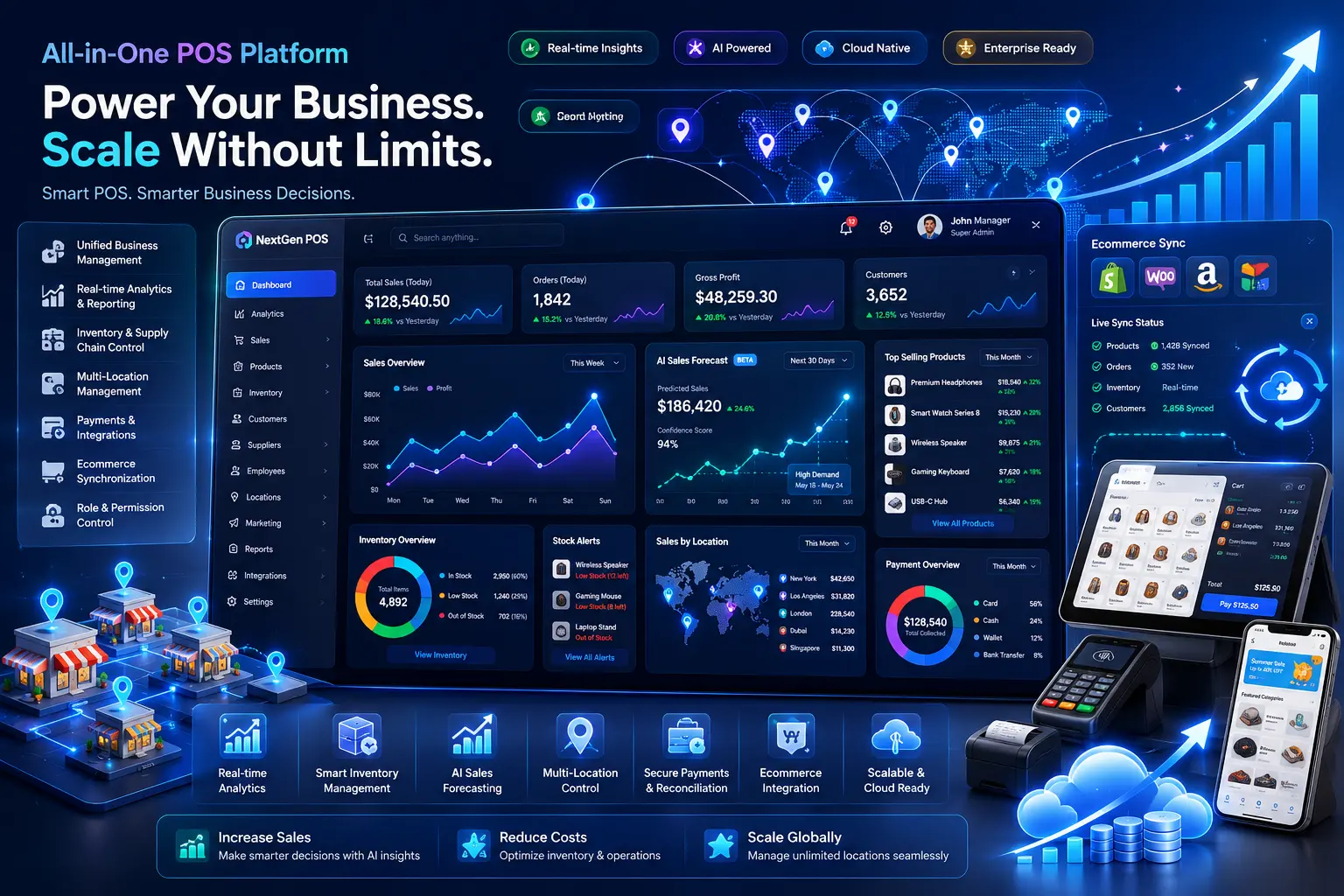
If you’ve read this far, you have a clear picture of what custom POS development actually costs — and whether it makes sense for your business.
Corexta builds custom POS software for retail businesses, restaurants, e-commerce operators, and enterprise clients. We specialize in systems that are scalable, PCI-compliant, and built to grow with your business rather than against it.
Whether you’re starting with a lean MVP or scoping a full enterprise platform, our team can give you a realistic cost estimate based on your actual requirements — not a ballpark pulled from a template.
Our relevant services:
- Custom POS Software Development — full-cycle POS builds for any vertical
- Retail & E-Commerce Software Development — unified in-store and online retail platforms
- Custom E-Commerce Software Development — scalable e-commerce infrastructure with POS integration
No commitment. No sales pressure. Just an honest conversation about what your project needs and what it will realistically cost.
Sources & Industry References:
- Grand View Research POS Market Report
- Market Research Future POS Market Analysis
- Sprinto PCI DSS Compliance Guide
- AWS Pricing Documentation
- Stripe Pricing
- Shopify POS Pricing
- Lightspeed POS Pricing