One of the ongoing issues in marketing agencies is that clients are increasingly asking for more video content at a faster pace, but the scale of production hasn’t kept up. The average price of a product video is ₹2.84 lakh – ₹7.57 lakh, and it takes 3-4 weeks. According to recent industry data, 57% of creative agencies report at least a 38% reduction in production timelines after adopting AI video tools. Agencies with better platforms generate 11 times more video content each month, without expanding their teams.
There are now dozens of platforms available, each with its own unique advantages. AI video generators such as Intellemo AI, Runway, HeyGen, Synthesia, Kling AI and Google Veo are all somewhat different in terms of their features and are used in various workflows or campaign types. For today’s agencies, knowing what platform is a solution to what problem is essential.
This guide examines the leading platforms and how they fit into agency workflows.
1. Intellemo AI
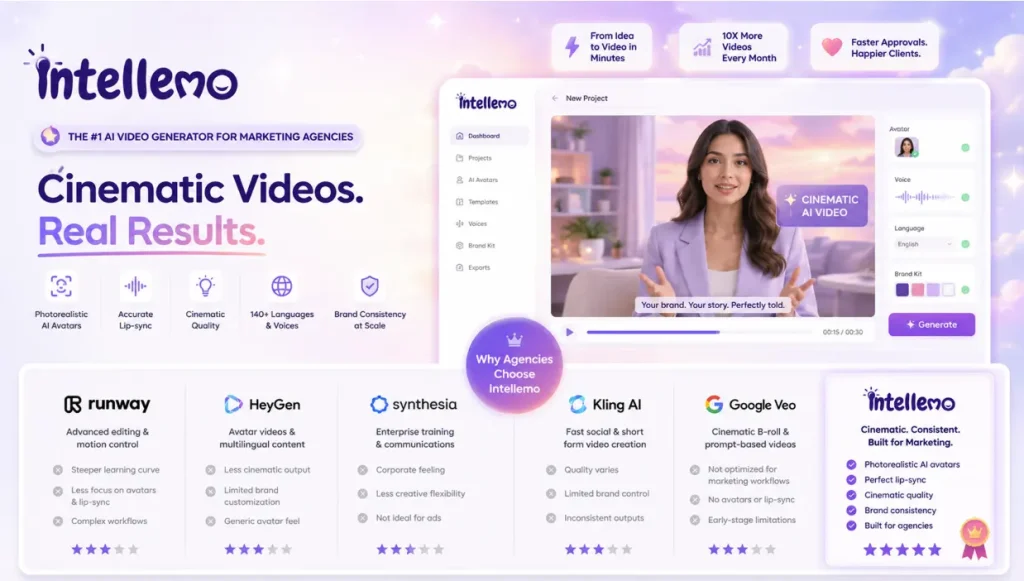
Intellemo AI positions itself as a cinematic-first platform, excelling at generating visually sophisticated videos. The platform’s USPs directly address the need of the marketing teams to scale their video production while being consistent with their brands and professionals.
Intellemo AI is known for its accurate lip-sync capabilities, ensuring that the avatar’s movements align seamlessly with the spoken text, all while avoiding the uncanny valley effect. Photorealistic AI avatars also ensure that your brand remains consistent throughout all campaigns, making it easier for audiences to recognize your brand. Realistic motion physics and advanced lighting provide broadcast-quality visuals with the cinematic capability of the video generation. Advanced voice synthesis and natural narration ensure that your AI representative sound like a real person, and character consistency makes sure that they remain the same in all of your campaign videos.
For marketing teams, these capabilities translate to business outcomes. Agencies create engaging campaign videos, AI product videos, and brand storytelling videos without any AI artifacts. The platform allows for quick campaign variation testing, creating multiple ad variations with varying messaging in hours, instead of weeks. Marketing teams leverage Intellemo AI for social media ads, explainer videos, product launches, and personalized communications. These videos are polished, maintain a consistent voice and are narrated naturally, and they achieve the same results as traditional videos. When clients get this level of sophistication, they are confidently approving assets created with AI, which is changing the way brands pitch a video-first approach to agencies.
2. Runway Gen-4.5
Runway Gen-4.5 is a video editing solution that combines the best of both worlds, offering a platform that’s ideal for agencies that have complex motion demands. It is very good at frame-level control, in-video editing features, and complex multi-scene sequences for which manual refinement is of importance.
The highlight of the feature is the Motion Brush that enables the animator to select a portion of an image or video and make it move, while the rest of the image remains stationary. This level of detail makes creative teams familiar with the traditional editing process more comfortable. In addition, users can edit their videos with conversational editing features in Runway, allowing them to use natural language to modify existing videos without having to start from scratch.
Agencies use Runway for narrative-rich content, VFX-integrated workflows, and when they need to seamlessly incorporate motion graphics into campaigns. The platform excels at incorporating AI-generated content into existing video footage, seamlessly integrating and manipulating clips of multiple shots, and ensuring accurate frame-by-frame alignment. Production time is shortened considerably from that of traditional production methods, and the tool requires more technical expertise than a tool geared toward ease of use.
3. HeyGen
HeyGen has built a reputation specifically around avatar-based video generation. The platform supports 175+ languages with natural lip-synchronization, enabling agencies to create localized content without reshoots or hiring multilingual talent. The avatar library includes photorealistic options, animated styles, and the ability to generate custom avatars from user-provided images or videos.
What agencies value most is the speed at which HeyGen transforms scripts into professional talking-head videos. A training video that would traditionally require studio booking, talent coordination, and multiple language recordings can be produced in hours with consistent visual presentation. The platform handles the entire workflow, including script input, voice generation, lip-sync, and video output, without requiring supplementary tools.
HeyGen excels for agencies managing global campaigns, corporate communications, product demonstrations requiring a spokesperson presence, and training programs distributed across regions. The platform enables scaled personalization, where agencies generate individual greeting videos or sales pitches for large prospect lists. The ability to customize avatars while maintaining quality consistency across hundreds of videos makes HeyGen the practical choice for high-volume localization needs.
4. Synthesia
Synthesia positions itself as an enterprise-grade platform, built for organizations prioritizing consistency, scalability, and professional presentation. The platform offers photorealistic avatars, robust brand consistency tools, multilingual support exceeding 140 languages, and the infrastructure to manage high-volume production.
Enterprise features include brand kits that ensure all generated videos maintain consistent colors, fonts, and logo placement. Synthesia’s avatar customization allows organizations to create digital representatives that match their specific visual identity. The platform integrates with business intelligence tools, allowing agencies to automate video generation triggered by data events such as new product launches, quarterly updates, or personalized customer messages.
Agencies recommend Synthesia when clients need professional-grade internal communications, corporate training delivered globally, or customer-facing content requiring consistent brand presence. The platform handles approval workflows, manages asset libraries, and provides the governance controls that large organizations require. While not positioned for creative experimentation, Synthesia delivers reliability and scalability that command trust in enterprise environments.
5. Kling AI
Kling AI represents the efficiency frontier, delivering 85-90% of premium platform quality at significantly reduced complexity and cost-per-generation. The platform prioritizes speed and intuitive workflows over granular creative control, making it accessible to teams without specialized video production backgrounds.
The platform excels at cinematic text-to-video generation, producing videos with realistic physics, natural motion, and coherent scenes from descriptive prompts. Kling AI handles diverse content types, from product demonstrations to explainer videos to social media content, without requiring extensive prompt engineering. The generation speed is notably faster than many competitors, enabling rapid iteration and high-volume production.
Agencies choose Kling AI for high-volume social content campaigns, rapid prototyping before committing to premium tools, and situations where production speed matters more than frame-level creative control. Marketing teams generating dozens of short-form videos monthly appreciate the balance between quality and efficiency. The platform proves particularly valuable when testing multiple creative concepts before investing production effort into winner formats.
6. Google Veo 3
Google Veo 3 operates as a general-purpose cinematic generator, accessible through multiple distribution channels, including Synthesia, various Google Workspace products, and standalone interfaces. The platform balances reliable quality with flexible application, making it suitable for diverse content needs across agency teams.
Veo 3 demonstrates strong prompt adherence, meaning generated videos closely follow creative instructions without significant hallucinations or misinterpretations. The platform includes native audio generation, creating synchronized sound effects and ambient audio alongside visual content. This integration eliminates post-production audio work traditionally consuming hours of editing time.
Agencies leverage Veo 3 for B-roll supplementation, explanatory content, diverse campaign types requiring cinematic visual quality, and situations where integration with existing Google tools provides workflow advantages. The platform appeals to teams wanting professional-grade output without the learning curve demanded by advanced motion control platforms.
Frequently Asked Questions
How do agencies choose the right platform for their workflow?
Start with your primary content type and creative requirements, not feature checklists. Ask: What’s your production volume? How much creative control do you need? Will clients require custom avatars or cinematic motion? Most agencies maintain multiple platforms for different jobs. The decision framework prioritizes use case first, then identifies which tool solves that problem most efficiently.
What quality can agencies realistically expect in 2026?
4K resolution, realistic motion physics, and character consistency across scenes are now baseline. Blind testing shows clients frequently cannot distinguish AI-generated content from traditional production. Quality has plateaued across top platforms; differentiation comes from creative direction and workflow efficiency rather than technical capability gaps. The real question: Does output match your brand aesthetic?
How can agencies scale output without expanding teams?
Real case studies show agencies producing 11x more content with identical headcount. Automation, template systems, and rapid iteration enable this multiplication. Junior producers create broadcast-quality videos with guidance. ROI metrics include content volume increase, quality consistency, reduced revision cycles, and compressed time-to-publish, making team expansion unnecessary.
Conclusion
The AI video generation market has matured beyond early-stage experimentation. Quality differentiation between top platforms has narrowed significantly, shifting competitive advantage toward agencies that understand tool-specific strengths and build workflows accordingly. The platforms listed here represent distinct approaches to solving video production challenges.
The future belongs to agencies viewing AI video not as production replacement but as creative amplification. These tools handle technical execution, freeing experienced teams to focus on strategy, creative direction, and client outcomes. The best AI video generator for your agency is the one solving your specific production bottleneck most efficiently, integrated into workflows that leverage your team’s creative strengths while removing friction from repetitive technical work.