Cloud computing has become a core foundation for modern enterprise operations. Organizations across industries are migrating applications, databases, and infrastructure to the cloud to improve scalability, operational flexibility, and long-term business resilience. However, enterprise cloud migration is no longer just an IT upgrade project. It is a strategic business initiative that affects security, compliance, costs, workflows, customer experience, and digital transformation goals.
As enterprise environments grow more complex, organizations must manage legacy systems, hybrid infrastructures, global compliance requirements, and increasing demands for real-time digital services. Without a structured migration plan, cloud initiatives often result in unexpected downtime, budget overruns, performance issues, and security risks. Recent industry research also shows that many enterprises still struggle with cloud cost optimization and workload modernization after migration.
A well-designed cloud migration strategy helps enterprises move workloads systematically while minimizing disruption and maximizing business value. It creates a roadmap for assessing infrastructure, prioritizing applications, choosing deployment models, managing risks, and optimizing cloud resources after migration. Modern cloud strategies also focus heavily on governance, automation, FinOps, AI readiness, and multi-cloud flexibility to support long-term operational growth.
What Is a Cloud Migration Strategy?
A cloud migration strategy is a structured plan that guides how an organization moves its applications, data, workloads, and IT processes from on-premises infrastructure to cloud environments. The strategy defines migration objectives, timelines, technologies, deployment models, security requirements, governance policies, and success metrics to ensure a smooth transition.
Rather than simply transferring systems to the cloud, an enterprise cloud migration strategy aligns technology decisions with business goals. It evaluates which workloads should migrate, which should remain on-premises, and which applications require modernization before migration. The strategy also determines how to reduce operational risks, maintain compliance, and optimize cloud performance throughout the migration lifecycle.
Modern enterprises commonly use established migration frameworks such as the “6 Rs” or “7 Rs” approach:
- Rehost (lift and shift)
- Replatform
- Refactor or re-architect
- Repurchase
- Retire
- Retain
These approaches help organizations decide the best migration path for each application based on complexity, business value, cost, and scalability requirements.
Today’s cloud migration strategies also incorporate hybrid cloud, multi-cloud, automation, cloud-native development, and continuous optimization practices. Enterprises increasingly prioritize flexibility and workload portability to avoid vendor lock-in and adapt to changing compliance or operational requirements.
Why Enterprises Need a Cloud Migration Strategy
Reduce Downtime and Business Disruption
Enterprise systems often support mission-critical operations such as finance, supply chain management, customer platforms, and internal collaboration tools. Unplanned outages during migration can negatively impact productivity, customer experience, and revenue generation.
A structured cloud migration strategy minimizes these risks through phased migration planning, dependency mapping, testing procedures, and rollback mechanisms. Instead of migrating all systems simultaneously, organizations can prioritize low-risk workloads first and gradually transition business-critical applications after validating stability and performance.
Modern migration frameworks also use automation, workload replication, and real-time monitoring to reduce service interruptions during deployment. Phased execution models are now considered a best practice for enterprise-scale migrations because they improve operational stability and reduce migration-related failures.
Keep Security and Regulatory Compliance
Security and compliance remain among the biggest concerns in enterprise cloud adoption. Organizations must protect sensitive customer data, intellectual property, and operational systems while complying with regulations such as GDPR, HIPAA, ISO 27001, SOC 2, and regional data sovereignty laws.
A cloud migration strategy helps enterprises integrate security controls and governance policies from the beginning rather than treating them as afterthoughts. This includes identity and access management, encryption, zero-trust security models, workload segmentation, backup planning, and compliance auditing.
Many enterprises are also adopting hybrid and sovereign cloud strategies to address evolving data residency requirements and geopolitical concerns. Cloud governance frameworks now play a critical role in ensuring workloads are deployed in environments that align with regulatory and operational requirements.
Control Cloud Costs and Avoid Resource Sprawl
While cloud platforms offer scalability and operational flexibility, unmanaged cloud environments can quickly become expensive. Many enterprises experience cloud cost overruns because of unused resources, overprovisioned infrastructure, lack of visibility, and poor workload optimization.
A well-planned migration strategy includes financial governance practices such as FinOps, resource monitoring, budget forecasting, automated scaling, and workload rightsizing. These controls help organizations manage cloud spending more effectively while maximizing return on investment.
Modern enterprises increasingly treat cost optimization as an ongoing operational discipline rather than a one-time migration activity. Continuous monitoring and automated governance help prevent resource sprawl and improve long-term financial efficiency.
Improve Application Performance and Reliability
Cloud environments provide enterprises with access to advanced infrastructure capabilities that improve application speed, uptime, scalability, and disaster recovery readiness. However, achieving these benefits requires careful workload planning and architecture optimization.
A cloud migration strategy evaluates application dependencies, network performance, storage requirements, and scalability demands before migration begins. This allows enterprises to modernize outdated applications, optimize resource allocation, and improve operational resilience.
Organizations also benefit from cloud-native technologies such as containerization, microservices, orchestration platforms, and AI-driven monitoring systems. These capabilities enhance reliability, accelerate deployment cycles, and support real-time operational visibility across enterprise environments.
Support Future Innovation and Digital Transformation
Cloud migration is increasingly viewed as the foundation for broader digital transformation initiatives. Enterprises need flexible, scalable platforms to support AI adoption, advanced analytics, automation, IoT integration, and modern customer experiences.
Legacy infrastructure often limits innovation because it lacks scalability, interoperability, and rapid deployment capabilities. A strategic cloud migration enables enterprises to modernize operations, accelerate product development, and respond more quickly to changing market demands.
Modern cloud ecosystems also support hybrid and multi-cloud architectures that improve flexibility and reduce dependency on a single provider. As organizations continue adopting AI-driven business models and cloud-native applications, migration strategies must focus not only on infrastructure movement but also on long-term modernization and innovation readiness.
Step-by-Step Cloud Migration Strategy Framework
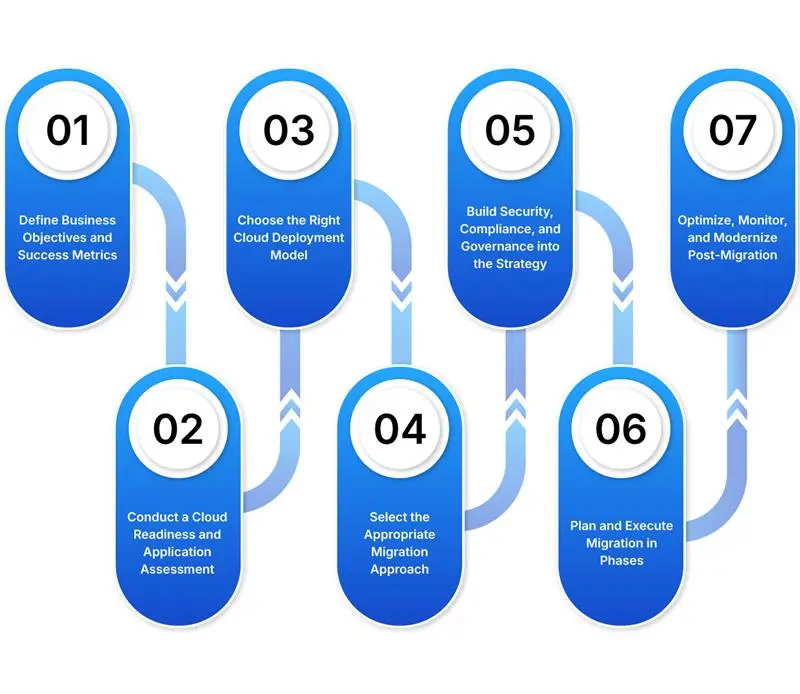
A structured cloud migration framework ensures enterprises move workloads to the cloud in a controlled, low-risk, and value-driven way. Rather than focusing only on infrastructure transfer, modern strategies emphasize business alignment, workload assessment, security-by-design, phased execution, and continuous optimization throughout the migration lifecycle.
Step 1: Define Business Objectives and Success Metrics
Every enterprise cloud migration begins with clearly defined business outcomes. The goal is not just to “move to the cloud,” but to solve specific operational and strategic challenges.
Common business objectives include:
- Reducing infrastructure and operational costs
- Improving scalability and elasticity for demand fluctuations
- Increasing system availability and resilience
- Accelerating software delivery and innovation cycles
- Strengthening security posture and compliance readiness
Once objectives are defined, enterprises establish measurable success metrics such as:
- Reduction in infrastructure costs or total cost of ownership (TCO)
- Application uptime and availability targets
- Deployment frequency and release velocity
- Incident response time and recovery metrics (RTO/RPO)
Clear metrics ensure migration success is measurable rather than subjective, and they help align IT teams with business leadership expectations.
Step 2: Conduct a Cloud Readiness and Application Assessment
A cloud readiness assessment is the foundation of any enterprise migration strategy. It provides a complete understanding of the existing IT landscape before any workloads are moved.
Key activities include:
- Creating a full inventory of applications, databases, and infrastructure
- Mapping application dependencies and integration flows
- Identifying legacy systems and technical debt
- Evaluating security requirements and data sensitivity
- Assessing compliance and data residency constraints
- Reviewing network architecture and performance limitations
This step also classifies workloads based on complexity and business criticality. Some systems may be ready for immediate migration, while others require modernization or even retirement before moving forward.
The outcome of this phase is a migration-ready portfolio that clearly defines what moves, what changes, and what stays behind.
Step 3: Choose the Right Cloud Deployment Model
Selecting the right deployment model is critical for balancing performance, compliance, and cost efficiency.
Enterprises typically choose from:
- Public cloud – Ideal for scalability, flexibility, and innovation-driven workloads
- Private cloud – Used for sensitive data, regulatory requirements, or high-control environments
- Hybrid cloud – Combines on-premises and cloud systems for gradual migration
- Multi-cloud – Uses multiple providers to avoid vendor lock-in and improve resilience
Most modern enterprises adopt hybrid or multi-cloud architectures to support both legacy systems and cloud-native workloads simultaneously.
The decision depends on:
- Regulatory constraints
- Data sensitivity
- Latency and performance needs
- Budget and long-term scalability goals
Step 4: Select the Appropriate Migration Approach
Not all applications should be migrated in the same way. Enterprises typically use a mix of migration approaches depending on workload complexity and business value.
Common approaches include:
- Rehosting (lift and shift) – Fast migration with minimal changes
- Replatforming – Small optimizations during migration for better performance
- Refactoring / Re-architecting – Full redesign for cloud-native capabilities
- Repurchasing – Moving to SaaS-based alternatives
- Retiring – Removing unused or obsolete systems
- Retaining – Keeping certain workloads on-premises temporarily
This step ensures each application is migrated using the most suitable method rather than forcing a one-size-fits-all approach.
Step 5: Build Security, Compliance, and Governance Into the Strategy
Security and governance must be embedded from the beginning—not added after migration.
A strong enterprise strategy includes:
- Identity and access management (IAM) with least-privilege controls
- Data encryption in transit and at rest
- Continuous monitoring and threat detection
- Regulatory compliance alignment (e.g., GDPR, ISO 27001, SOC 2, HIPAA)
- Cloud governance policies for cost, access, and resource control
- Audit logging and traceability across all environments
Modern cloud environments follow a shared responsibility model, meaning security is jointly managed between the provider and enterprise. This makes governance frameworks essential for maintaining visibility and control.
Step 6: Plan and Execute Migration in Phases
Enterprise migrations are executed in controlled phases to reduce risk and ensure stability.
A typical phased approach includes:
- Starting with non-critical or low-risk workloads
- Running pilot migrations to validate tools and processes
- Migrating workloads in waves based on priority and complexity
- Performing parallel runs to reduce downtime risk
- Validating performance, security, and functionality after each phase
Phased migration allows teams to learn and adapt throughout the process, improving success rates and minimizing operational disruption.
Automation tools, Infrastructure as Code (IaC), and cloud-native migration services are widely used to improve speed and consistency.
Step 7: Enhance, Watch, and Modernize Post-Migration
Migration is not the final stage—it marks the beginning of continuous optimization.
Post-migration activities include:
- Monitoring application performance and infrastructure health
- Optimizing cloud costs through right-sizing and resource tuning
- Implementing FinOps practices for financial governance
- Strengthening security posture with continuous assessments
- Modernizing applications into cloud-native architectures
- Improving automation and scaling policies
Enterprises increasingly focus on ongoing modernization to fully realize cloud benefits such as agility, resilience, and innovation readiness. This ensures cloud environments continue evolving with business needs rather than becoming static infrastructure.
Common Challenges in Enterprise Cloud Migration
Enterprise cloud migration delivers significant long-term value, but the journey is often complex due to technical debt, organizational constraints, and evolving governance requirements. Understanding these challenges early helps organizations reduce risk and improve migration success rates.
Legacy Application Constraints
Many enterprises still rely on legacy systems built decades ago using outdated architectures, monolithic designs, or unsupported technologies. These applications often:
- Lack modularity, making them difficult to refactor
- Depend on tightly coupled infrastructure
- Require specific operating systems or hardware environments
- Have limited documentation or institutional knowledge gaps
Because of these limitations, direct migration to the cloud is often not feasible without redesigning or replatforming parts of the application. In many cases, enterprises must adopt hybrid approaches where legacy workloads remain on-premises while modern services move to the cloud.
Skills Gaps in Cloud Technologies
A successful cloud migration requires expertise in cloud architecture, DevOps, security engineering, and automation tools. However, many enterprises face internal skill shortages in areas such as:
- Cloud-native application development
- Infrastructure as Code (IaC)
- Containerization and orchestration (e.g., Kubernetes)
- Cloud security and identity management
- FinOps and cloud cost optimization
This skills gap can slow down migration projects and increase reliance on external vendors or managed service providers. Continuous training and upskilling are now essential components of enterprise cloud strategies.
Cost Visibility and Budget Control
While cloud computing introduces operational flexibility, it also introduces variable and sometimes unpredictable cost structures. Enterprises often struggle with:
- Unmonitored resource consumption
- Overprovisioned workloads
- Idle or forgotten cloud assets
- Complex pricing models across services and regions
Without proper governance, cloud costs can escalate quickly and exceed on-premises spending. Modern enterprises address this through FinOps practices, real-time cost monitoring dashboards, automated scaling policies, and budget enforcement controls. Still, achieving full cost transparency remains a major challenge during and after migration.
Data Sovereignty and Compliance Risks
Global enterprises must comply with strict data regulations depending on geography and industry. Cloud migration introduces new risks related to:
- Data residency requirements
- Cross-border data transfer restrictions
- Industry-specific compliance frameworks (e.g., financial or healthcare regulations)
- Audit and reporting obligations
Choosing the wrong cloud region or deployment model can lead to regulatory violations. As a result, organizations must carefully design data architecture and governance policies before migration begins. Hybrid and sovereign cloud strategies are increasingly used to address these concerns.
Organizational Resistance to Change
One of the most underestimated challenges in cloud migration is organizational resistance. Even when the technical strategy is sound, adoption can be slowed by:
- Resistance from IT teams used to traditional infrastructure models
- Lack of trust in cloud security or performance
- Process misalignment between departments
- Fear of job role changes or automation
Successful migration requires strong change management practices, executive sponsorship, and clear communication of benefits across the organization. Without cultural alignment, even well-funded migration programs can face delays or partial adoption.
Best Practices for an Effective Cloud Migration Strategy
To overcome these challenges and ensure long-term success, enterprises must follow proven best practices that align technology decisions with business outcomes.
Align IT and Business Stakeholders Early
Cloud migration should never be treated as a purely IT initiative. Early alignment between business leaders, finance teams, security teams, and IT operations ensures:
- Shared understanding of migration goals
- Realistic budgeting and ROI expectations
- Prioritization of critical business workloads
- Faster decision-making during execution
Strong executive sponsorship also helps eliminate roadblocks and ensures migration remains aligned with enterprise strategy.
Use Standardized Frameworks and Documentation
Standardization reduces complexity and improves repeatability across large-scale migrations. Enterprises should adopt structured frameworks for:
- Application assessment and classification
- Migration planning and execution
- Security and compliance validation
- Post-migration optimization
Consistent documentation improves transparency, reduces dependency on individual expertise, and enables smoother collaboration across teams and vendors. It also ensures that migration processes can scale across multiple business units.
Leverage Automation and Cloud-Native Tools
Automation is a key driver of efficiency in modern cloud migration strategies. Enterprises increasingly rely on tools and platforms that support:
- Infrastructure as Code (IaC) for repeatable deployments
- Automated workload discovery and dependency mapping
- Continuous integration and delivery (CI/CD) pipelines
- Auto-scaling and self-healing infrastructure
- Real-time monitoring and observability platforms
Cloud-native tools reduce manual effort, minimize human error, and accelerate migration timelines while improving consistency and reliability.
Partner with Experienced Cloud Migration Experts
Many enterprises choose to work with external partners or managed service providers to accelerate migration and reduce risk. Experienced partners bring:
- Proven migration frameworks and methodologies
- Industry-specific compliance expertise
- Advanced tooling and automation capabilities
- Cross-platform cloud architecture experience
This is especially valuable for large-scale or multi-cloud migrations where complexity and risk are higher. Strategic partnerships can significantly improve execution speed and operational stability.
Treat Cloud Adoption as a Continuous Journey
Cloud migration is not a one-time project—it is an ongoing transformation process. After initial migration, enterprises must continuously:
- Optimize performance and scalability
- Improve security posture and governance
- Refactor applications into cloud-native architectures
- Control costs through FinOps practices
- Adopt new cloud services and innovations
Organizations that treat cloud adoption as a continuous journey gain long-term advantages in agility, resilience, and innovation capability compared to those that stop at basic infrastructure migration.
FAQs
1. What is a cloud migration strategy?
A cloud migration strategy is a structured plan that defines how an enterprise moves applications, data, and workloads from on-premises infrastructure to cloud environments. It outlines objectives, workload priorities, migration methods, security controls, and timelines to ensure a controlled and low-risk transition. A well-designed strategy also aligns technical execution with business goals such as cost reduction, scalability, and performance improvement.
2. Why is a cloud migration strategy important for enterprises?
Enterprises rely on cloud migration strategies to reduce operational risk and ensure predictable outcomes. Without a clear plan, migrations can lead to downtime, security gaps, and uncontrolled cloud spending. A strategy helps organizations maintain continuity while improving agility, enabling better scalability, resilience, and long-term digital transformation readiness.
3. What are the key components of a cloud migration strategy?
A modern enterprise cloud migration strategy typically includes:
- Business objectives and KPIs
- Application and infrastructure assessment
- Cloud deployment model selection (public, private, hybrid, multi-cloud)
- Migration approach (rehost, replatform, refactor, etc.)
- Security, compliance, and governance framework
- Phased migration plan
- Post-migration optimization and modernization
These components ensure migration is not only technical but also operationally and financially aligned with enterprise goals.
4. How long does it take to implement a cloud migration strategy?
The timeline varies depending on enterprise size, system complexity, and application architecture. Small workloads may migrate in weeks, while large-scale enterprise transformations can take several months to years. Phased migration approaches are commonly used today to reduce disruption and gradually transition workloads while validating performance at each stage.
5. What is the biggest challenge in enterprise cloud migration?
The most common challenge is managing legacy systems and application dependencies. Many enterprises also struggle with cloud skills shortages, cost control, and compliance requirements. Organizational resistance to change is another major barrier that can slow down adoption even when technical readiness is high.
6. Is a cloud migration strategy different from cloud adoption?
Yes. Cloud migration focuses on the technical process of moving workloads to the cloud, while cloud adoption is broader. Adoption includes organizational change, operational transformation, governance, and continuous optimization after migration. In simple terms, migration is a part of adoption, but adoption covers the full business integration of cloud technologies.
7. Can enterprises use a hybrid or multi-cloud migration strategy?
Yes. Many modern enterprises adopt hybrid or multi-cloud strategies to balance flexibility, compliance, and resilience. Hybrid cloud combines on-premises systems with cloud environments, while multi-cloud uses multiple cloud providers to avoid vendor lock-in and improve redundancy. These approaches are now widely used in enterprise environments to support both legacy systems and modern cloud-native applications.
Read More: Top 10 Benefits of Cloud ERP for Growing Businesses