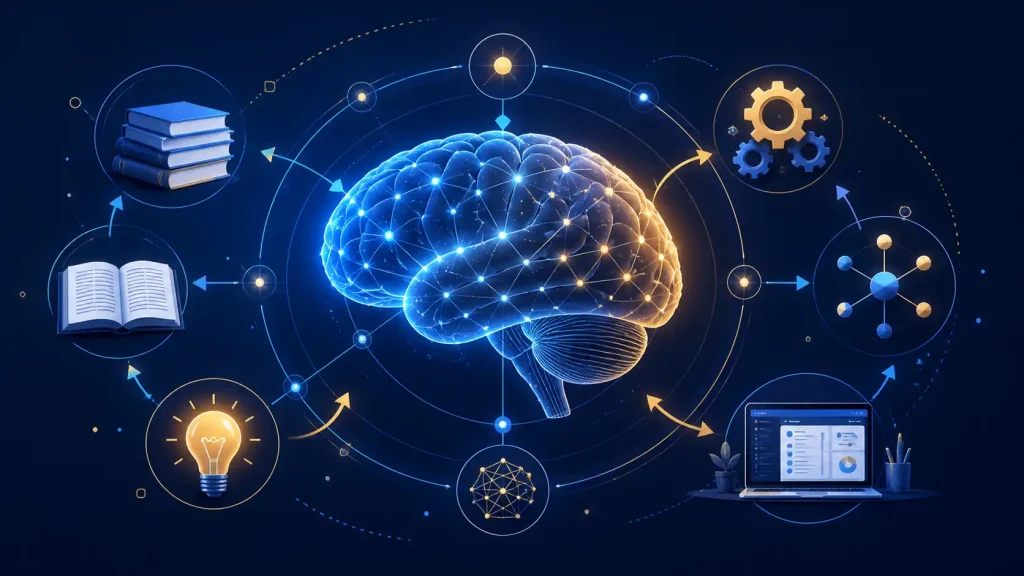
Understanding how people actually learn has never been more critical for managers, HR teams, and L&D professionals. Businesses are spending billions on training, yet retention rates remain dismally low — because most training programs ignore the science of cognition.
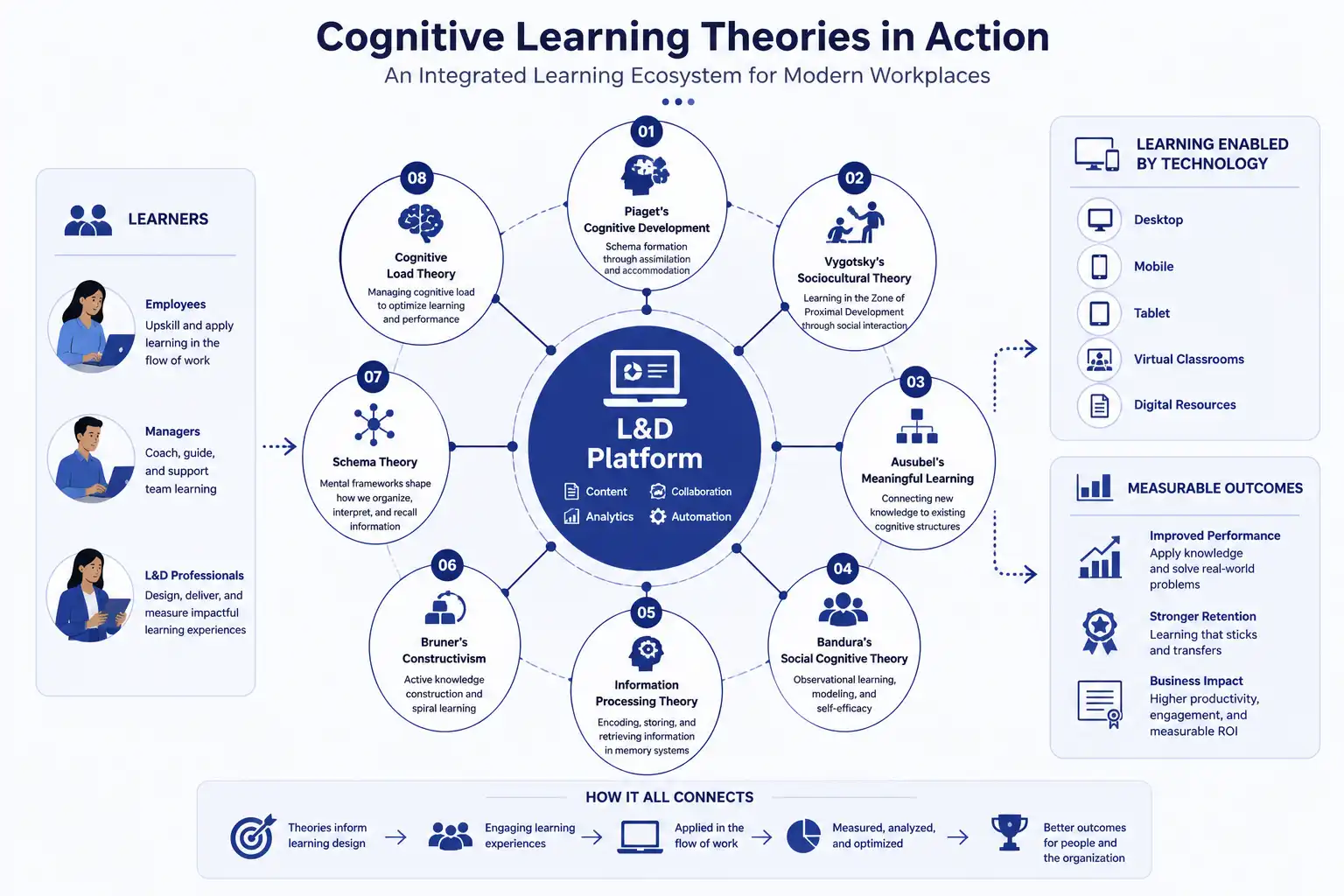
Cognitive learning theories provide the foundation for designing training, onboarding, and knowledge-management systems that genuinely stick. They explain how information enters the brain, how it’s processed, organized into existing knowledge structures, and eventually retrieved under real working conditions. Whether you’re building a new employee onboarding journey, designing eLearning modules, or coaching a high-performance team, these theories are your blueprint.
This guide covers every major cognitive learning theory, how they connect, and — critically — how forward-thinking organizations are applying them with modern platforms like Corexta to turn theory into measurable results.
What Are Cognitive Learning Theories?
Cognitive learning theories are a family of psychological frameworks that explain learning as an internal mental process — not merely a behavioral response to external stimuli. Unlike behaviorism, which focuses on observable actions and conditioning, cognitive theories explore what happens inside the mind: how learners perceive information, build mental models, store knowledge in memory, and apply it in new situations. These concepts are also reflected in formal models of learning in academic philosophy.
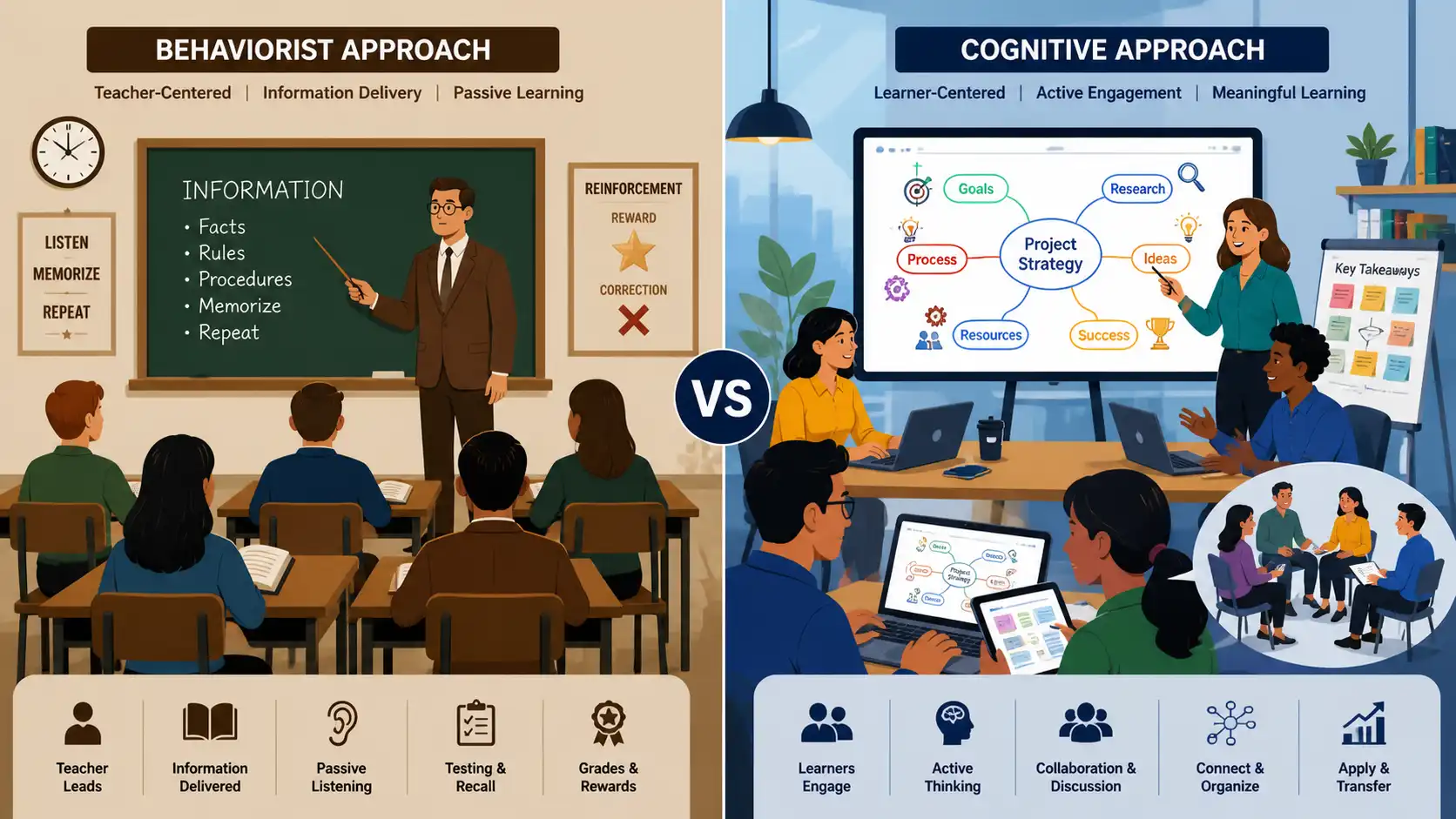
The term “cognitive” comes from the Latin cognoscere — “to know.” These theories emerged prominently in the mid-20th century as researchers challenged behaviorist models that reduced learning to stimulus-response loops. Psychologists like Jean Piaget, Jerome Bruner, David Ausubel, and Albert Bandura demonstrated that the mind is an active participant in learning, not a passive receiver.
Core Principles Shared Across Cognitive Learning Theories
- Active processing: Learners actively construct meaning rather than passively absorbing facts.
- Schema theory: New knowledge is organized into mental frameworks (schemas) built on prior knowledge.
- Metacognition: Awareness of one’s own thinking processes improves learning outcomes.
- Memory systems: Information moves through sensory, working, and long-term memory through encoding, storage, and retrieval.
- Transfer of learning: Meaningful learning enables knowledge to be applied across different contexts.
The Major Cognitive Learning Theories Explained
1. Piaget’s Theory of Cognitive Development
Jean Piaget’s model — built from decades of observing children — remains one of the most influential frameworks in education and organizational training alike. Piaget proposed that learners develop understanding through two fundamental processes:
- Assimilation: Fitting new information into existing schemas.
- Accommodation: Modifying existing schemas (or building new ones) when new information doesn’t fit.
He described four stages of cognitive development: sensorimotor, preoperational, concrete operational, and formal operational. While these stages are most discussed in childhood education, the underlying mechanisms — schema formation, assimilation, and accommodation — apply directly to adult learning.
Workplace Application: When onboarding a new hire with prior industry experience, their existing schemas (how projects work, how clients communicate) speed up assimilation. But when they join an organization with a radically different methodology, accommodation is required — and this takes time, scaffolded instruction, and practice.
2. Vygotsky’s Sociocultural Theory and the Zone of Proximal Development
Lev Vygotsky argued that learning is fundamentally social. His most famous concept — the Zone of Proximal Development (ZPD) — describes the gap between what a learner can do independently and what they can achieve with guidance from a more capable peer or instructor.
Vygotsky also introduced the idea of scaffolding: temporary support structures (instruction, hints, worked examples) that help learners bridge the ZPD gap, with support gradually withdrawn as competence grows.
Workplace Application: Mentorship programs, pair programming in software teams, and peer-review processes are all practical expressions of Vygotsky’s ZPD. Platforms like Corexta that support collaborative task management and team-based workflows enable exactly this kind of scaffolded, social learning in professional environments.
3. Ausubel’s Meaningful Learning Theory and Advance Organizers
David Ausubel distinguished between rote learning (memorizing disconnected facts) and meaningful learning (connecting new knowledge to existing cognitive structures). His key instructional tool: the advance organizer — an introductory framework presented before new content that helps learners connect what they’re about to learn to what they already know.
“The most important single factor influencing learning is what the learner already knows.” — David Ausubel
Workplace Application: Before launching a new software system or process, effective L&D teams use advance organizers — briefing decks, overview videos, concept maps — to prime existing mental schemas. This dramatically reduces resistance and accelerates adoption.
4. Bandura’s Social Cognitive Theory
Albert Bandura’s social cognitive theory expanded cognitive learning into the social realm. His key contributions include:
- Observational learning: People learn by watching others, mentally encoding behaviors, and then reproducing them.
- Modeling: Demonstration by an expert is one of the most efficient learning mechanisms.
- Self-efficacy: A learner’s belief in their ability to succeed in a task powerfully predicts actual performance.
Bandura’s famous Bobo doll experiments demonstrated that children (and adults) learn behaviors without direct reinforcement — purely through observation and mental representation.
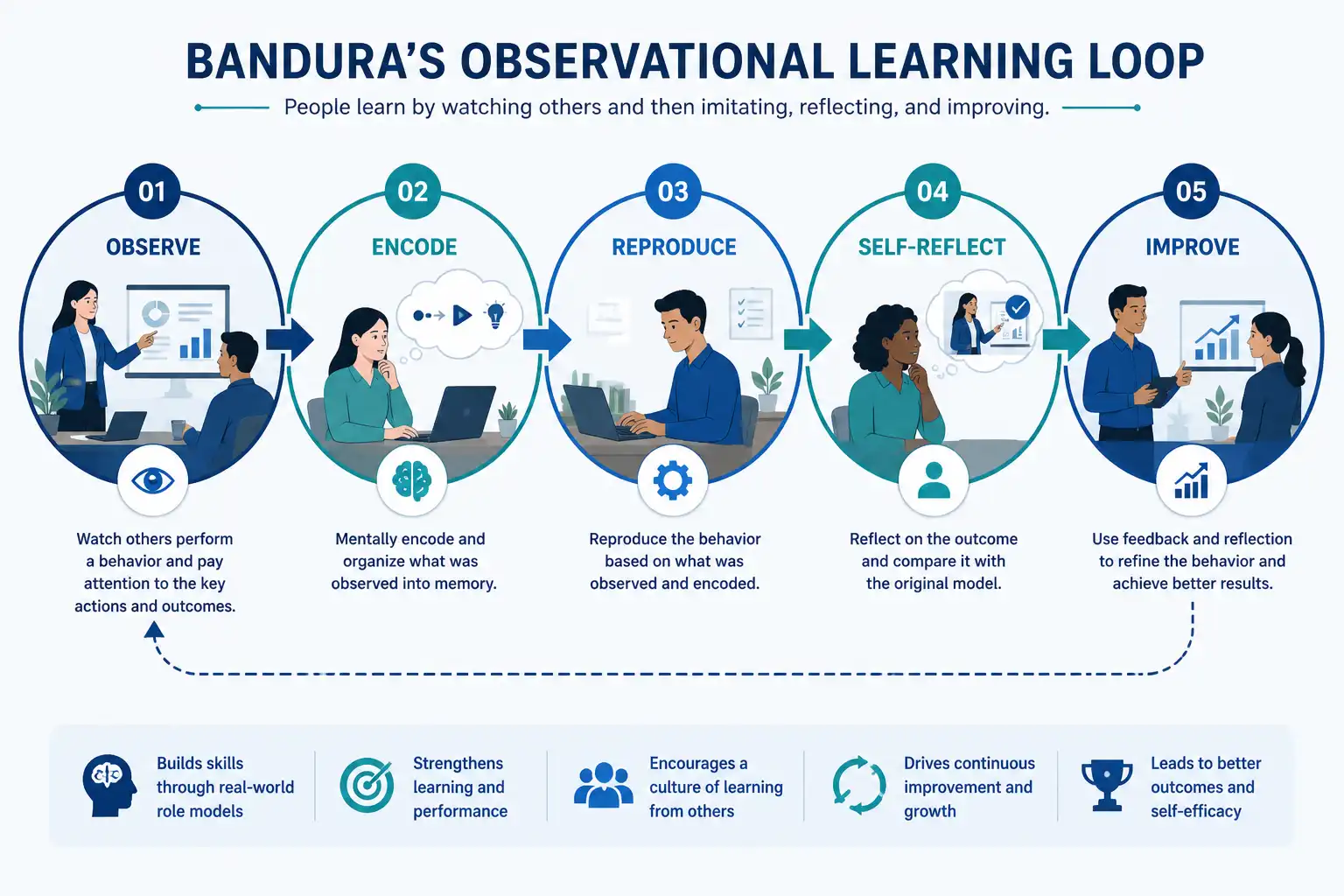
Workplace Application: Leadership modeling, shadowing programs, and video-based training all leverage observational learning. Building self-efficacy through early wins and progressive challenges is a cornerstone of effective L&D program design.
5. Information Processing Theory
The information processing model treats the human mind as analogous to a computer — receiving, encoding, storing, and retrieving information. The model describes three memory stores, each with distinct properties:
| Memory System | Capacity | Duration | Function |
|---|---|---|---|
| Sensory Memory | Very large | < 1 second | Briefly holds raw sensory input |
| Working Memory | Very limited (7±2 items) | 15–30 seconds | Active processing and manipulation |
| Long-Term Memory | Virtually unlimited | Lifetime | Permanent storage of knowledge |
The critical bottleneck is working memory. Cognitive load theory — built directly on this model — warns that overwhelming working memory prevents learning. Effective instructional design manages cognitive load by chunking information, using dual-coding (text + visuals), and building on prior knowledge to automate frequently-used concepts.
Workplace Application: Training modules that pack too many new concepts into a single session violate working memory limits. Breaking content into micro-learning modules, spacing practice over time (spaced repetition), and using visual aids alongside verbal instruction all reflect sound information processing design.
6. Constructivism (Bruner & Cognitive Constructivism)
Jerome Bruner’s constructivist framework holds that learners actively build knowledge rather than receive it passively. Bruner proposed the spiral curriculum: key concepts should be revisited repeatedly at increasing levels of complexity.
He also described three modes of representation:
- Enactive: Learning through doing (hands-on action).
- Iconic: Learning through images and visual models.
- Symbolic: Learning through abstract symbols, language, and logic.
Workplace Application: Effective training programs use all three modes. A new finance team member doesn’t just read the payroll policy (symbolic) — they watch a walkthrough video (iconic) and then practice in a sandboxed environment (enactive). Tools like Corexta’s project management and task assignment features support enactive learning by letting new employees practice real workflows from day one.
7. Schema Theory
Schema theory, developed by Frederic Bartlett and later expanded by researchers in cognitive psychology, explains how existing knowledge structures influence how we interpret, store, and recall new information. Schemas are mental templates — frameworks for understanding the world built from accumulated experience.
When learners encounter new information, they:
- Recognize similarities to existing schemas.
- Fit new details into those schemas (assimilation).
- Update schemas when new information contradicts expectations (accommodation).
Workplace Application: Experienced employees have rich professional schemas that accelerate learning of related material. Onboarding programs that explicitly connect new concepts to familiar experiences activate schemas and reduce cognitive load.
8. Cognitive Load Theory (Sweller)
John Sweller’s cognitive load theory — grounded in information processing theory — identifies three types of cognitive load and explains how working memory limitations affect learning efficiency and instructional design.
- Intrinsic load: The inherent complexity of the subject matter.
- Extraneous load: Unnecessary mental effort caused by poor instructional design.
- Germane load: Mental effort invested in building schemas (productive load).
The goal of good instructional design: reduce extraneous load, manage intrinsic load, and maximize germane load.
Workplace Application: Clean, well-structured training materials, logical onboarding sequences, and modern project management tools that reduce administrative overhead all lower extraneous load — freeing cognitive resources for actual learning.
Comparing the Major Cognitive Learning Theories
| Theory | Key Theorist | Core Idea | Best Used For |
|---|---|---|---|
| Cognitive Development | Piaget | Schema formation through assimilation/accommodation | Structured, staged learning programs |
| Sociocultural Theory | Vygotsky | Learning in the ZPD through social interaction | Mentorship, coaching, collaboration |
| Meaningful Learning | Ausubel | Connect new knowledge to existing schemas | Onboarding, new system training |
| Social Cognitive Theory | Bandura | Observational learning and self-efficacy | Modeling, leadership development |
| Information Processing | Atkinson & Shiffrin | Memory systems and cognitive bottlenecks | Microlearning, spaced repetition |
| Constructivism | Bruner | Active knowledge construction, spiral curriculum | Project-based learning, L&D design |
| Schema Theory | Bartlett | Mental templates shape comprehension | Experienced learner programs |
| Cognitive Load Theory | Sweller | Manage working memory to optimize learning | eLearning design, complex skill training |
How Cognitive Learning Theories Apply in Modern Workplaces
Onboarding Programs Built on Cognitive Principles
A cognitive-aligned onboarding program doesn’t dump a hundred policies onto a new hire on Day 1. Instead:
- It activates prior knowledge (Ausubel) through pre-arrival reading and advance organizers.
- It scaffolds complex tasks (Vygotsky) through buddy systems and guided task completion.
- It uses multiple representation modes (Bruner) — videos, walkthroughs, hands-on practice.
- It manages cognitive load (Sweller) by spacing out new concepts over the first 90 days.
Platforms like Corexta — which combine task management, collaboration, and HR tools in a single interface — reduce the extraneous cognitive load of navigating multiple systems. New hires can focus on learning the role, not the tools.
Sales and CRM Training
Sales teams rely on schema-rich knowledge: understanding customer personas, objection patterns, competitive positioning, and negotiation strategies. Applying cognitive learning theories to CRM training means:
- Bandura’s modeling: Recordings or live shadowing of top performers.
- Schema activation: Connecting new product features to familiar customer pain points.
- Spaced repetition: Revisiting objection-handling scripts over multiple sessions.
- Self-efficacy building: Setting achievable early targets to build confidence.
Corexta’s CRM module supports this by giving sales managers visibility into team activity, enabling coaching interventions precisely when they’re needed.
Project Management and Team Learning
Complex projects are among the richest environments for cognitive learning — if managed well. Cognitive constructivism (Bruner) tells us that doing real work on real projects is the most powerful learning mode. Reflection — debriefs, retrospectives, lessons-learned sessions — activates metacognition and converts experience into durable schemas.
Corexta’s project management features — including Kanban boards, Gantt charts, time tracking, and collaborative task comments — create a structured environment where learning through doing is built into daily work.
The Role of Technology in Cognitive Learning
The intersection of cognitive learning theory and technology has given rise to some of the most important instructional design innovations of the past decade:
- Adaptive learning platforms that adjust difficulty based on cognitive load signals.
- Microlearning modules that respect working memory limits.
- Spaced repetition software that schedules review at optimal intervals.
- AI-powered coaching tools that deliver feedback at the point of need.
- Collaborative platforms that enable Vygotsky-style social learning at scale.
Organizations that align their technology stack with cognitive learning principles see measurably higher training completion rates, faster skill acquisition, and stronger knowledge retention.
Corexta’s AI automation capabilities can support workflow-based learning by surfacing relevant knowledge resources at the moment they’re needed — reducing search time and lowering extraneous cognitive load for teams managing complex, multi-project environments.
Practical Checklist: Applying Cognitive Learning Theories
Use this checklist when designing any training, onboarding, or knowledge-management program:
Before Training:
- ☐ Identify learners’ existing schemas (prior knowledge assessment)
- ☐ Build advance organizers to prime relevant mental frameworks
- ☐ Structure content from simple to complex (spiral curriculum)
During Training:
- ☐ Use dual coding — combine visual and verbal instruction
- ☐ Chunk content into working-memory-friendly units (max 5–7 new concepts)
- ☐ Include modeling demonstrations for procedural skills
- ☐ Build in collaborative practice activities (ZPD scaffolding)
After Training:
- ☐ Schedule spaced repetition reviews (Day 1, Day 7, Day 30)
- ☐ Facilitate reflective practice and debriefs
- ☐ Create low-stakes performance opportunities to build self-efficacy
- ☐ Measure transfer: Are learners applying knowledge in real work contexts?
📥 Download the Free Cheat Sheet: Get all 8 cognitive learning theories, the memory systems table, cognitive load breakdown, and the full checklist in one printable PDF.
→ Download: Cognitive Learning Theories Cheat Sheet (PDF)
FAQ: Cognitive Learning Theories
What is the main idea behind cognitive learning theories?
Cognitive learning theories propose that learning is an active, internal mental process. Rather than simply responding to external stimuli, learners process, organize, store, and retrieve information using mental structures called schemas. The quality of learning depends on how well new information connects to and integrates with existing knowledge.
What is the difference between cognitive and behavioral learning theories?
Behavioral theories (like Pavlov’s classical conditioning or Skinner’s operant conditioning) focus on observable behavior changes caused by external reinforcement or punishment. Cognitive theories focus on internal mental processes — how information is perceived, processed, stored, and applied. Cognitive theories better explain complex learning like problem-solving, conceptual understanding, and skill transfer.
Who are the key theorists in cognitive learning theory?
The most influential cognitive learning theorists include Jean Piaget (cognitive development stages), Lev Vygotsky (sociocultural theory, ZPD), David Ausubel (meaningful learning, advance organizers), Albert Bandura (social cognitive theory, self-efficacy), Jerome Bruner (constructivism, spiral curriculum), and John Sweller (cognitive load theory).
How does cognitive load theory affect instructional design?
Cognitive load theory states that working memory has strict capacity limits. Good instructional design minimizes extraneous cognitive load (caused by poor presentation) and manages intrinsic load (content complexity), so learners can invest mental resources into building new schemas (germane load). Practical implications include chunking content, using visuals alongside text, and building on prior knowledge.
What is the Zone of Proximal Development?
The Zone of Proximal Development (ZPD), coined by Vygotsky, is the space between what a learner can do independently and what they can achieve with guidance from a more knowledgeable person. Effective instruction operates within the ZPD — challenging enough to promote growth, but supported enough to prevent frustration.
How do cognitive learning theories apply in the workplace?
Cognitive learning theories inform how organizations design onboarding programs, sales training, leadership development, and knowledge management systems. They guide decisions like how to sequence training content, when to use peer learning versus instructor-led sessions, how to structure microlearning modules, and how to build self-efficacy in new employees.
What is schema theory in learning?
Schema theory holds that humans store knowledge in interconnected mental frameworks called schemas. When we encounter new information, we fit it into existing schemas (assimilation) or modify our schemas to accommodate it. Rich schemas — built through experience — make learning related new material faster and more reliable.
Can cognitive learning theories be applied to remote or digital training?
Yes. In fact, digital learning environments benefit significantly from cognitive principles. Microlearning respects working memory limits; spaced repetition tools schedule review at cognitively optimal intervals; video modeling supports observational learning; and collaborative platforms enable social learning aligned with Vygotsky’s sociocultural framework.
Conclusion
Cognitive learning theories are not academic abstractions — they are practical blueprints for building smarter, more effective learning experiences. Whether you’re designing a new hire onboarding program, developing a sales training curriculum, or building a culture of continuous learning, understanding how the mind processes and retains information gives you an enormous strategic advantage.
The organizations winning in 2026 aren’t just investing more in training — they’re investing smarter, aligning learning design with the science of cognition. And they’re using integrated platforms that reduce extraneous cognitive load, support social learning, and enable learning-by-doing in the flow of real work.
Corexta brings together project management, CRM, HR, finance, and AI automation in one platform — creating exactly the kind of structured, low-friction work environment where cognitive learning principles thrive.