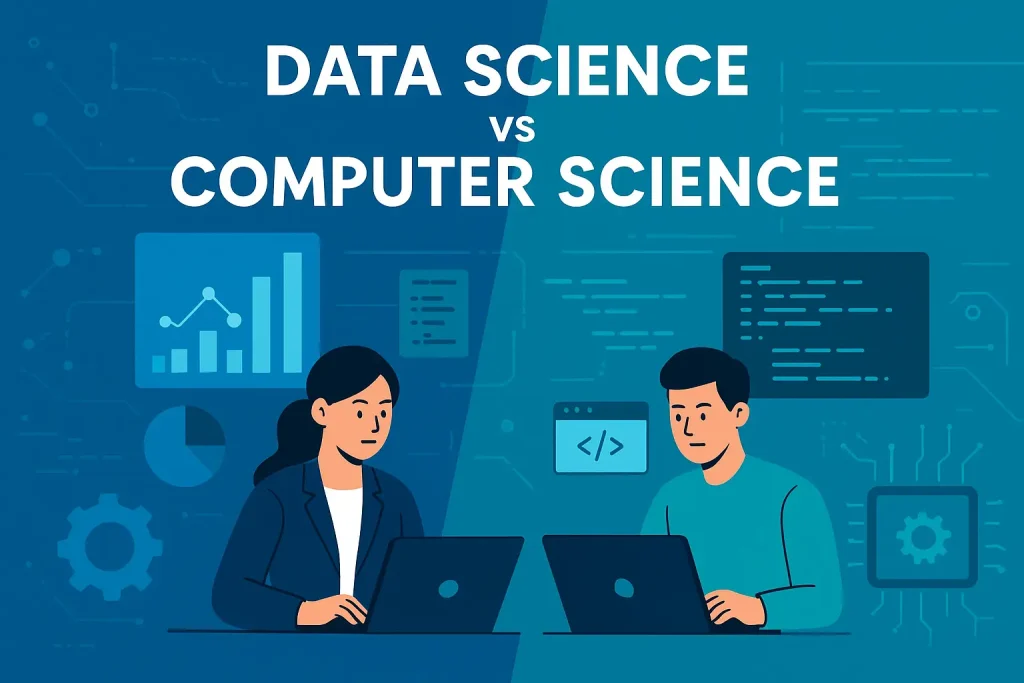
Choosing between Computer Science vs Data Science can feel like standing at a crossroads — both paths lead to thriving tech careers, but the journey and destination can look very different. If you’re passionate about technology, coding, and solving complex problems, you’ve probably wondered: Should I study Computer Science or Data Science? Which offers better opportunities, salary, and long-term growth?
Let’s break it down.
Computer Science (CS) is the foundation of modern technology. It’s all about understanding how computers work, designing software systems, and building digital solutions that power everything from mobile apps to artificial intelligence.
On the other hand, Data Science (DS) is where technology meets data-driven decision-making. It focuses on collecting, analyzing, and interpreting large amounts of data to extract insights that help businesses and organizations make smarter choices.
In today’s world, both fields are booming — and sometimes even overlap. For example, a Data Scientist uses programming and algorithms (core CS concepts) to analyze information, while a Computer Scientist might apply machine learning (a Data Science tool) to improve software.
In this article, we’ll help you understand the difference between Computer Science and Data Science in simple terms. We’ll explore what each field involves, the skills you’ll need, the career paths they open, the salaries you can expect, and how each degree shapes your future. By the end, you’ll have a clear picture of which field aligns better with your interests, goals, and personality — whether you’re drawn to the logic of coding or the storytelling power of data.
So, let’s dive into the Computer Science vs Data Science debate and discover which path might be your best fit.
What Is Computer Science?
Computer Science (CS) is the study of computers and computational systems — how they work, how to design them, and how to make them smarter and more efficient. It’s a broad field that covers everything from theory and algorithms to software engineering, systems design, and artificial intelligence.
At its core, computer science is about problem-solving using technology. You learn to think logically, write efficient code, and design systems that perform specific tasks. A computer scientist doesn’t just use computers — they create the technology that powers the modern world.
Common Career Roles
Graduates in computer science can pursue a variety of roles, including:
- Software Engineer or Developer – Builds and maintains applications and systems.
- Systems Architect – Designs large-scale computing systems and networks.
- Cybersecurity Analyst – Protects data and systems from digital threats.
- AI Engineer or Game Developer – Creates intelligent systems and immersive digital experiences.
Core Computer Science Skills
To excel in this field, you’ll need strong technical skills such as:
- Programming languages like C++, Java, or Python
- Understanding data structures and algorithms
- Working with databases and operating systems
- Knowledge of software development life cycles
Many prestigious institutions, such as the IIT Computer Science programs in India, are globally recognized for producing top-tier computer scientists who go on to work for companies like Google, Microsoft, and Amazon.
A computer science career path offers vast opportunities — from building the next mobile app to designing secure cloud systems or developing AI-powered software. With technology evolving rapidly, the scope of a computer science degree continues to expand, making it one of the most versatile and future-proof choices for tech enthusiasts.
What Is Data Science?
Data Science (DS) is an interdisciplinary field that focuses on extracting meaningful insights from data using a blend of statistics, programming, and domain expertise. In simple terms, it’s about turning raw data into valuable information that drives smarter decisions.
While Computer Science builds systems and applications, Data Science focuses on making sense of information — identifying trends, predicting outcomes, and providing actionable insights.
Common Career Roles
If you pursue a data science career path, you might find yourself in roles such as:
- Data Analyst – Cleans and interprets data to support business decisions.
- Data Scientist – Uses advanced statistics and machine learning to uncover patterns.
- Machine Learning Engineer – Builds algorithms that allow systems to learn automatically.
- Business Intelligence Analyst – Translates data into visual insights for strategy teams.
Core Data Science Skills
Key skills that define a successful data scientist include:
- Programming in Python, R, and SQL
- Data wrangling – cleaning and preparing messy data
- Statistical analysis and machine learning
- Data visualization with tools like Tableau or Power BI
- Understanding business context and communication
Data Science is inherently interdisciplinary — it blends mathematics, computer science, and business intelligence. Whether it’s predicting market trends, personalizing recommendations, or improving healthcare outcomes, data scientists are in high demand across industries.
A data science degree opens doors to tech companies, financial institutions, healthcare organizations, and startups. The scope of a data science career continues to grow as businesses increasingly rely on data to stay competitive. With strong analytical skills and curiosity, you can turn data into powerful stories that influence decisions and innovation.
Key Differences Between Computer Science and Data Science
Although Computer Science and Data Science share some similarities — both rely on programming, algorithms, and analytical thinking — their goals and applications differ significantly. Let’s break it down in a detailed comparison table:
| Feature | Data Science | Computer Science |
|---|---|---|
| Core Focus | Extracting insights from data to support decisions | Building software, systems, and computing infrastructure |
| Key Skills | Statistics, Machine Learning, Python, Data Visualization | Algorithms, Programming (C++, Java), System Design |
| Tools Used | Python, R, SQL, Tableau, TensorFlow | Java, C++, MySQL, Git, Linux |
| Common Roles | Data Scientist, ML Engineer, Data Analyst | Software Engineer, Systems Architect, Cybersecurity Analyst |
| Applications | Business analytics, finance, marketing, healthcare | Operating systems, AI systems, cybersecurity, gaming |
| Educational Focus | Statistics, ML, data analysis, business context | Programming, algorithms, computer systems, theory |
| Mindset | Analytical and research-oriented | Logical and design-oriented |
Overlap and Divergence
The difference between Computer Science and Data Science often lies in purpose. Computer Scientists build the digital infrastructure — databases, algorithms, and applications — while Data Scientists use that infrastructure to extract meaning from data.
In other words:
- Computer Science creates the “engine.”
- Data Science drives the “insights” from what the engine produces.
However, the two fields are increasingly interconnected. Many data science tools (like TensorFlow or PyTorch) are built using computer science principles, while modern computer science applications often rely on data science methods like predictive analytics or AI.
Choosing Between the Two
If you enjoy building systems and solving logical problems, computer science might be your path. But if you love finding stories in data and making data-driven decisions, data science could be a better fit.
Both fields offer high salaries, global demand, and continuous learning — the real question is where your curiosity lies: in coding the system, or decoding the data.
Salary Comparison in 2025
When comparing data science vs computer science salary, it’s clear both paths offer very strong compensation — yet there are meaningful differences tied to geography, role, experience, and industry. Here’s an at-a-glance summary:
| Role | Avg Salary (India) | Avg Salary (US) |
|---|---|---|
| Software Engineer | ~ ₹10–18 LPA* | ~$90K–$130K* |
| Data Scientist | ~ ₹12–22 LPA* | ~$100K–$140K* |
| ML Engineer | ~ ₹15–25 LPA* | ~$110K–$150K* |
These ranges represent ballpark figures for mid-level positions (3–6 yrs experience) in 2025, aggregating multiple sources.
India:
For a software engineer in India, typical salary ranges from ₹3.5–12 LPA for early stage, rising up to ~₹12–18 LPA for 5-10 years of experience. (PSTech Global)
For a data scientist in India, freshers often earn ₹5–8 LPA, mid-level ₹10–20 LPA, and senior professionals ₹20 LPA+ (even 30–40 LPA in niche roles). (unstop.com)
Thus the “₹10–18 LPA” and “₹12–22 LPA” are reasonable mid-level estimates.
United States:
In the U.S., software engineers average around $128,000 according to Indeed data. (Indeed)
Data scientists in the U.S. have average salaries around $150,000+ per year. (Glassdoor)
Influencers on Salary
Here are key factors that influence compensation in both fields:
- Experience & seniority: More years, more responsibility = higher pay. For example, entry-level data scientists in India earn ~₹6 LPA, but with 10+ yrs experience they can reach ₹20 LPA+. (unstop.com)
- Location & market cost of living: U.S. salaries are higher in part due to higher living costs, and within India salaries are higher in metro tech hubs (Bangalore, Mumbai) compared to smaller cities. (unstop.com)
- Industry & company type: Big tech, product companies, AI/ML roles pay more than service roles. Skills in emerging technologies (cloud, AI, ML) command premium pay. (upGrad)
- Role and specialization: An ML engineer tends to earn more than a general software engineer or junior data analyst because of extra specialization.
- Comparing data science vs computer science salary: While both fields are lucrative, data science roles often start a little higher (especially in the U.S.) because of data-driven business demand and limited supply of top talent. However, in India the difference may be less pronounced and will depend heavily on company and skills.
In short: if you’re choosing between computer science vs data science, both fields can lead to very good compensation. But your actual salary will depend more on how you build your skills, pick your role and location, than simply the label of “computer science” vs “data science”.
Job Demand and Market Trends
When evaluating computer science vs data science job demand, it’s essential to look at market dynamics, growth trends, and how the two fields are evolving in 2025.
Data Science Demand
Demand for data science roles remains exceptionally strong in 2025. According to a 2025 job-outlook report by 365 DataScience, the field is shifting: entry-level (0-2 years) roles are now least common, while mid- and senior-level demand is highest. (365 Data Science) Another source reports a global market size for data science (and analytics) projected to reach ~$178.5 billion by 2025 with a ~26.5 % CAGR from 2023–25. (Towards AI)
Also: AI, machine learning, cloud skills, business-domain analytics are driving demand. (Analytics Insight) Remote work and global hiring also benefit this field: many data science roles can be done remotely and companies are open to talent globally.
Computer Science Demand
For computer science career paths (software engineering, systems, cybersecurity), demand remains strong but with some nuance. Areas like AI infrastructure, cloud engineering, cybersecurity are booming. For example, the list of “Top 10 most in-demand tech careers for 2025” includes roles in AI, data analytics, cybersecurity—all tied to CS foundations. (LSE)
That said, certain purely routine programming roles are facing automation pressures and hiring slowdown in some segments (especially ones lacking specialization) — meaning that CS demand is more selective and may favour specialization (cloud, security, systems design).
Global & Remote Trends
Both fields are increasingly global and remote-friendly. Data science roles benefit from global data teams, analytics across locations, remote dashboards, etc. For CS, firms still hire globally for software engineering, cloud infrastructure, DevOps, but often require working in distributed teams, familiarity with remote tools, and newer paradigms (DevSecOps, cloud native).
Moreover, companies increasingly prioritise hybrid/remote work arrangements, which broadens the talent pool and opens doors for international candidates.
Summary
In short, when comparing computer science vs data science job demand, you’ll find:
- Data science: Very strong and growing demand, especially for candidates with ML/AI + business insight skills.
- Computer science: Still vital and in demand, especially where system-building, infrastructure, cloud and security matter — but the field is branching and the “generalist software engineer” may face stronger competition or need to specialise.
- For either field: Continuous learning, specialization, domain/business context, and remote/global adaptability will boost demand and career options.
Education Pathways and Degrees
Choosing the right degree for data science or computer science and understanding the pathways is important if you’re deciding which career to pursue.
Degree Options for Computer Science
For a computer science career path, common degree routes include:
- Bachelor’s in Computer Science (B.Sc or B.Tech)
- Master’s/M.Tech in Computer Science or Software Engineering
- Post-graduate diplomas or certifications in specialized areas (cybersecurity, cloud, systems design)
- Bootcamps or short-term intensive programs (e.g., full-stack development, cloud / DevOps) to supplement skillsets
For example, institutions such as the IIT Computer Science programs are globally respected for rigorous CS education and strong placements. This degree gives you strong foundations in algorithms, data structures, operating systems, software engineering, and systems architecture. These foundations prepare you for varied CS roles and allow adaptability over time.
Degree Options for Data Science
For a data science career path, typical education pathways include:
-
Bachelor’s in Data Science, Statistics, Mathematics, or Computer Science with data-science electives
-
Master’s in Data Science, Analytics, Machine Learning
-
PG diplomas in Data Science/Business Analytics
-
Bootcamps / Certifications in Python, R, Machine Learning, Data Wrangling, Visualization
Because data science is interdisciplinary — combining math/statistics, programming, and domain knowledge — flexibility is key. Many data scientists start with a CS or Math degree and pivot with postgraduate studies or certifications. For example, the IIT Bombay Data Science program offers a PG diploma in AI and Data Science, helping professionals gain practical and theoretical expertise.
Flexibility & Switching
One advantage: there is flexibility in switching between fields. If you begin with a computer science degree, you can add data science skills (statistics, ML, visualization) later and transition into data roles. Similarly, if you start in data science but want deeper system-engineering credentials, you can bolster your CS fundamentals. Many professionals take a hybrid route: CS degree + data science postgraduate or certifications.
When asking “best degree for data science or computer science”, it often depends on your interests: if you’re drawn to system design, software, algorithms → pick CS; if you’re drawn to statistics, analysis, business insights → data science may fit. But whichever you pick, layering skills is key.
Summary
- For CS: strong foundational degree (B.Tech/BS) + specialisation.
- For DS: either a data-centric degree or CS/Math + data science overlay.
- Certifications, bootcamps, domain experience matter a lot—especially in DS where the tech and business overlap.
- The best pathway is the one aligned with your interest, and which allows you to pivot as technologies evolve.
Which Career Is Right for You?
Now comes the question: which is better computer science or data science for you? There’s no one-size-fits-all answer. Instead, consider your personality, interests, and long-term goals.
Decision Checklist
✅ You prefer logic, systems, engineering, building software, designing infrastructure → lean toward CS.
✅ You love data, patterns, extracting stories, business impact, and seeing how insights drive decisions → lean toward DS.
✅ You want flexibility across industries (finance, healthcare, marketing, product) and enjoy domain & data interplay → that suggests DS.
✅ You prefer building scalable tech systems, and working on software architecture, cloud, cybersecurity, algorithms → that points to CS.
Reflecting on Your Interests
If you get excited by writing code that runs millions of times, optimizing performance, building robust systems, designing networks or cloud platforms — computer science will likely be a rewarding path.
If you find joy in exploring datasets, asking “what’s hidden here?”, building models, visualising results, connecting data to business outcomes — data science might be more fulfilling.
Long-Term Growth Considerations
Both paths offer excellent long-term growth and demand. But the kind of growth differs. In CS you might progress to senior software architect, systems engineer, dev-ops lead, or even become a core tech specialist. In DS you might become principal data scientist, ML lead, analytics director, or domain specialist. The business value orientation of DS means you often mix tech + business.
Also consider that technology evolves: data science is increasingly important as companies become data-driven; likewise CS fundamentals remain vital because infrastructure and systems always need design and maintenance. Which means your ability to keep learning will matter most.
In short: Pick the path that aligns with what you enjoy doing every day. The salary, demand, and opportunities are strong in both. But your daily satisfaction – the code you write, the problems you solve, the mindset you bring to work – will echo in your growth and success. So ask yourself: Do I want to build the system (CS), or extract insights from it (DS)? Your answer will steer you toward the right choice.
FAQs
These are some of the most common questions students and professionals ask when deciding between a computer science vs data science career. Each answer is written clearly to help you make an informed choice and boost snippet visibility.
Q1. Is Computer Science harder than Data Science?
It depends on your strengths and interests. Computer Science (CS) is typically more focused on algorithms, systems, and software engineering — which demands strong logical thinking and programming ability. Data Science (DS) combines coding with statistics, mathematics, and business understanding.
If you enjoy theory, logic, and building systems, CS may feel easier. But if numbers, analysis, and storytelling through data excite you, DS might be more engaging. In short, both fields are challenging in their own ways — the “harder” one is simply the one less aligned with your natural skill set.
Q2. Can I switch from Computer Science to Data Science?
Absolutely. Many data scientists actually begin in computer science and later specialize in analytics or machine learning. Your computer science background gives you a strong programming and algorithmic foundation, which is essential for data science.
To switch, focus on learning statistics, Python or R, SQL, data visualization, and machine learning. Online courses, PG diplomas, or certifications can help you bridge the gap quickly.
Q3. Which field has better job security?
Both fields offer strong long-term stability, but for different reasons. Computer Science roles like software engineering and cybersecurity are evergreen — every company needs robust systems and secure networks.
Data Science, meanwhile, is crucial for organizations making data-driven decisions. The explosion of AI, ML, and analytics ensures high demand. Overall, job security is excellent in both, especially for professionals who keep updating their skills.
Q4. What’s the best degree for Data Science?
The best degree for data science is typically a Bachelor’s in Computer Science, Statistics, Mathematics, or Data Science, followed by a Master’s or PG Diploma in Data Science or Machine Learning.
Since the field is interdisciplinary, a strong base in math and coding helps the most. Some learners even start with engineering or economics degrees and later transition through certifications and practical projects.
Q5. Is IIT Computer Science good for Data Science careers?
Yes, IIT Computer Science programs are among the best academic foundations for a career in both software engineering and data science. They provide advanced coursework in algorithms, AI, and machine learning — all core components of data science. Many IIT graduates successfully move into data-focused roles at global tech and analytics companies.
Q6. Which field is better for remote jobs?
Both fields now offer great remote opportunities. Data Science often leads in remote flexibility because data analysis, visualization, and ML modeling can be done entirely online. Computer Science roles like software development and DevOps are also remote-friendly, though infrastructure or hardware-related jobs may still need on-site work.
In 2025, the trend shows a growing hybrid workforce for both, especially across AI, cloud, and analytics roles.
Q7. Do both require coding?
Yes — but to different extents. Computer Science heavily revolves around coding; you’ll work with languages like C++, Java, or Python daily. Data Science also requires coding, mainly for analyzing and visualizing data using Python, R, or SQL.
So, while both require programming, the purpose differs: CS focuses on building systems and software; DS uses code to process and interpret data.
In summary, when it comes to a data science vs computer science comparison, both careers offer high salaries, global demand, and continuous learning opportunities. Your ideal path depends on what excites you more — building the digital world or interpreting the data that drives it.
Conclusion and Next Steps
Choosing between Computer Science vs Data Science isn’t about picking a “better” field — it’s about finding the one that best matches your skills, curiosity, and long-term goals.
If you’re drawn to designing systems, writing code, and building technology that powers modern life, computer science is your arena. You’ll work on software, cloud systems, AI frameworks, and secure networks that keep the digital world running.
If you’re fascinated by patterns, insights, and the power of data to transform decisions, data science might be your calling. You’ll analyze complex information, train machine-learning models, and turn numbers into actionable business intelligence.
Both paths lead to rewarding, future-proof careers — but they demand different mindsets. Computer scientists are builders; data scientists are interpreters. And in an increasingly AI-driven world, both skill sets often converge, offering flexible and hybrid opportunities across industries.
Whichever you choose, focus on continuous learning. Technology evolves fast, and those who adapt thrive the most.
If you’re considering a world-class academic path, explore the IIT Computer Science program for advanced opportunities in software, systems, and data-driven innovation. It’s one of the best routes to build a foundation strong enough to transition easily between computer science and data science as the tech landscape grows.
Ultimately, in the debate of Computer Science vs Data Science, the winner is the one that aligns with your passion and purpose.