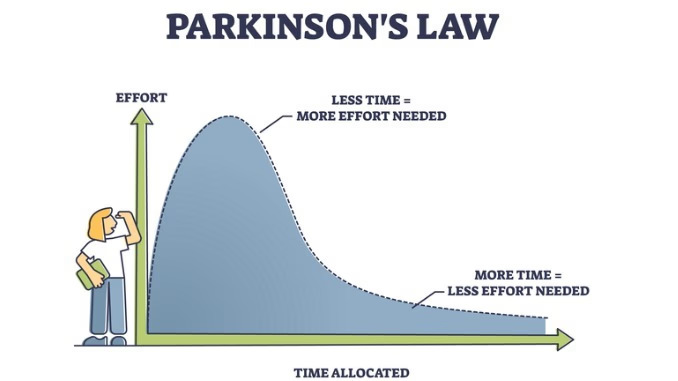
Many of us have encountered the strange phenomenon: a task that seems straightforward nonetheless ends up consuming the entire time we allow for it. You give yourself a week and the work stretches to fill all seven days. You give yourself a day and you’re still scrambling for the last hour. In time-management literature this effect is commonly known as Parkinson’s Law, the idea that “work expands so as to fill the time available for its completion.”
While this sounds like just a trick of procrastination, deeper reflection shows that it points to something far more subtle: hidden friction in how we work, how our systems operate, or in our own minds. It is not just about laziness or inefficiency—it is a signal.
In this article we will unpack where the concept comes from, what it really means (and what it doesn’t), why simply “making deadlines shorter” is often not enough, and then walk through a three-layer diagnostic framework for understanding the root causes and some practical prescriptions to reclaim your time and attention.
The Origin of Parkinson’s Law
The phrase “work expands so as to fill the time available for its completion” was coined by the British naval historian and author C. Northcote Parkinson. He first published an essay in The Economist in 1955, in which he satirically examined bureaucracy and administrative growth.
Parkinson observed that even as the number of warships in the British Navy declined, the number of administrators in the Admiralty grew. He noted that officials often hired subordinates not to relieve workload but to create more “work” (reports, memos, meetings) so that everyone remained busy.
Hence, the original context was organisational inefficiency and institutional bloat — not necessarily personal time-management. But over time, the idea became generalised into individual productivity: tasks swell to fill available time.
What Parkinson’s Law Is — And What It’s Not
What It Is
In the personal productivity space, Parkinson’s Law shows up like this: you schedule 3 hours to complete something that really only needs 90 minutes; yet you spend most of the 3 hours on it anyway. You set a two-week deadline for a project, and the first week drags, you procrastinate, you fiddle around, you wait for inspiration — only to finish in the last 24 hours.
The key insight: the work didn’t truly require all that time. The time available expanded, and the work expanded in tandem. The more space given, the more “filling” happened: extra drafting, tangents, over-analysis, busy-work.
What It Isn’t
It’s important to state what this phenomenon is not: it’s not simply procrastination. Procrastination is the failure to begin, or the deferral of starting meaningful effort until later. Parkinson’s Law is different: the work is started, and you are busy—but the work itself is bloated beyond what is strictly necessary.
Also: it’s not a “law” in the strict scientific sense. It’s an observation about human behaviour and organisational dynamics.
By conflating it with just “be more efficient” or “work faster,” we miss the deeper drivers: where does the expansion come from? Why is it that time available correlates so strongly with time consumed?
Why Simply “Set Shorter Deadlines” Often Doesn’t Work
A common instinct is: well, if work expands to fill time, let’s just give it less time. Set shorter deadlines. Makes sense. But research and experience show that this is not a universal fix—and in fact, can backfire.
Different Types of Work
There’s a psychological principle called the Yerkes–Dodson law which states that performance improves with pressure, up to a point—but beyond that, too much pressure causes performance to drop.
For simple, repetitive tasks, imposing a tighter deadline can increase focus and drive efficiency. But for complex work—creative, strategic, ambiguous—a too-tight deadline can trigger anxiety, reduce thinking time, cause shortcuts, mishaps or poor quality.
Hidden Friction
What’s more, simply shortening deadlines ignores the underlying friction that causes the expansion of work: your capacity, your environment, and your psychology. If those are broken or mis-aligned, then shrinking the time doesn’t remove the drag—it only intensifies it.
The Brain’s Default
When given large spans of time and fuzzy structure, our brain tends to default into low‐energy “autopilot” mode. Instead of diving into the high-energy core of the task, we engage in easier but less meaningful work: formatting, gathering extra information, rearranging files, starting tangents. This is often called “productive procrastination.”
Thus, the simple prescription of “tighten the deadline” is often a blunt instrument—it might work in some cases, but without insight into what is really making the work drag, it can degrade output or lead to burnout.
A Three-Layer Diagnostic Framework for Why Work Expands
Instead of just hacking deadlines, a more sustainable and nuanced way is to recognise the expansion of work as a symptom of friction somewhere in the system. You can think of this using three layers:
-
Capacity — your ability to do the work
-
Environment — the context, systems, structure around the work
-
Psychology — your internal mindset, motivation, beliefs about the work
Let’s dive into each.
1. Capacity (Your Engine)
This is about your physical energy, mental bandwidth, and actual skills.
-
If you’re fatigued, burned out, or overloaded, even a small task can feel huge.
-
Working memory is limited. If your brain is already juggling too many open loops, distractions, notifications, context switches, then you have less cognitive headroom for the task at hand.
-
When capacity is low, it’s tempting to stay in “autopilot” mode: easier, safe tasks, rather than engage in deep, focused, high-energy work. Hence the work drags and expands.
2. Environment (Your Operating System)
Here we look at the external systems, culture, processes, and clarity around the work.
-
If goals are ambiguous, priorities shifting, or your day is full of interruptions, misalignment, and unstructured blocks, the environment allows the task to bloat.
-
In organisations where “looking busy” is rewarded, or where there’s lack of psychological safety to ask questions or say “this goal is unclear,” you may find endless meetings, check-ins, rework, and busywork.
-
A messy environment means tasks aren’t well-scoped, definitions of done are fuzzy—this gives the work room to expand as everyone hedges and creates more buffer than needed.
3. Psychology (Your Relationship to the Work)
This layer addresses your internal state: how you feel about the task, what you believe, how you approach the work.
-
Low motivation: If a task feels meaningless, imposed, or disconnected from your values, you’re unlikely to bring full energy. The work might drag and fill the time available.
-
Perfectionism and fear: When you’re afraid of judgment or failure, you may unconsciously create extra “padding” in the work, doing “performative tasks” (extra layout, extra data, extra meetings) to protect yourself if the outcome isn’t perfect.
-
Overthinking: Since you know you have “time available,” you may delay or avoid committing to a clear finish line, thereby increasing the chance of the work expanding.
Two-Step Solution: Diagnose, Then Act
Having identified the three layers, the next step is to intervene intentionally. The process has two parts:
Step 1: Pause and Diagnose
When you feel a task dragging, or sense that you’re spending more time than you expected, ask yourself:
-
Is it Capacity that’s the issue? Am I drained, overloaded, lacking skill?
-
Is it Environment that’s the issue? Are the goals unclear? Do I have too many interruptions? Is the context a mess?
-
Is it Psychology that’s the issue? Am I avoiding something? Fearful? Unmotivated? Perfectionistic?
Often more than one layer is involved, but typically one is dominant.
Step 2: Take the Right First Action
Once you’ve identified the dominant layer, respond with a targeted action:
-
If Capacity is the problem → Recover. Rest, recharge, protect your energy. Don’t just push harder. For example: take a short break, nap, walk, remove other cognitive load.
-
If Environment is the issue → Clarify or Shield. Clarify the scope, objectives, definition of done. Shield your time from chaos (turn off notifications, block focus time).
-
If Psychology is at play → Reframe or Resize. Reframe the meaning of the task (find purpose, link to higher goal) or resize it (set a clear “good enough” endpoint rather than perfect).
Importantly, diagnosing correctly is more effective than brute-forcing harder. Better to fix the engine, the system, or your mindset than simply compress time without addressing root causes.
Practical Prescriptions: Tools & Techniques
Once you know your layer, here are some time-tested tools and techniques you can apply. Think of them not as generic hacks but targeted prescriptions aligned with your diagnosis.
When Capacity is the Constraint
-
Pomodoro Technique: Work in short bursts (e.g., 25 minutes) followed by short breaks. This creates manageable chunks, prevents fatigue, helps keep focus high.
-
Off-load mental overhead: Use an external system (not just memory) to capture tasks, ideas, interruptions so your brain isn’t juggling many things at once.
-
Protect rest and recovery: set boundaries around your work hours, get adequate sleep, schedule downtime.
-
Avoid prematurely “muscling through” when the real issue is low energy or cognitive load.
When Environment is the Constraint
-
Time Blocking: Assign specific time blocks on your calendar for deep work, for emails, for buffer time. Avoid leaving big unfilled stretches that busy-work can creep into.
-
Eisenhower Matrix: Prioritise tasks by importance vs urgency—avoid being hijacked by others’ urgent but not important demands.
-
Define clear objectives: what done means, who’s accountable, what the boundaries are. This clarity prevents scope creep.
-
Minimise interruptions: batch interruptions, turn off notifications, create dedicated times for checking email/Slack rather than reacting to everything in real-time.
-
Ensure your team/organisation environment supports clarity, autonomy, and psychological safety—otherwise even good individual effort can be undermined.
When Psychology is the Constraint
-
Use the Pareto Principle (80/20 rule): Ask “what 20 % of this task will deliver 80 % of the value?” Focus on that first. This helps tame perfectionism and endless tinkering.
-
Reframe meaning: connect the task to a larger goal or value you care about. When work feels meaningful you bring more drive and less drag.
-
Define “good enough”: before you begin, set realistic expectations and finish lines. This stops you from “just one more tweak” that expands the work.
-
Recognise performative work: ask whether you’re doing this for actual value or because you fear judgement or want to signal busyness.
Real-Life Examples & Scenarios
Example 1: A Marketing Campaign
A team is given two weeks to develop a campaign concept. Because the deadline is generous, the team falls into this pattern: research week one, alignment meetings mid-week two, creative ideas generated, refined, re-refined. Then final sprint in last 12 hrs.
-
The root issue: Environment + Psychology. The goal wasn’t tightly defined (environment), and the team defaulted into perfectionism (psychology).
-
Prescription: Clarify scope (what success looks like, deadline), block focus periods (time blocking), use 80/20 rule to decide which ideas deliver most value.
-
Doing so would reduce wasted time and result in a sharper output, without needing to just arbitrarily shorten the deadline.
Example 2: Writing a Report
You have one week to write a 10-page report. Instead you spend days arranging the document, collecting marginal data, rewriting headings, procrastinating starting. On the final day you rush.
-
Root issue: Capacity + Psychology. Your mental bandwidth is fragmented (capacity) and you fear the result so you ‘pad’ the work (psychology).
-
Prescription: Use Pomodoro to chunk focus sessions, define an endpoint “the report needs an executive summary + 2 key charts” (80/20), reboot by capturing all your ideas in a mind-dump so you clear cognitive overhead.
Example 3: Inbox & Interruptions
Your day looks full: meetings, notifications, Slack pings, new requests. You plan 4 hours for strategic work but end up using it for firefighting.
-
Root issue: Environment. The system around you is noisy, unclear priorities, tasks hijacked by others.
-
Prescription: Time block ‘deep work’ sessions, designate fixed times for interruptions (say 11 am and 4 pm for email/Slack), use Eisenhower matrix to push back on tasks that are urgent but not important.
Why Recognising Parkinson’s Law Matters Now
In today’s world of knowledge work, remote/hybrid teams, asynchronous communication and constant notifications, the opportunity for work to expand beyond necessary bounds is greater than ever. The original observation about bureaucracies still holds: extra meetings, extra reports, extra communication don’t mean more value—they often mean more friction.
If unchecked, this leads to:
-
Burnout (you end up working far more than you intended)
-
Value dilution (you spend time on the wrong things or doing too much for little gain)
-
Lost autonomy (your schedule is taken over by busy-work)
-
Reduced satisfaction (because you feel busy but not productive or effective)
By seeing the expansion of work not as a failure of time-management but as a symptom of something deeper, you can begin to design systems (internal and external) that reduce the opportunities for bloat and make your effort more intentional.
Putting It All Together: Your Anti-Friction Plan
Here’s a step-by-step process you might follow in your next week:
-
Schedule a Review – At the end of your week, pick one task that you felt expanded or dragged.
-
Diagnose – Ask: What was the dominant source of friction?
-
Capacity: Did I feel drained, overloaded?
-
Environment: Were goals unclear? Too many interruptions?
-
Psychology: Was I avoiding something? Perfectionistic?
-
-
Select a Targeted Fix – Based on the diagnosis, pick one change:
-
If Capacity → plan a rest/recovery or reduce cognitive load.
-
If Environment → clarify scope, block time, reduce interruptions.
-
If Psychology → define “good enough,” connect to purpose.
-
-
Apply a Tool – Use an appropriate technique:
-
Pomodoro or mind-dump for capacity.
-
Time-blocking or Eisenhower matrix for environment.
-
80/20 rule or re-framing for psychology.
-
-
Measure and Reflect – At the end of the next week, ask: did that change reduce the drag? Did tasks feel different?
-
Iterate – If it got better, keep refining. If not, perhaps you misdiagnosed; revisit the layers.
By acting not just on “do the task faster” but on “why is the task dragging?” you become what might be called a “Chief Friction Officer” of your work—someone who doesn’t just execute tasks but manages the system around the tasks.

Common Questions and Mis-conceptions
Q: Isn’t shortening deadlines always good?
A: Not always. For simple tasks, yes a shorter deadline can sharpen focus. But for complex tasks or where there is friction already, a shorter deadline might simply increase stress, lower quality, or lead to deeper avoidance. It doesn’t fix the underlying drag.
Q: Isn’t this just another productivity hack?
A: Better phrased: it’s a mindset shift. Instead of treating time as the only lever (give less time, do more), the focus becomes diagnosing why time is being wasted (or swallowed). Time-management is useful—but only when paired with systemic thinking about capacity, environment and psychology.
Q: How do I know which layer is the problem?
A: Start with what you feel. If you feel drained or overloaded before you even begin → capacity. If you feel your calendar hijacked or goals fuzzy → environment. If you feel dread, avoidance, need to polish endlessly → psychology. You may also test by applying a small fix in one layer and see if things improve.
Q: Will this work in team/organisational settings?
A: Yes—but it often requires influencing more than just yourself. If the environment is dysfunctional (unclear roles, shifting priorities, culture of busyness), you may need to advocate for change: clarify tasks, block focus time, reduce meetings. As a team you can adopt shared time-blocking, priority frameworks, and reduce busywork.
Final Thoughts
The expansion of work to fill the time you give it is not merely a quirk—it’s a signal. A signal that somewhere in your engine (you), your system (environment), or your mindset (psychology) there is friction. Recognising this changes the game from “how do I work faster?” to “how do I design for less drag?”
By pausing to diagnose, by using tools strategically rather than blindly, and by iterating over your system, you can shift from reacting to overload to proactively managing your work, your time, and your energy. You will find that tasks take only the time they truly need, and that you regain space—not just in your schedule, but in your mind and your capacity for meaningful work.
As you move forward, remember: the goal isn’t just finishing tasks. It’s building better engines. Systems where high-value work can flow easily, where your energy is aligned, your environment supports you, and your attitude matches your intention.
Give yourself the time to reflect, but not so much extra time that the task becomes bigger than it needs to be. Then watch what happens: the work will shrink, your stress will shrink, and your impact will grow.
Read more: How to Choose the Right Knowledge Base Software for Your Business