Imagine asking a generative AI like ChatGPT or Gemini for a recommendation in your industry, only to find your own brand completely absent from the answer. For modern marketers, this isn’t a hypothetical scenario—it’s a growing reality that underscores a fundamental shift in how information is discovered. Traditional Search Engine Optimization (SEO) is no longer sufficient because a significant portion of searches now start and end within AI platforms, which provide direct, summarized answers instead of a list of blue links.
This paradigm has given rise to Generative Engine Optimization (GEO), the discipline of optimizing your digital content to be accurately interpreted, cited, and surfaced by Large Language Models (LLMs). As we move into 2026, with an estimated 41% of users regularly turning to AI for direct answers, establishing GEO maturity is critical for brand visibility and authority. The right tools are essential to decode how AI engines “think” and to track your performance across this fragmented landscape.
This guide analyzes the 13 best AI tools for GEO in 2026, providing a clear framework for what to look for and detailed overviews of each platform. Whether you’re a content marketer, an SEO specialist, or a business founder, these insights will help you choose the technology to ensure your brand doesn’t just rank on Google, but also earns its place in the AI-generated answers shaping user decisions.
What Should You Look for in AI Tools for Generative Engine Optimization (GEO)
Choosing a GEO tool requires a different mindset than selecting a traditional SEO platform. AI search engines operate on semantic understanding and citation, not just keyword matching and backlinks. Here are the critical capabilities to prioritize when evaluating tools for your 2026 strategy:
Multi-Engine Prompt Tracking: The tool must monitor your brand’s visibility across all major AI platforms—ChatGPT, Perplexity, Gemini, Claude, and others—not just one. Look for functionality that shows your ranking position, the frequency of mentions, and the specific prompts (user questions) that trigger your appearance or absence.
Competitor Benchmarking in AI Responses: Beyond tracking your own brand, a robust GEO tool should reveal how often and in what context your competitors appear in AI-generated answers. This helps identify gaps in your content strategy and uncover user intent you may be missing.
Content Optimization for AI Interpretation: The best tools go beyond tracking to provide actionable insights. They should help you structure content with prompt-style phrasing and semantic clusters that AI models can easily parse, effectively guiding you on “how” to write for AI understanding.
Citation and Sentiment Analysis: It’s not enough to know you’re mentioned; you need to know how. Look for tools that analyze whether your brand is being directly linked, paraphrased, or summarized, and if possible, gauge the sentiment (positive, neutral, negative) of the citation.
Insight into AI Crawler Behavior: Some advanced, enterprise-focused tools offer visibility into how AI bots access and interpret your website. This is crucial for technical GEO, helping you ensure your site’s schema markup and content structure are optimized for LLM ingestion.
Frequent and Reliable Data Updates: AI search results are dynamic and can change rapidly. Prioritize tools that offer daily or near real-time updates on your rankings and mentions, as this allows for prompt monitoring and agile strategy adjustments.
Best AI Tools for Generative Engine Optimization at a Glance
Selecting the right GEO tool depends on your team’s size, budget, and specific strategic goals. The following table provides a quick comparison of the leading platforms to help you identify the best starting point for your needs in 2026.
| Tool Name | Key Features | Best For | Starting Price |
|---|---|---|---|
| Peec AI | Multi-engine prompt tracking, competitor benchmarks, platform-agnostic analytics | Mid-sized teams seeking affordable, dedicated GEO analytics | Custom Quote |
| BrightEdge | Enterprise SEO & AI intent insights, automated content optimization, workflow dashboards | Large enterprises needing scalable, all-in-one SEO intelligence | Custom Quote |
| Conductor | Actionable SEO/GEO dashboards, content health monitoring, enterprise integrations | Agencies and large brands managing complex, multi-site strategies | Custom Quote |
| Otterly.AI | Brand mention tracking across major AI engines, sentiment analysis, keyword prompts | Brands prioritizing brand visibility and citation tracking | $29/month |
| Semrush | ChatGPT/Perplexity ranking tracking, prompt sentiment, integrated SEO/GEO toolkit | SEO teams expanding their existing workflow into AI search | $199/month |
| Scrunch AI | Prompt-level monitoring, automated CSV exports, basic scoring and alerts | Small-to-mid marketing teams focused on AI branding basics | $300/month |
| AthenaHQ | GEO-focused analytics, sentiment & competitor tracking, prompt volume control | Mid-to-large brands building and scaling a dedicated AI visibility strategy | $295/month |
| Rankscale | Credit-based prompt tracking, AI crawler insights, unknown competitor detection | Agencies or technical users needing granular, query-level GEO data | $20/month |
| Mangools AI Search Grader | AI Search Score across multiple models, basic prompt insights and tracking | Small teams or individuals exploring entry-level GEO awareness | $24.50/month |
| Profound | Conversation Explorer, sentiment mapping, crawler audits, BI integrations | Enterprise brands requiring deep, analytical GEO insights and reporting | $99/month |
| Surfer SEO | Real-time content editor, SERP & GEO analyzer, topic planner, JSON-LD generation | Content teams blending classical SEO with GEO-friendly writing | $99/month |
| MarketMuse | AI topic modeling, content inventory scoring, automated brief generation | SEO/content teams managing large-scale editorial pipelines | Freemium / Custom |
| HubSpot AI Search Grader | Instant brand sentiment & share of voice across GPT-4o, Perplexity, Gemini | Anyone wanting a quick, free snapshot of their AI visibility | Free |
This comparison highlights the diversity of the GEO tool landscape, from free snapshots to enterprise-grade platforms. To make an informed decision, a deeper understanding of each tool’s strengths and limitations is essential. The following detailed reviews will provide that comprehensive analysis.
The Best AI Tools for Generative Engine Optimization (GEO)
1. Peec AI
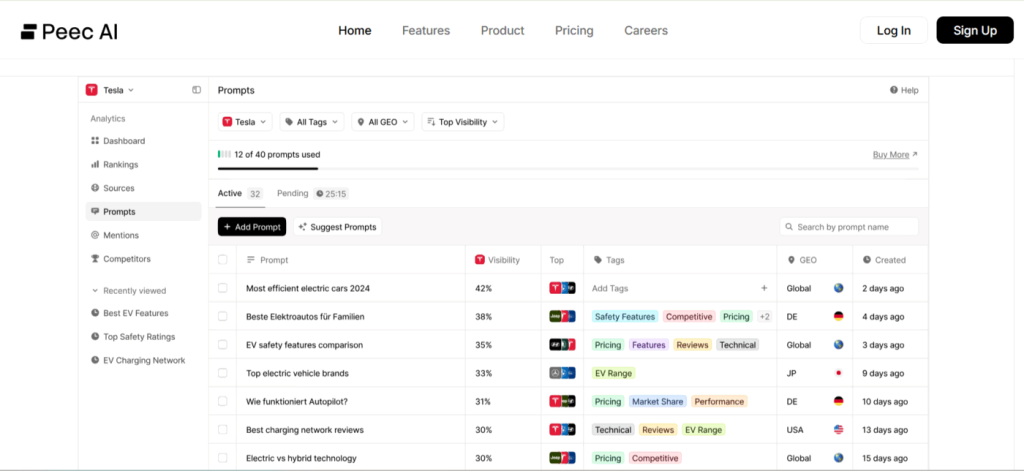
Peec AI is a specialized GEO analytics platform designed to give marketing teams clear, prompt-level visibility into generative search engines. It directly addresses the core question of modern AI search: “When, where, and how often is my brand cited in AI answers?” Moving into 2026, its strength lies in providing platform-agnostic analytics, tracking mentions across ChatGPT, Gemini, Perplexity, and other LLMs without bias. It transforms guesswork into actionable data, showing not just if you appear, but the exact user prompts that trigger your citations and those of your competitors.
Best Features
Prompt-Level Brand Tracking: See your brand’s appearance in AI search results tied directly to the specific questions users ask. This allows for strategic content optimization based on real query data.
Competitor Benchmarking: Compare your AI visibility performance side-by-side with direct competitors across multiple AI models to identify content gaps and opportunities.
Real-Time Alerts: Get notified immediately when your brand enters or drops out of AI-generated responses for critical prompts, enabling rapid strategy adjustments.
Comprehensive Data Export: Download all visibility and prompt data via CSV or API to integrate insights into existing dashboards and analytics platforms.
Limitations
The platform is primarily an analytics and tracking tool. It does not provide direct, actionable recommendations for on-page optimization, schema markup, or citation improvement, leaving the strategic implementation to the user.
As a focused GEO tool, it lacks the broad suite of traditional SEO features (like backlink analysis or technical site audits) that full-platform suites offer.
Pricing
Peec AI operates on custom pricing based on the scale of tracking (number of brands, competitors, and prompts monitored). Prospective users must contact their sales team for a quote. This model typically suits mid-market to enterprise teams with dedicated GEO budgets.
Ratings and Reviews
While established review platforms like G2 and Capterra show insufficient volume for a formal score as of late 2025, user sentiment in professional marketing communities highlights its effectiveness. Users praise its fast setup and immediate, clear insights into AI mention tracking, specifically valuing the ability to see which URLs are being cited by LLMs.
2. BrightEdge

BrightEdge is an enterprise-grade AI-powered search intelligence platform. It goes beyond GEO to encompass the entire digital visibility lifecycle, from keyword discovery and page optimization to rank tracking and performance reporting. Its GEO capabilities, particularly through BrightEdge Insights, analyze billions of data points to surface trends and content opportunities shaped by AI search behavior. For large organizations in 2026, it acts as a centralized command center for unifying traditional SEO and GEO strategy at scale.
Best Features
ContentIQ for Site Health: Automatically audits site health at scale to detect critical technical SEO issues that can hinder both search engine and AI crawler accessibility.
BrightEdge Copilot: An AI assistant that generates optimized metadata, titles, and descriptions based on real-time search and intent data.
AI-Powered Storybuilder: Creates custom, one-click performance dashboards for stakeholders, visualizing data for program performance, the buyer’s journey, and competitive landscapes.
AI Intent Insights: Uncovers high-impact content opportunities by analyzing patterns in search intent and engagement data influenced by generative AI answers.
Limitations
Its primary GEO tracking focus has been on Google’s AI Overviews (SGE). Support for deep tracking across other major AI engines like ChatGPT, Perplexity, or Gemini is less comprehensive compared to specialized GEO-only tools.
The platform’s vast scope and enterprise focus can lead to a steeper learning curve and higher cost, making it less accessible for small businesses or solo practitioners.
Pricing
BrightEdge uses custom enterprise pricing. Costs are tailored to the size of the website(s), search volume, and required feature suites (including GEO modules). It is a significant investment aimed at large enterprises and complex digital ecosystems.
Ratings and Reviews
G2 Rating: 4.4/5 (Based on 690+ reviews)
Capterra Rating: 4.1/5 (Based on 40+ reviews)
Reviews consistently praise its depth of data and powerful insights. A common theme among users is its effectiveness for large-scale operations, though some note the complexity and desire for more intuitive navigation within the extensive feature set.
3. Conductor

Conductor is a unified content and website intelligence platform that has integrated AI deeply into its core workflow. While it originated as an SEO optimization platform, Conductor AI now helps teams automate content brief generation, on-page optimization, and trend discovery. For GEO, its strength in 2026 is helping brands create the high-quality, topically authoritative, and well-structured content that both search engines and AI models prioritize. It excels at ensuring your foundational content is “AI-ready.”
Best Features
AI Topic Map: Intelligently clusters content by topical authority and visually maps where strategic content is missing, guiding a GEO-friendly content strategy.
AI Search Performance Tracking: Monitors brand mentions and citations within AI-generated responses, providing insight into brand perception in this new space.
ContentProfiles: A centralized hub to store brand voice, tone, product information, and compliance guidelines, ensuring all AI-assisted content generation remains on-brand.
Natural Language Search: Allows users to ask plain-language questions about their search performance and receive instant, analyzed insights from the platform’s data.
Limitations
The platform is optimized for content quality and search performance but does not specialize in the behavioral logic of specific LLMs. It offers fewer tools for direct prompt-level tracking or optimization for platforms like ChatGPT.
Its recommendations are broad and aimed at general search excellence rather than providing tactical GEO-specific actions for different AI engines.
Pricing
Conductor is offered on a custom pricing model based on the number of tracked keywords, website size, and required platform seats. It is positioned as an enterprise and agency-level solution.
Ratings and Reviews
G2 Rating: 4.5/5 (Based on 450+ reviews)
Capterra Rating: 4.4/5 (Based on 30+ reviews)
Users frequently commend its clean interface, comprehensive data, and the actionable nature of its optimization recommendations. It is particularly valued by content teams and agencies for streamlining the content strategy and production process.
4. Otterly.AI

Otterly.AI is a purpose-built AI search engine optimization tool focused on delivering prompt-level intelligence. Its core mission is to track and improve your brand’s visibility across the generative AI landscape. A standout feature for 2026 is its Brand Visibility Index, a proprietary metric that scores your presence across ChatGPT, Perplexity, Gemini, and Claude. It provides clear metrics on whether you’re being directly linked or paraphrased, offering a clear picture of your brand’s AI authority.
Best Features
Multi-Engine Mention Tracking: Monitors brand appearances across all leading AI platforms from a single dashboard, complete with ranking position and prompt context.
Link Citation Analysis: Differentiates between direct links (high-value citations) and paraphrased mentions, giving insight into the quality of your AI visibility.
Domain Ranking & Analytics: Benchmarks your website’s performance against competitors specifically within AI-generated responses, tracking movement over time.
Sentiment & Keyword Prompt Analysis: Reveals the tone of AI citations and identifies the exact keyword prompts that trigger your brand’s mentions.
Limitations
As a specialized tool, its primary function is tracking and reporting. It provides the “what” and “where” but leaves the strategic “how to fix it” largely in the user’s hands.
It may not include the broader technical SEO or content creation tools that some teams need for a fully integrated strategy.
Pricing
Otterly.AI adopts a transparent, tiered subscription model.
Starter Plan: Begins at $29 per month, suitable for individual professionals or small brands.
Higher-tier plans (Professional, Business) with increased tracking capacities and features are available at custom price points, scaling for agencies and larger enterprises.
Ratings and Reviews
While broader review aggregators are still catching up to this niche tool, user feedback indicates high satisfaction with its specialized focus and actionable GEO data. Users appreciate the straightforward dashboard and the unique insights into citation quality, which are not typically provided by general SEO platforms.
5. Semrush

Semrush is a dominant, all-in-one digital marketing suite that has successfully integrated GEO capabilities into its extensive toolkit. For SEO teams in 2026, it offers a powerful advantage: the ability to manage traditional search and generative AI visibility from a single, familiar platform. Its GEO features, like AI Answer Tracking, allow users to monitor brand rankings within ChatGPT and Perplexity answers, effectively bridging the gap between classic keyword rankings and modern prompt-based visibility.
Best Features
Integrated AI Answer Tracking: Monitor your website’s appearance in ChatGPT and Perplexity AI answers directly alongside your standard SERP rankings, providing a unified view of search performance.
Prompt Sentiment Analysis: Gain insight into the context of your AI mentions by analyzing whether the sentiment of the prompt that triggered your citation is positive, neutral, or negative.
Comprehensive SEO Toolkit: Leverage a full suite of established tools—including keyword research, site auditing, backlink analysis, and content optimization—to build a foundational SEO strategy that supports GEO success.
Position Tracking & Analytics: Compare performance trends over time with detailed historical data and visualize your visibility across both organic and AI search channels.
Limitations
Its GEO features are an add-on within a vast platform. They may not offer the same depth of specialized, prompt-level intelligence (like detailed competitor citation analysis across multiple AI models) as dedicated GEO-only tools.
The extensive feature set can be overwhelming for new users whose primary goal is straightforward AI tracking, and the cost to access premium features is significant.
Pricing
Semrush operates on a tiered per-user subscription model. Access to its core SEO toolkit, which includes basic position tracking, starts with the Pro plan at $129.95 per month. However, advanced features like the AI Answer Tracking are included in the higher-tier Guru plan, which costs $249.95 per month. Custom enterprise solutions are also available.
Ratings and Reviews
G2 Rating: 4.5/5 (Based on 6,000+ reviews)
Capterra Rating: 4.7/5 (Based on 1,200+ reviews)
Reviews consistently praise Semrush for being an “industry standard” and an “all-in-one powerhouse.” Users value the breadth of data, though some note that the complexity and price point make it most suitable for serious marketing professionals and agencies.
6. Scrunch AI

Scrunch AI is a focused platform designed for AI-powered brand monitoring and reputation tracking. It caters specifically to marketers and PR professionals who need to understand their brand’s narrative within generative AI outputs. Rather than offering broad SEO metrics, Scrunch AI excels at tracking brand mentions, key personnel, product names, and slogans across AI chatbots and search engines, providing a clear lens on brand health in the age of conversational AI.
Best Features
Automated Brand & Keyword Monitoring: Set up continuous tracking for specific brand terms, executives’ names, or campaign slogans across major AI platforms to receive alerts for new mentions.
AI-Specific Scoring & Metrics: Utilize proprietary scores that rate your brand’s visibility and authority within AI-generated text, offering a quick health check.
Automated CSV Exports: Easily export mention data for further analysis in spreadsheets or for inclusion in client reports and presentations.
Centralized Dashboard: View all AI mentions, sentiment trends, and visibility scores from a single, clean interface designed for quick daily reviews.
Limitations
The tool is specialized for brand monitoring and does not provide broader SEO or content optimization functionalities. It tells you “if” and “how” you are mentioned, but not necessarily how to improve your underlying content for better citations.
It is primarily an alerting and reporting system, with limited strategic recommendations for proactive GEO content creation.
Pricing
Scrunch AI adopts a premium subscription model aimed at professional teams. Pricing starts at $300 per month, scaling upward based on the number of tracking keywords, brands, and the required volume of AI queries processed.
Ratings and Reviews
As a specialized tool in a emerging niche, Scrunch AI does not yet have a high volume of reviews on major aggregator sites. Feedback from early adopters in marketing circles highlights its effectiveness for filling a critical gap in brand monitoring suites, which have traditionally focused on social media and news, not AI chatbots.
7. AthenaHQ

AthenaHQ is a dedicated Generative Engine Optimization platform built from the ground up for technical SEOs and marketers aiming to dominate AI search. It provides deep-lift analytics that go beyond surface-level tracking, focusing on understanding “why” your content is or isn’t being cited. For mid-to-large brands scaling a sophisticated GEO strategy in 2026, it offers features like sentiment mapping, unknown competitor detection, and direct insights into AI crawler behavior.
Best Features
GEO-Focused Action Center: Receives prioritized, actionable recommendations—not just data—on how to improve content, site structure, and markup to increase AI visibility.
Advanced Sentiment & Competitor Tracking: Maps the sentiment of AI citations over time and identifies not just known competitors, but also emerging domains that are winning visibility for your target prompts.
Prompt Volume & Trend Control: Allows users to filter and analyze data based on the estimated monthly volume of specific prompts, helping prioritize high-opportunity queries.
AI Crawler Insights: Provides a technical view of how AI bots from OpenAI, Google, etc., crawl and interpret your website, highlighting potential ingestion blockers.
Limitations
The platform’s depth and specialized focus come with a steeper learning curve and a higher price point, making it less accessible for solopreneurs or very small teams.
It is a strategic GEO platform, not a general SEO tool. Users will need complementary solutions for other aspects of their digital marketing stack.
Pricing
AthenaHQ is positioned as a professional-grade tool. Subscription plans start at $295 per month, with costs increasing based on the number of tracked domains, keywords (prompts), and the depth of required analytics.
Ratings and Reviews
While still building its profile on large review sites, AthenaHQ is recognized within advanced SEO communities for its technical depth and data granularity. Users who have adopted it appreciate its focus on moving from analytics to action, a step many pure tracking tools miss.
8. Rankscale

Rankscale offers a unique, credit-based approach to GEO tracking designed for flexibility and granular data access. Instead of rigid monthly plans for a set number of keywords, users purchase credits to run specific tracking queries across AI models. This model is particularly appealing to agencies, consultants, and in-house teams who need deep, query-level intelligence for specific campaigns or clients without a constant, high-volume monitoring commitment.
Best Features
Pay-As-You-Go Credit System: Purchase credits and use them to track brand visibility for specific prompts across ChatGPT, Perplexity, and Gemini. This allows for highly targeted, cost-effective campaigns.
Granular Prompt-Level Data: Get detailed results for each query run, including ranking position, the exact AI response text, and cited sources.
Unknown Competitor Detection: The system can reveal domains you may not have considered as competitors that are consistently winning visibility in AI answers for your niche.
AI Crawler Insights Reports: Understand how different AI bots render and interpret your web pages, providing actionable technical guidance for optimization.
Limitations
The credit-based system requires active management and strategic planning of queries. It is not designed for “set-and-forget” monitoring of a broad keyword portfolio, which may be a need for some brands.
It functions primarily as a data and insights provider rather than a full workflow platform with content optimization tools or integrated dashboards.
Pricing
Rankscale’s entry-level plan starts at $20 per month, which includes a base number of credits. Additional credit packs can be purchased as needed. This flexible model makes advanced GEO analytics accessible at a lower entry point than many flat-fee enterprise platforms.
Ratings and Reviews
As a newer and highly specialized tool, widespread public reviews are limited. However, its flexible pricing and focused data offering have gained positive attention from technical SEOs and digital agencies who value precise control over their data queries and costs.
9. Mangools AI Search Grader

Mangools AI Search Grader is an accessible, entry-level tool designed to demystify GEO for small businesses, bloggers, and SEO beginners. Part of the popular Mangools SEO suite, it provides a straightforward AI Search Score that rates your content’s visibility across multiple AI models, including GPT-4o, Gemini, DeepSeek, and Perplexity. It serves as a practical starting point for anyone asking, “How does my site currently perform in AI search?” without requiring a deep technical or financial commitment.
Best Features
Unified AI Search Score: Receive a single, easy-to-understand percentage score that aggregates your visibility performance across four major AI engines, offering a quick health check.
Multi-Model Insight Breakdown: View performance details for each individual AI model (e.g., your rank in ChatGPT vs. Perplexity) to identify platform-specific strengths or weaknesses.
Basic Prompt Tracking: Analyze which specific user prompts or questions trigger your website’s appearance in the AI answers, providing initial direction for content optimization.
Integration with Mangools Suite: Seamlessly use the grader alongside other Mangools tools like KWFinder for keyword research and SERPChecker for traditional SEO analysis.
Limitations
The tool offers a high-level overview rather than deep, granular analytics. It lacks advanced features like sentiment analysis, competitor benchmarking, or detailed citation tracking.
It is designed for awareness and initial diagnosis, not for ongoing, enterprise-level GEO campaign management or strategic content planning.
Pricing
Mangools AI Search Grader is included in all paid Mangools subscriptions. The suite’s pricing starts at $24.50 per month (billed annually) for the “Basic” plan, which includes access to the grader alongside 5 core SEO tools. A 10-day free trial with full functionality is available.
Ratings and Reviews
As a relatively new feature within an established suite, specific reviews for the AI Search Grader are limited. However, the broader Mangools suite is highly rated for its user-friendliness and value. On G2, the overall suite holds a 4.7/5 score, with users frequently praising its intuitive interface and cost-effectiveness for freelancers and small teams.
10. Profound

Profound positions itself as a deep GEO analytics and research platform for data-driven enterprises. It moves beyond tracking to offer a “Conversation Explorer” that analyzes the structure and logic of AI-generated dialogues. This is crucial for brands in 2026 that need to understand not just if they are cited, but the narrative context of entire AI conversations about their industry, competitors, and products to inform high-level strategy.
Best Features
Conversation Explorer: Deconstructs multi-turn AI dialogues to understand how topics evolve, where brands are introduced, and what sources are trusted, revealing the semantic pathways of AI reasoning.
Advanced Sentiment Mapping: Tracks the emotional tone and context of brand mentions across thousands of AI conversations, providing nuanced reputation intelligence.
Comprehensive Crawler Auditing: Offers detailed reports on how your site is crawled and interpreted by various AI bots, identifying technical barriers to citation.
BI and Data Warehouse Integrations: Built for the enterprise stack, it allows for the export of raw data directly into business intelligence tools like Looker Studio or data warehouses for custom analysis.
Limitations
The platform’s depth and focus on raw data analysis result in a steep learning curve. It is less of a daily dashboard and more of a strategic research tool for analysts.
Its power is in analysis, not automation; it provides profound insights but does not automate content optimization or correction within the platform.
Pricing
Profound operates on a subscription model starting at $99 per month for its core platform access. Enterprise plans with increased query volumes, advanced API access, and dedicated support are offered at custom pricing levels.
Ratings and Reviews
Profound is a specialized platform used primarily by analysts at medium-to-large companies. While it doesn’t have a high volume of public reviews, it is recognized in technical and content strategy circles for providing a unique, conversation-level depth of insight that other tracking tools cannot match.
11. Surfer SEO

Surfer SEO is a data-driven content optimization platform that has successfully integrated GEO signals into its core workflow. Famous for its real-time “Content Editor” that provides NLP (Natural Language Processing) recommendations, Surfer now also analyzes top-ranking pages within AI-generated answers. For content creators and SEOs in 2026, it bridges the gap by helping you write content that satisfies both traditional search engine algorithms and the semantic understanding of Large Language Models.
Best Features
GEO-Enhanced Content Editor: Get real-time writing recommendations based on an analysis of content that ranks well in both traditional SERPs and AI overviews, guiding on-term usage, structure, and depth.
SERP & GEO Analyzer: Analyze the top pages cited by AI for a target keyword to understand common themes, content length, and structural patterns that trigger citations.
Automated Content Audits: Audit existing pages against GEO-friendly criteria to receive prioritized recommendations for updates that can improve AI visibility.
JSON-LD Schema Generator: Easily generate and implement crucial structured data markup (like FAQPage or HowTo) that helps AI crawlers understand and extract content accurately.
Limitations
The tool is fundamentally an optimization assistant for page-level content. It does not offer broad, multi-prompt brand tracking or sentiment analysis across the AI landscape.
Users must have a foundational keyword and content strategy; Surfer optimizes what you create but does not generate high-level topical strategy from scratch.
Pricing
Surfer SEO offers tiered plans based on the number of content audits or “article writes” per month.
The Essential plan starts at $99 per user/month (annual billing) and includes core features for individual creators.
Higher-tier plans (Advanced, Max) offer more capacity and advanced features like competitor gap analysis.
Ratings and Reviews
G2 Rating: 4.8/5 (Based on 1,000+ reviews)
Capterra Rating: 4.9/5 (Based on 200+ reviews)
Surfer is overwhelmingly praised for its direct, actionable recommendations that tangibly improve content quality and ranking potential. Users often note it removes guesswork from on-page SEO and is now valued for its early integration of GEO insights.
12. MarketMuse

MarketMuse is an AI-powered content strategy and intelligence platform that uses advanced topic modeling to help brands build topical authority—a key ranking factor for both SEO and GEO. Instead of tracking individual prompts, it helps you build a comprehensive content library that covers a subject exhaustively, making your site an authoritative source that AI models are compelled to cite. For enterprises with large content inventories, it’s a system for strategic, AI-resilient content planning.
Best Features
AI Topic Modeling & Inventory Scoring: Maps your entire website’s content against an ideal knowledge graph for your domain, scoring each page for comprehensiveness and identifying critical content gaps.
Automated Content Brief Generation: Creates detailed, data-driven briefs that outline the questions, subtopics, and entities a comprehensive article must cover to rank and be cited by AI.
Competitive Gap Explorer: Analyzes the content of competitors who rank for your target topics, showing exactly what they cover that you don’t.
Connect Internal Linking Tool: Automatically suggests intelligent internal links as you write, strengthening site architecture and helping AI crawlers understand contextual relationships.
Limitations
It is a strategic planning and research platform, not a real-time tracker. You won’t monitor daily AI mentions or prompt rankings here.
The platform requires a significant upfront investment in content planning and is most effective when used to guide the creation of many pieces of content over time, not for quick wins.
Pricing
MarketMuse uses a custom enterprise pricing model, typically based on the size of your domain and content inventory. They also offer a free plan with limited features, allowing users to generate basic content briefs and explore the platform’s core concepts.
Ratings and Reviews
G2 Rating: 4.5/5 (Based on 100+ reviews)
Reviews highlight MarketMuse’s unique value in moving beyond keywords to a topic-cluster-based strategy. Enterprise content teams praise its ability to bring systematic rigor to content planning and its effectiveness for large-scale site audits.
13. HubSpot AI Search Grader

HubSpot AI Search Grader is a free, instant diagnostic tool provided by the marketing software giant. It is designed for maximum accessibility, requiring no account, login, or credit card. Simply enter your domain and a target keyword, and it provides a snapshot of your brand’s current visibility and sentiment within AI-generated answers from GPT-4o, Perplexity, and Gemini. It’s the fastest way to get a preliminary answer to “Am I showing up in AI search?”
Best Features
Instant, Frictionless Analysis: Get immediate results without any sign-up process, making it ideal for quick checks, presentations, or initial curiosity.
Brand Sentiment & Share of Voice: See not only if your brand appears but also the sentiment of the mention (Positive, Negative, Neutral) and your “share of voice” percentage among all cited sources for a query.
Multi-Engine Snapshot: Check your performance across three major AI platforms (OpenAI’s ChatGPT, Perplexity, Google’s Gemini) simultaneously in a single report.
Actionable Next Steps: The report includes basic, helpful recommendations for improving your GEO, such as optimizing your “About Us” page or creating more foundational content.
Limitations
By design, it is a static snapshot tool, not a monitoring platform. It cannot track changes over time, alert you to new mentions, or monitor competitors.
The analysis is limited to a single keyword query per report, providing a narrow view rather than a comprehensive brand analysis.
Pricing
The HubSpot AI Search Grader is completely free with no hidden tiers or usage limits.
Ratings and Reviews
As a free tool, it is widely used and appreciated for its simplicity and utility. While not formally rated on software review sites, it is frequently recommended in marketing blogs and social media as the first step anyone should take when beginning to explore their brand’s GEO performance. Users value the immediate, actionable data it provides at zero cost.
Read More: 18 Brainstorming Techniques To Spark Creative Ideas
The Common User Scenarios to Help You Decide Quickly
The table below matches tools to common user scenarios to help you decide quickly.
| Your Profile & Goal | Recommended Tool(s) | Primary Reason |
|---|---|---|
| Solo Creator / Small Business on a tight budget, wanting a free check. | HubSpot AI Search Grader | Instant, free snapshot of AI visibility. |
| SEO Beginner / Freelancer needing an affordable all-in-one SEO suite with basic GEO insights. | Mangools (with AI Search Grader) | Cost-effective bundle of core SEO tools + GEO grader. |
| Content Creator / SEO Specialist focused on writing AI-optimized content. | Surfer SEO | Real-time editor optimized for both SEO and GEO content. |
| Marketing Team / Agency needing dedicated, multi-engine brand tracking and mention alerts. | Otterly.AI or Peec AI | Specialized, prompt-level tracking across all major AI models. |
| Enterprise SEO Team requiring a unified platform that scales traditional SEO with AI insights. | Semrush, BrightEdge, or Conductor | Combines deep SEO intelligence with integrated GEO tracking. |
| Data Analyst / Strategist needing deep conversational analysis and raw data for BI tools. | Profound | Explores the “why” behind AI conversations with enterprise integrations. |
| Brand & PR Team focused exclusively on monitoring brand reputation within AI outputs. | Scrunch AI | Automated tracking of brand, executives, and slogans in AI chat. |
How to Choose: Three Key Questions
To move from scenarios to a final decision, answer these questions:
What is my main objective?
Awareness & Quick Check: Use HubSpot’s free grader.
Content Creation & Optimization: Choose Surfer SEO or MarketMuse.
Monitoring & Tracking: Pick Otterly.AI, Peec AI, or Scrunch AI.
Enterprise Strategy & Scale: Opt for Semrush, BrightEdge, or Conductor.
What is my budget?
$0: Start with HubSpot AI Search Grader.
$20 – $100/month: Explore Rankscale (flexible credits), Mangools, or Otterly.AI.
$100+/month: Consider Surfer SEO, Profound, or AthenaHQ for deeper features.
Enterprise Investment ($$$): Evaluate Semrush, BrightEdge, Conductor, or MarketMuse (custom pricing).
How do I want to use the tool?
Integrated Workflow: If you want GEO within your existing SEO platform, choose Semrush or your current suite’s add-on.
Standalone Specialist Tool: If you need best-in-class, dedicated GEO analytics, choose Peec AI, AthenaHQ, or Profound.
For a final shortlist, identify your profile and goal from the table, then test the recommended tool’s free trial or demo to see if its interface and data meet your needs.
Read More: 12 Best No-Code Tools for Product Managers in 2026
FAQs for The AI Tools for Generative Engine Optimization (GEO) in 2026
1. What’s the core difference between SEO and GEO?
SEO (Search Engine Optimization) focuses on optimizing content and websites to rank highly on traditional search engine results pages (SERPs), like Google’s list of blue links. Success is measured by organic traffic and click-through rates.
GEO (Generative Engine Optimization) focuses on optimizing content to be selected, cited, and summarized by AI models (like ChatGPT, Gemini) in their generated answers. Success is measured by citation frequency, accuracy, and sentiment within the AI’s response itself, often with zero clicks back to your site.
2. Why is GEO suddenly important in 2026?
The importance has accelerated due to widespread user adoption. With over 40% of users now regularly using AI for search and major search engines integrating AI Overviews directly into results, a significant portion of information discovery happens without visiting websites. If your brand is absent or poorly represented in these AI answers, you become invisible to a growing segment of your audience, regardless of your traditional SEO rank.
3. Do I need a separate GEO tool, or can my existing SEO suite handle it?
It depends on your existing suite and needs. Major all-in-one platforms like Semrush, BrightEdge, and Conductor are rapidly adding GEO modules (e.g., AI Answer Tracking). These are excellent for a unified view if you already use them. However, dedicated GEO tools like Peec AI, Otterly.AI, or AthenaHQ typically offer deeper, more specialized analytics—such as multi-model sentiment tracking or conversation mapping—that broader suites may not yet match. For advanced GEO strategy, a dedicated tool or add-on is often necessary.
4. How much does it cost to get started with GEO?
Costs vary widely:
Free Diagnostic: Start with HubSpot AI Search Grader.
Low-Cost Entry ($20-$50/month): Use Rankscale’s credit-based tracking or the Mangools suite, which includes an AI grader.
Professional Tier ($100-$300/month): Tools like Surfer SEO (for content) or Otterly.AI/AthenaHQ (for tracking) fit here.
Enterprise Investment (Custom Pricing, $$$): Solutions like Semrush, MarketMuse, BrightEdge, or Profound require custom quotes but offer scale and integration.
5. Can I do GEO without any technical knowledge?
Yes, to an extent. Tools like Mangools AI Search Grader and HubSpot’s grader are designed for ease of use, providing simple scores and snapshots. However, to act on the insights—such as optimizing technical schema, restructuring content for AI comprehension, or analyzing crawler data—a foundational understanding of SEO principles and content strategy becomes essential.
6. How do I measure the success of my GEO efforts?
Success metrics differ from traditional SEO:
Primary GEO KPIs: Citation Rate (how often you’re mentioned), Share of Voice (your mentions vs. competitors’), Citation Sentiment (positive/neutral/negative), and Answer Position (e.g., “source #1” in the AI’s summary).
Secondary/Business Impact: While the goal is often zero-click brand visibility, monitor downstream effects like branded search traffic increases, direct website visits, and mention lift in other channels as AI-driven brand awareness grows.
7. What’s the most common mistake beginners make with GEO?
The most common mistake is prioritizing AI visibility over foundational E-E-A-T (Experience, Expertise, Authoritativeness, Trustworthiness). AI models are trained to prioritize authoritative, trustworthy sources. A weak, thin website attempting to “trick” AI with optimized phrasing will fail. The winning strategy is to first build robust topical authority with high-quality content, then use GEO tools to ensure that authority is properly communicated and cited by AI.