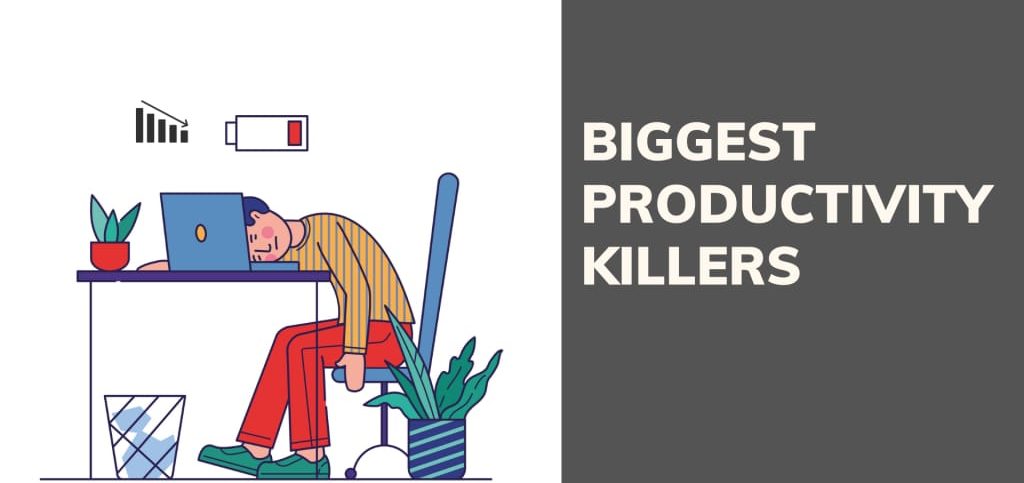
In our fast-moving world, productivity doesn’t depend only on eliminating obvious distractions like social-media or ambient noise. Some of the most potent obstacles to getting meaningful work done come from within—from our mindset, habits, and interactions. Understanding and dismantling these internal productivity killers can unlock far more than just “doing more” — it can mean doing better, with less stress and more autonomy.
In this article, we’ll explore five key internal productivity killers: self-doubt, perfectionism, weak boundaries, denial and poor self-accountability. For each one we’ll examine (a) how it works, (b) why it damages productivity, and (c) concrete strategies to overcome it.
1. Self-Doubt
How It Works
Self-doubt is that internal voice that asks: “Am I good enough?” “Will I succeed?” “Maybe I should wait until I’m more ready.” It may masquerade as caution or “planning”, but the effect is that you don’t move—or you move very slowly. The original article describes self-doubt as “the calls that come from inside the house”.
When you doubt your capability, you often delay action: you research more, you prepare more, you review more—but you don’t start. And each moment of delay feeds the doubt: “See, I wasn’t ready yet, so I better wait some more.”
Why It Kills Productivity
-
Time gets eaten by preparation instead of execution. You may feel busy, but the progress is minimal.
-
When you don’t start tasks, momentum is lost and the “task inertia” grows heavier.
-
Opportunities slip by: you might wait for the “perfect time” or the “right moment” which doesn’t arrive.
-
Emotional energy is degraded: self-doubt drains confidence, resulting in slower decision-making and more second-guessing.
Strategies to Overcome Self-Doubt
-
Just start: The most powerful antidote is movement. It doesn’t require full certainty—just taking the first step. The article puts it succinctly: “You don’t have to believe you’re invincible, you just have to do it.”
-
Break tasks into small, manageable pieces: If a project feels overwhelming, divide it into mini-tasks. Completing a small piece builds confidence and reduces the fear barrier.
-
Seek input early: If you’re unsure, ask a peer, mentor or colleague—external viewpoints reduce self-doubt and keep you accountable.
-
Reframe mistakes as learning: Rather than seeing “I might fail” as a stop sign, treat it as “What can I learn if this goes wrong?”
-
Create visible evidence of progress: Maintain a log of achievements—even small ones. When you look back at what you’ve done, self-doubt has less ammo.
Example in Practice
Suppose you need to write a long report but feel unsure where to begin. Instead of waiting until you’re “ready”, schedule 30 minutes today to sketch an outline. That moves you into action, reduces the unknown, and gives you something concrete to build on. Tomorrow you refine it, then write a section. Over time the initial self-doubt fades because you’ve created visible momentum.
2. Perfectionism
How It Works
Perfectionism presents itself as a desire to “do it right”, to “get every detail perfect” before moving ahead. It may seem like a virtue—but in practice, it often becomes a blocker. As the original article notes: perfectionism “masquerades as excellence” while it actually slows you down.
When you are perfectionist, you might revise endlessly, re-check details, polish until it’s just “one more edit” away. Meanwhile, the broader work remains undone.
Why It Kills Productivity
-
Time-cost vs. outcome gets out of proportion: You spend hours tweaking something that may not substantially benefit from the extra time.
-
You delay launching, finishing, or moving to the next phase because “it’s not perfect yet”.
-
Opportunity cost: Time spent perfecting one thing may mean other tasks, projects or opportunities are delayed.
-
It often creates anxiety: the belief that anything less than perfect equals failure means you carry extra emotional load, which slows mental focus.
Strategies to Tame Perfectionism
-
Define “good enough”: Set criteria in advance for when a task is complete. Ask: “What level of quality will satisfy the objective?” Then aim for that, not “flawless”.
-
Embrace iteration: Accept that you can release a first version and improve later. This supports momentum and allows feedback.
-
Prioritise high-impact over high-detail: Ask: “Will this extra hour in detail lead to a meaningful difference?” If not, stop.
-
Set deadlines: Finite deadlines force decision-making and prevent endless revision loops.
-
Celebrate progress, not perfection: Focus on finishing rather than perfecting. Small wins build forward motion.
Example in Practice
Suppose you’re preparing a client presentation. Instead of tweaking fonts, colour shades, and transitions infinitely, decide that after two hours your slide deck will be 90% ready, allow 15 minutes for review, then send it. That way you release on time, get feedback, adjust as needed, rather than pushing endlessly.
3. Poor Boundaries
How It Works
Poor boundaries refer to unclear or weak limits between tasks, time, energy and demands—whether from others or from yourself. This can show up as: saying “yes” to everything, letting interruptions constantly break your workflow, or failing to differentiate between work time and personal time. The article emphasises how lack of boundaries leads to diluted focus.
In today’s work-culture (especially remote or blended work), the boundaries blur easily and work expands to fill whatever space is allowed.
Why It Kills Productivity
-
Without clear boundaries you end up multitasking, switching contexts, and fragmenting your focus—which dramatically reduces output and quality.
-
“Yes” overload: by taking on too many commitments you spread yourself thin and can’t do any one task with full attention.
-
You lose control of your schedule: interruptions and demands from others become the default, not your tasks or priorities.
-
Mental fatigue: frequent context switching and lack of rest degrade cognitive performance.
Strategies to Strengthen Boundaries
-
Decide your top priorities first: Know what tasks matter most and what you will commit to for the day or week.
-
Communicate your availability and limits: At work and at home, let others know when you are focused, when you’re unavailable, and what you will commit to.
-
Schedule undisturbed blocks: Use calendar blocks for “deep work” where you minimize interruptions and external demands.
-
Learn to say no (or “not now”): It’s okay to decline or defer requests that don’t align with your current focus or capacity.
-
Designate “off” time: Protect periods where you are not working—this mental rest supports long-term productivity.
Example in Practice
Imagine you’re working from home, and family members keep interrupting while you’re on a big task. Set a rule: From 10:00 to 12:00 you’ll work in “do not disturb” mode, with a sign on your door or headphones on. Let family know you’ll be free from 12:00–12:30. After 12:00 you can engage, but during your block you’re off-limits. This structured boundary allows you to focus when needed.
4. Denial
How It Works
Denial is the internal narrative that says: “I’ll do it later.” “I’ve got plenty of time.” “It’ll sort itself out.” It downplays the urgency or significance of starting, continuing, or finishing a task. The article identifies it as a major productivity killer because it precedes procrastination.
You might tell yourself there’s still room, or you’ll feel like working later, or the circumstances will align—so you delay acting now.
Why It Kills Productivity
-
It leads to procrastination: By denying how long or how difficult a task is, you delay starting until the pressure is high, quality drops.
-
It causes time mis-estimation: Underestimating required effort or overestimating spare time leads to rushed work or missed deadlines.
-
It erodes self-trust: When you repeatedly say “later” and fail to deliver, you undermine your own commitments and set the stage for future denial.
-
Stress builds: The gap between “I should have started earlier” and “I now must finish under pressure” creates stress and lowers output quality.
Strategies to Overcome Denial
-
Flip the question: Instead of “When will I start?” ask “If I don’t start now, what will I lose?” That sense of risk breaks denial.
-
Estimate realistically: Write down how long a task will take, when it must be done, and back-schedule your start.
-
Schedule the first action today: Make an appointment with yourself—today, not tomorrow. The article says: “Schedule it now.”
-
Reflect on past outcomes: Recall tasks you delayed and suffered for it. Use that memory as motivation to act sooner.
-
Treat small starts as victories: Even if you don’t finish the giant task today, if you start it you’ve shifted out of the denial zone.
Example in Practice
You have to prepare an annual review for your team in two weeks, but you keep saying “I’ll start next Monday.” Instead, you open the document today for 15 minutes, outline the key headings. That small action ensures you don’t fall into “I’ll do it later” mode, and you’ve started breaking denial.
5. Poor Self-Accountability
How It Works
Self-accountability is about owning your tasks, your time, your commitments—and holding yourself to them. When this is weak or missing, you drift: you don’t finish tasks, you don’t adhere to your schedule, you attribute delays to external factors rather than your choices. The article puts it simply: without accountability, progress stalls.
It’s the moment when you stop being the captain of your progress and become a passenger hoping things will happen.
Why It Kills Productivity
-
Without clear ownership, tasks linger unfinished or half-done.
-
You rely on externals (bosses, clients, colleagues) to keep you on track rather than your own drive.
-
Blame shifts outward (“I was interrupted”, “I got too busy”) rather than inward (“What could I have done differently?”) and therefore improvement doesn’t occur.
-
Lack of clarity: If you don’t set specific outcomes and deadlines, you don’t know when you’re done; you might keep tinkering or forgetting the task altogether.
Strategies to Build Self-Accountability
-
Define clear deliverables: For each task ask: What am I producing? By when? How will I know it’s done?
-
Break large goals into subtasks: Big goals overwhelm; small steps make accountability manageable.
-
Track progress visibly: Maintain a log, use a simple checklist, or review daily: What did I do today toward this goal?
-
Externalize accountability: Tell a friend, colleague or mentor what you’ll commit to and ask them to check in. External pressure helps.
-
Review failures as data: When you don’t meet a commitment, don’t just shrug. Ask: Why not? What do I adjust? This reflection builds accountability muscle.
-
Reward completions: Finishing matters. Celebrating even a small task done reinforces the behaviour of seeing things through.
Example in Practice
Say you plan to publish a monthly article. Define the outcome: “Write, edit, and publish by the 25th of each month.” Set subtasks: research (15th–17th), first draft (18th–21st), review (22nd) and publish (25th). Mark them in a checklist. Ask a colleague to remind you on the 18th. At the end of the month review: Did I meet deadlines? Why/why not? What changes next month? This kind of process builds accountability and improves consistency.
Integrating the Five: A Unified Framework
These productivity killers don’t act in isolation—they often intertwine. For instance:
-
Self-doubt may cause you to delay, which leads to denial (“I’ll start later”), which weakens accountability because you don’t own the start.
-
Perfectionism may make you refuse to release work until “perfect”, which creates self-doubt (“Is it good enough?”), and suggests weak boundaries (“I’ll keep working late to get it right”) and ends in lost accountability.
-
Poor boundaries let constant interruptions—these reduce focus, make you say “I’ll get to it later” (denial) and weaken your ability to hold yourself to commitments.
Understanding how these factors overlap helps you address them more effectively: tackling one also influences the others.
A Practical Weekly Framework
Here’s one way to implement change across the five areas in a structured way:
-
Pick one focus area this week (e.g., “I will build stronger boundaries”).
-
Specify one measurable goal (e.g., “Between 9–11 am each weekday I will work without interruptions on my priority task”).
-
Define your “done” criteria (e.g., “I will complete Task A by Friday 11 am”) – accountability.
-
Schedule the initial action (e.g., “Today 9:00–9:15 I will outline Task A steps”) – avoid denial.
-
Check for perfectionist traps: Ask yourself daily: “Is the time I’m spending yielding proportional return?”
-
At end-of-day reflection: What got in the way? Did self-doubt arise? Did I uphold the boundary?
-
At end of week review: What changed? What will I adjust next week?
By iterating weekly, you gradually build habits that shift you from reactive to proactive, from distracted to focused, and from stuck to progressing.
Why This Matters
Beyond simply “doing more”, this approach is about:
-
Working with clarity: You know which tasks matter, you start them, you finish them.
-
Managing your internal world: Productivity isn’t just external (distractions, tools) but also internal (mindset, habits).
-
Building sustainable output: Instead of bursts of frantic work, you adopt rhythms of start-commit-finish that build over time.
-
Improving well-being: Less self-doubt, less over-commitment, clearer boundaries and greater accountability lead to less stress, smoother focus and higher satisfaction.
-
Creating agency: You become the driver of your productivity instead of its victim.
Common Pitfalls & How to Avoid Them
-
“I’ll fix all five at once” → Too ambitious. Focus on one small change at a time.
-
“I’ll wait until I’m ready” → Delay is denial. Action beats readiness.
-
“I’ll just be more motivated tomorrow” → Motivation fluctuates; rely on systems and commitments.
-
“I need perfect systems” → Perfectionism again. Start simple, refine later.
-
“I’ll hold myself accountable in my head” → External check-ins and visible tracking help more than vague intentions.
Best Productivity Tool to Avoid Them
While self-awareness and discipline are crucial to overcoming productivity killers, having the right tool can make a world of difference. One of the most effective platforms designed to help individuals and teams defeat these hidden productivity traps is Corexta.
Why Corexta Helps You Conquer Productivity Killers
Corexta is an all-in-one productivity and project management solution that empowers professionals to stay organized, focused, and accountable. It integrates the essential elements of planning, tracking, communication, and performance analytics into a single intuitive workspace—reducing clutter, confusion, and wasted time.
Here’s how Corexta helps you tackle each productivity killer discussed above:
1. Defeat Self-Doubt with Clear Visibility
When self-doubt arises, it often stems from uncertainty about progress. Corexta eliminates that ambiguity by providing real-time task visibility—you always know what’s done, what’s pending, and what’s next.
-
Break large projects into manageable tasks.
-
Visualize progress with Kanban boards and checklists.
-
Track achievements to reinforce confidence and momentum.
With everything organized in one place, you see tangible results daily—boosting confidence and reducing hesitation.
2. Tame Perfectionism with Structure and Deadlines
Corexta enables you to set deadlines and define deliverables, so you don’t fall into the trap of endless tweaking.
-
Assign due dates and automated reminders to tasks.
-
Use progress dashboards to monitor completion rather than perfection.
-
Collaborate with peers to get feedback early, reducing over-polishing.
By making “done” measurable, Corexta helps you close loops efficiently and avoid getting trapped in perfectionist cycles.
3. Strengthen Boundaries with Smart Scheduling
Weak boundaries often come from poor planning and lack of visibility into workloads. Corexta’s smart calendar and workload management tools make it easy to protect your time.
-
Schedule focus blocks and meetings directly inside the app.
-
Balance team workloads to avoid burnout or overload.
-
Integrate with communication tools to streamline collaboration.
By centralizing your schedule and notifications, Corexta ensures you’re not constantly switching between apps or saying “yes” to everything.
4. Overcome Denial with Automated Accountability
Denial thrives when we lose track of what’s urgent or assume “there’s still time.” Corexta combats this by keeping priorities visible and automatically tracking deadlines.
-
Prioritize tasks with visual urgency indicators.
-
Receive alerts for overdue items.
-
Review weekly progress reports that show what’s on track and what’s slipping.
These built-in accountability systems make procrastination harder—because your goals, tasks, and timelines are always front and center.
5. Build Self-Accountability Through Insights
Corexta’s analytics and reporting tools help you take ownership of your productivity patterns.
-
Track personal and team productivity metrics.
-
Identify bottlenecks and recurring delays.
-
Set custom performance goals and monitor your progress.
Self-accountability becomes natural when you have transparent metrics that show how your time is spent and where improvements are needed.
Why Choose Corexta?
Unlike basic to-do lists or standalone time trackers, Corexta delivers a holistic productivity ecosystem—one that blends project management, collaboration, analytics, and automation.
It empowers both individuals and teams to:
-
Focus on high-impact tasks.
-
Maintain balance through better boundaries.
-
Grow confidence with visible progress.
-
Stay aligned and accountable without micromanagement.
Corexta doesn’t just help you organize your work—it helps you redefine how you work, freeing you from the silent productivity killers that hold you back. Beating productivity killers isn’t about working harder—it’s about working smarter. By combining mindful awareness with powerful tools like Corexta, you can overcome internal barriers, manage your time intentionally, and consistently perform at your best.
Visit Corexta.com to explore how you can transform your productivity, eliminate distractions, and build a system that sustains long-term success.