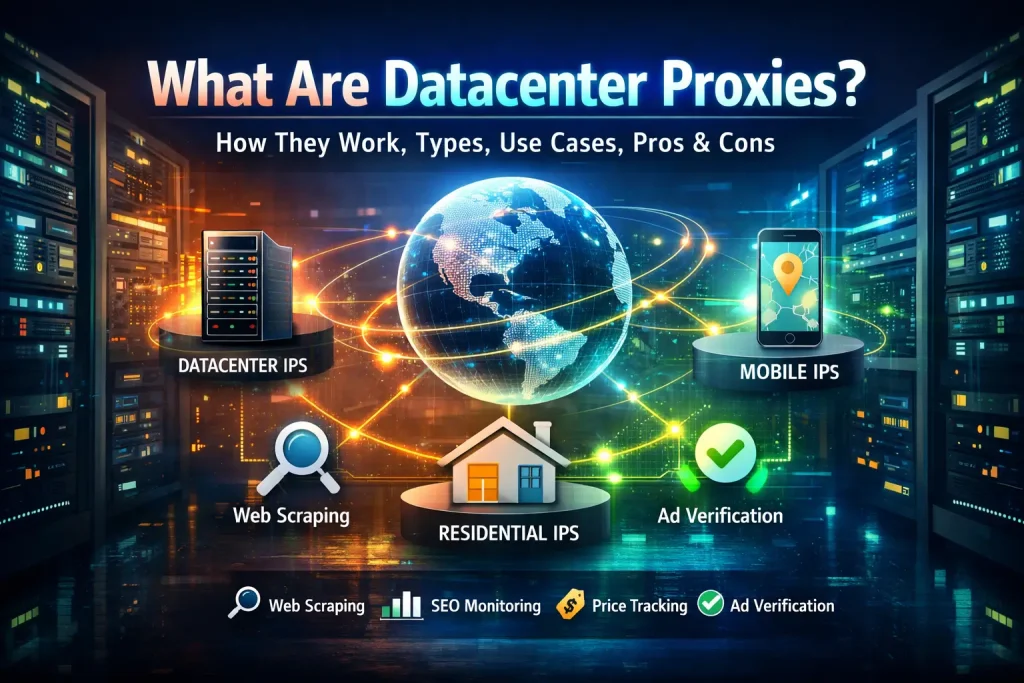
Datacenter proxies are proxy servers that route internet traffic through IP addresses generated and hosted in data centers rather than by internet service providers (ISPs).
These proxy IPs come from large cloud infrastructure providers and hosting companies that operate data centers around the world. Unlike residential or ISP proxies, datacenter proxy IPs are not linked to real household connections. Instead, they are virtual IP addresses designed for speed, scalability, and high-volume usage. This makes them especially effective for tasks that require fast, repeated requests across the web.

The key difference between datacenter proxies and ISP-based proxies lies in their origin and behavior. ISP proxies are issued by real internet providers and resemble genuine home users, while datacenter proxies are easier for websites to recognize as automated traffic. In exchange, datacenter proxies offer significantly higher speed, lower cost, and greater control over IP rotation and volume.
A datacenter proxy is widely used by businesses, developers, and marketers who need efficient access to public web data. Common users include SEO teams tracking search rankings, developers testing applications, marketers verifying ads, and data teams running large-scale web scraping projects. When speed, affordability, and scale matter more than mimicking human behavior, datacenter proxies are often the preferred choice.
How Datacenter Proxies Work (Step-by-Step)

Datacenter proxies work by acting as an intermediary between a user and a target website, masking the user’s real IP address and replacing it with a datacenter-based IP. The process follows a straightforward flow.
First, the user sends a request, such as loading a webpage or collecting data from a website. Instead of going directly to the destination, this request is sent to a proxy server. The proxy then assigns a datacenter IP address from its available pool.
Next, the request is routed through cloud-based infrastructure hosted in a data center. Because these servers are optimized for performance, the request travels quickly and efficiently. The target website receives the request and sees the datacenter IP address rather than the user’s original location or network.
Once the website processes the request, it sends a response back to the proxy server. The proxy forwards that response to the user, completing the cycle. From the user’s perspective, the interaction feels direct, but their identity remains hidden behind the proxy.
Most datacenter proxy function as forward proxies, meaning they act on behalf of the user to access external websites. This differs from reverse proxies, which sit in front of websites and manage incoming traffic for performance or security purposes.
A simple analogy is mail forwarding. Instead of sending mail directly from your home address, you send it through a forwarding service that uses a different address. The recipient never sees your original location, but the message still arrives quickly and reliably. A datacenter proxy operates in much the same way—redirecting traffic efficiently while masking the sender.
Key Characteristics of Datacenter Proxies
Datacenter proxies stand out because of how they’re built and operated. Below are the core characteristics that define them—and why each one matters in real-world scenarios like scraping, SEO monitoring, and automation.
Infrastructure & Hosting
- What it is: A datacenter proxy is hosted on a server inside professional data centers or cloud platforms, using enterprise-grade hardware and networking.
- Why it matters: This setup ensures high uptime, stable connections, and predictable performance for long-running tasks such as continuous web scraping or automated testing.
- Implicit comparison: Unlike residential proxies, which depend on individual home connections, a datacenter proxy runs on controlled, purpose-built infrastructure..
Speed & Latency
- What it is: These proxies benefit from high-speed fiber connections and optimized routing within data centers.
- Why it matters: Faster response times are critical for large-scale scraping, SEO rank tracking, and automation tools that send thousands of requests per minute.
- Implicit comparison: Residential proxies can be slower and inconsistent due to household network limitations, while a datacenter proxy prioritizes raw speed.
Bandwidth Capacity
- What it is: Datacenter environments offer significantly higher bandwidth than consumer internet connections.
- Why it matters: High bandwidth allows uninterrupted data collection, bulk downloads, and parallel requests without throttling or congestion.
- Implicit comparison: Residential proxies often have bandwidth caps or fluctuating throughput, making them less efficient for data-heavy operations.
Scalability
- What it is: Datacenter proxies are available in large IP pools and can be scaled up or down quickly.
- Why it matters: Businesses can easily expand scraping, price monitoring, or automation projects without reworking infrastructure.
- Implicit comparison: Residential IP pools are harder to scale rapidly because they rely on real user devices.
Cost Structure
- What it is: Datacenter proxies are typically sold in bulk at a lower cost per IP.
- Why it matters: This makes them ideal for high-volume tasks where budget efficiency is crucial.
- Implicit comparison: Residential proxies cost more due to sourcing, compliance, and maintenance tied to real ISP connections.
Together, these characteristics make datacenter proxies a practical choice when speed, scale, and cost efficiency matter more than mimicking real-user behavior.
Types of Datacenter Proxies

Datacenter proxies come in several forms, each designed for different performance, security, and budget requirements. Understanding these types helps you choose the right option for your specific use case.
Dedicated (Private) Datacenter Proxies
- Definition: A dedicated datacenter proxy is a private IP address assigned exclusively to a single user.
- Best use cases: Long-running web scraping projects, SEO rank tracking, account management, and automation workflows that require consistent sessions.
- Pros:
- High speed and stability
- Lower risk of IP reputation issues
- Full control over proxy behavior
- Cons:
- More expensive than shared proxies
- Who should avoid it: Users with small-scale projects or strict budget constraints who don’t need exclusive IP access.
Shared Datacenter Proxies
- Definition: A shared datacenter proxy is an IP address used simultaneously by multiple users.
- Best use cases: Market research, light scraping, ad verification, and non-sensitive automation tasks.
- Pros:
- Cost-effective
- Easy to access large IP pools
- Cons:
- Higher chance of IP bans due to shared usage
- Inconsistent performance at peak times
- Who should avoid it: Projects requiring stable identity, high trust scores, or uninterrupted sessions.
Rotating vs Static Datacenter Proxies
- Definition: Static proxies keep the same IP address, while rotating proxies automatically change IPs per request or at set intervals.
- Best use cases:
- Static: Account logins, session-based scraping, API interactions
- Rotating: Large-scale scraping, price monitoring, and data collection at high request volumes
- Pros:
- Static proxies offer consistency
- Rotating proxies reduce detection risk
- Cons:
- Static IPs can be blocked over time
- Rotating proxies may break sessions or logins
- Who should avoid it: Users who don’t need frequent IP changes should avoid rotating proxies due to added complexity.
Free/Public Datacenter Proxies (Security Warning)
- Definition: A free or public datacenter proxy is an IP address openly available without payment.
- Best use cases: Short-term testing or learning purposes only.
- Pros:
- No cost
- Cons:
- Extremely slow and unreliable
- High risk of IP blacklisting
- Serious security and privacy risks
- Who should avoid it: Anyone handling sensitive data, business operations, or large-scale tasks.
By consolidating these proxy types into one clear framework, it becomes easier to match performance, security, and cost with real-world requirements—something most competitor pages fail to do effectively.
Datacenter Proxies vs Residential vs Mobile Proxies

Choosing the right proxy type depends on your performance needs, budget, and how closely you must resemble real user behavior. Datacenter, residential, and mobile proxies each serve different purposes, and understanding their differences helps avoid unnecessary cost or detection issues.
Speed
Datacenter proxies are the fastest of the three. They operate on high-performance servers with direct access to fiber networks, making them ideal for tasks that require rapid request handling, such as large-scale web scraping or SEO monitoring.
Residential proxies are slower by comparison because they rely on real household internet connections, which can fluctuate in speed and stability.
Mobile proxies often fall between the two but can experience latency due to mobile network congestion and carrier-level routing.
Cost
Datacenter proxies are the most cost-effective option. Their IPs are generated in bulk, allowing providers to offer large pools at a lower price per IP.
Residential proxies are significantly more expensive due to the complexity of sourcing IPs from real devices and ISPs.
Mobile proxies are typically the most expensive, reflecting their scarcity and higher trust level with websites.
Anonymity
Residential and mobile proxies provide higher perceived legitimacy because their IPs are tied to real users. Websites are more likely to treat this traffic as organic.
Datacenter proxies still offer anonymity by masking your real IP, but they don’t naturally blend in with normal user traffic as effectively.
Detection Risk
Datacenter proxies carry the highest detection risk since their IP ranges are commonly recognized and monitored by websites.
Residential proxies have a lower detection rate because they mimic everyday browsing behavior.
Mobile proxies are the hardest to detect, as mobile IPs are frequently shared and rotated by carriers, making them appear highly natural.
Scalability
Datacenter proxies excel in scalability. Thousands of IPs can be deployed quickly, making them ideal for automation-heavy workflows.
Residential proxies scale more slowly due to supply limitations.
Mobile proxies are the least scalable because they rely on limited carrier IP pools.
Which Should You Choose?
- Choose datacenter proxies if speed, scale, and cost efficiency are your top priorities.
- Choose residential proxies if you need lower detection risk and higher trust for sensitive scraping or account-related tasks.
- Choose mobile proxies when maximum anonymity and minimal blocking are essential, despite higher costs.
Selecting the right proxy type ensures optimal performance while minimizing risk and unnecessary expense.
Common Use Cases of Datacenter Proxies
Datacenter proxies are widely used in business and technical workflows where speed, scale, and cost efficiency matter more than mimicking individual user behavior. Below are the most common use cases, explained with practical context and clear decision logic.
Web Scraping & Crawling
- The problem: Websites limit the number of requests from a single IP, blocking large-scale data collection.
- Why datacenter proxies work well: Their high speed and bandwidth allow thousands of concurrent requests, making them ideal for scraping search results, product catalogs, or public datasets.
- Limitations: High-security websites may detect and block datacenter IPs, requiring rotation or fallback proxy types.
SEO Monitoring
- The problem: Search engines personalize results based on location, IP, and behavior, making accurate rank tracking difficult.
- Why a datacenter proxy works well: They enable fast, region-specific SERP checks at scale without throttling, which is essential for daily or hourly rank monitoring.
- Limitations: For hyper-local or highly personalized results, residential proxies may provide more accuracy.
Price Intelligence
- The problem: E-commerce platforms show different prices based on geography, demand, or competitor behavior.
- Why a datacenter proxy works well: Their low cost and scalability allow frequent price checks across multiple regions and competitors without excessive infrastructure expense.
- Limitations: Aggressive anti-bot systems may flag static datacenter IPs if request patterns aren’t optimized.
Ad Verification
- The problem: Advertisers need to confirm ads are displayed correctly, in the right locations, and without fraud.
- Why datacenter proxies work well: They allow rapid, repeated checks across regions, ensuring ad placement, creatives, and landing pages function as intended.
- Limitations: For verifying mobile-specific ads, mobile proxies may be more accurate.
Account Management
- The problem: Managing multiple social media or marketplace accounts from one IP increases the risk of bans.
- Why a datacenter proxy works well: Dedicated datacenter proxies provide stable IPs for each account, helping maintain consistent sessions.
- Limitations: Platforms with strict trust requirements may still prefer residential or mobile IPs.
App Testing & Automation
- The problem: Developers need to test applications under different network conditions and automate workflows at scale.
- Why datacenter proxies work well: Their predictable performance and rapid deployment make them ideal for load testing, API validation, and automated QA processes.
- Limitations: They may not fully replicate real-user mobile or home network behavior.
By explaining why datacenter proxies fit each scenario—along with their limits—this approach helps businesses choose confidently rather than relying on generic use-case lists.
Advantages of Datacenter Proxies
Datacenter proxies are widely adopted not just because they are fast or affordable, but because they deliver measurable operational advantages for businesses running data-driven workflows.
High Speed
A datacenter proxy operates on an enterprise-grade server with a high-speed fiber connection. This results in faster response times and lower latency across large volumes of requests.
Operational advantage: Tasks like web scraping, SEO rank tracking, and price monitoring complete faster, allowing teams to collect fresher data and act on insights in near real time.
Cost Efficiency
Because datacenter IPs are generated and maintained in bulk, they cost significantly less than residential or mobile proxies.
Operational advantage: Businesses can run high-frequency automation and data collection without inflating operational budgets, making datacenter proxies ideal for long-term or large-scale projects.
Easy Scaling
Datacenter proxies are highly scalable, with thousands of IPs available on demand. Scaling up does not require sourcing new devices or networks.
Operational advantage: Companies can expand scraping, monitoring, or testing operations instantly—without reconfiguring infrastructure or disrupting workflows.
Infrastructure Reliability
Unlike consumer networks, datacenter proxies run in controlled environments with stable power, optimized routing, and high uptime guarantees.
Operational advantage: This reliability reduces failed requests, connection drops, and downtime, which is critical for automated systems that depend on consistent performance.
Overall, datacenter proxies translate technical strengths into business outcomes—faster execution, predictable costs, and scalable operations—making them a strategic choice for performance-focused use cases.
Disadvantages & Risks of Datacenter Proxies
While datacenter proxies offer speed and cost advantages, they also come with limitations that businesses should understand before deploying them at scale. Addressing these risks proactively helps maintain performance and credibility.
Easier Detection
Datacenter IP ranges are widely known and often monitored by websites with advanced anti-bot systems. Because these IPs are not tied to real ISPs or consumer devices, traffic patterns can appear automated.
Mitigation: Use request throttling, human-like behavior patterns, and rotate IPs regularly to reduce detection signals.
IP Blacklisting
Shared or overused datacenter IPs may already appear on blacklists, leading to blocked requests or CAPTCHAs. This is especially common with low-quality providers.
Mitigation: Choose reputable proxy providers, prioritize dedicated IPs, and monitor IP reputation continuously.
Geo-Restriction Limitations
Datacenter proxies may not accurately represent certain regions, particularly for hyper-local content or services restricted to residential users.
Mitigation: Combine datacenter proxies with residential or mobile proxies for region-sensitive tasks.
Misuse & Compliance Risks
Datacenter proxies are sometimes misused for spam, credential stuffing, or other abusive activities. Poor implementation can also violate website terms or data policies.
Mitigation: Establish ethical usage guidelines, comply with legal and platform policies, and avoid aggressive scraping patterns.
By acknowledging these disadvantages and pairing datacenter proxies with smart configuration and hybrid strategies, businesses can minimize risk while retaining the speed and scalability that make datacenter proxies valuable.
How to Choose the Right Datacenter Proxy Provider
Selecting the right datacenter proxy provider has a direct impact on performance, reliability, and long-term scalability. Instead of focusing on brand names or marketing claims, use the checklist below to evaluate providers objectively.
IP Pool Quality
Look for providers that offer clean, well-maintained IP pools with minimal prior abuse. Ask whether IPs are shared or dedicated and how frequently they are rotated.
Why it matters: High-quality IPs reduce the risk of blocks, CAPTCHAs, and blacklisting during scraping or automation tasks.
Geographic Locations
A strong provider should offer IP coverage across multiple regions and countries. Location transparency is critical.
Why it matters: Accurate geo-targeting is essential for SEO monitoring, price intelligence, and ad verification across markets.
Speed Benchmarks
Evaluate real performance metrics such as latency, success rate, and throughput—not just advertised speeds.
Why it matters: High-speed proxies improve data freshness and reduce task execution time, especially at scale.
Authentication Methods
Reliable providers support flexible authentication, including IP whitelisting and username–password access.
Why it matters: Different workflows require different security models, particularly when integrating proxies into automation tools or cloud environments.
Support & Documentation
Check for clear setup guides, API documentation, and responsive technical support.
Why it matters: Proper documentation reduces onboarding time, while knowledgeable support helps resolve IP or performance issues quickly.
By evaluating providers using these criteria, businesses can select datacenter proxies that align with their operational needs. For businesses seeking reliable options, premium datacenter proxies offer high-quality IPs, fast speeds, and global coverage to support SEO, scraping, and automation workflows.
Best Practices for Using Datacenter Proxies Safely
Using datacenter proxies effectively goes beyond just acquiring IPs. Following best practices ensures long-term success, reduces the risk of blocks, and maintains ethical standards.
IP Rotation
Regularly rotate IP addresses to mimic natural user behavior and avoid detection. Use dedicated or rotating proxies depending on task sensitivity.
Why it matters: Rotation minimizes the chance of IP blacklisting and helps maintain uninterrupted access during high-volume scraping or automation.
Rate Limiting
Throttle request frequency to match realistic human activity. Avoid sending too many simultaneous requests from a single IP.
Why it matters: Respecting rate limits prevents overloading target servers, reduces detection risk, and maintains provider trust.
Ethical Scraping
Only collect publicly available data and avoid harvesting sensitive personal information. Focus on actionable insights without infringing on privacy or security.
Why it matters: Ethical practices reduce legal risks, maintain reputation, and ensure compliance with data protection regulations.
Respect Terms of Service
Always comply with website Terms of Service and platform-specific guidelines. Use proxies responsibly to avoid violating policies.
Why it matters: Respecting ToS ensures sustainable access to target sites and avoids permanent bans or legal consequences.
By combining these practices, organizations can maximize the advantages of a datacenter proxy—speed, scalability, and cost-efficiency—while minimizing risks. Adhering to ethical and technical guidelines promotes long-term, reliable operations and protects both the business and its data sources.
FAQs
1. Are datacenter proxies legal?
Yes, datacenter proxies are legal in most countries. They are simply servers that route your internet traffic through alternate IPs. However, legality depends on usage—ethical tasks like web scraping, market research, or SEO monitoring are fine, while illegal activities like fraud or unauthorized access can violate laws.
2. Are datacenter proxies anonymous?
Datacenter proxies provide strong anonymity by masking your original IP address. They hide your location and identity from websites, making tracking difficult. However, they are easier to detect than residential proxies, so for sensitive tasks, consider rotating IPs or combining with other proxy types for added privacy.
3. Why are datacenter proxies cheaper?
Datacenter proxies are cheaper because they are hosted in centralized data centers with bulk IP allocation. Unlike residential proxies tied to individual ISPs, datacenter IPs can be scaled and maintained at lower cost. This makes them ideal for high-volume tasks like scraping, testing, and automation without breaking the budget.
4. Can datacenter proxies be detected?
Yes, websites can detect datacenter proxies because their IP ranges are publicly known and associated with corporate servers. Advanced anti-bot systems may flag repeated requests or high-volume traffic. Using rotating IPs, rate limiting, and ethical practices reduces detection risk.
5. Are datacenter proxies good for SEO?
A datacenter proxy is excellent for SEO tasks such as rank tracking, competitor analysis, and keyword research. Its speed and scalability allow multiple queries from different locations. Limitations include occasional blocking by search engines, which can be mitigated through IP rotation and careful rate management.
6. Datacenter vs residential proxies: which is better?
It depends on your needs. Datacenter proxies excel in speed, cost, and scalability, making them ideal for large-scale automation. Residential proxies are better for high anonymity, avoiding blocks, and accessing geo-restricted content. Businesses often use a hybrid approach for balanced performance and privacy.
7. Can datacenter proxies access geo-restricted content?
Yes, datacenter proxies can access geo-restricted content by selecting IPs from the desired region. However, some platforms may block datacenter IPs, so combining them with residential proxies can improve reliability when location-specific access is critical.
Final Verdict: Are Datacenter Proxies Right for You?
Datacenter proxies are ideal for businesses and professionals who need speed, scalability, and cost efficiency. They excel in web scraping, SEO monitoring, price intelligence, ad verification, and automation tasks where high-volume requests and fast performance matter most. If your operations require reliable infrastructure without the premium cost of residential IPs, datacenter proxies are a strong choice.
However, they are not the best fit for activities demanding high anonymity, frequent access to geo-restricted content, or sensitive data collection. In such cases, residential or mobile proxies provide more legitimacy and lower detection risk.
For most users, combining a datacenter proxy with rotation strategies—or even a hybrid setup with residential proxies—offers the best balance of performance, privacy, and reliability.
Conclusion: Datacenter proxies provide a powerful, affordable solution for large-scale online operations, but understanding their limitations and applying best practices ensures sustainable, effective use. When speed and volume outweigh anonymity concerns, datacenter proxies are the expert-recommended choice.