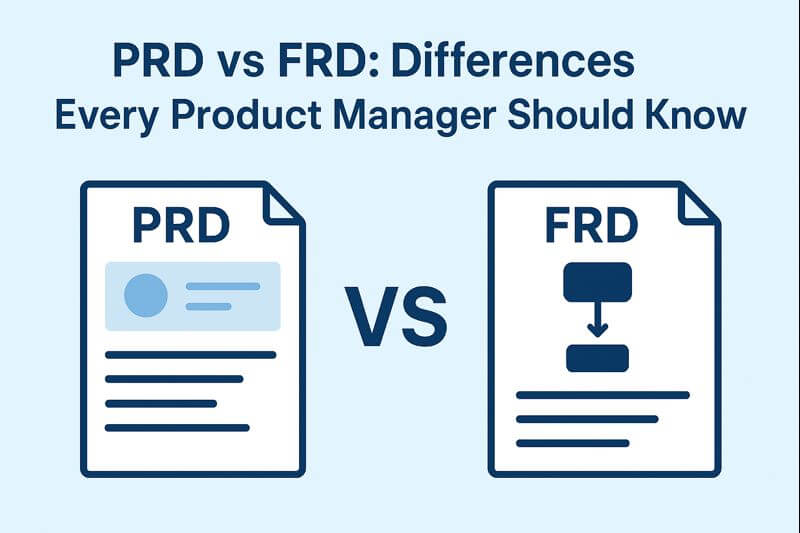
In product management, clarity is everything. When teams misunderstand requirements, even the best ideas can turn into delayed launches, bloated features, or products that miss user expectations. Two documents play a critical role in preventing this confusion: the Product Requirement Document (PRD) and the Functional Requirement Document (FRD).
While PRDs and FRDs are often mentioned together—and sometimes even used interchangeably—they serve very different purposes in the product development lifecycle. A PRD focuses on what problem the product is solving and why it matters from a business and user perspective. An FRD, on the other hand, dives into how those requirements will be implemented from a functional and technical standpoint.
For product managers, understanding the differences between PRD and FRD is not just a documentation exercise—it’s essential for aligning stakeholders, guiding engineering teams, and ensuring smooth execution from idea to release. In this guide, we’ll break down what PRDs and FRDs are, how they differ, when to use each, and how modern tools can help you create, manage, and maintain both documents efficiently.
What is a Product Requirement Document (PRD)?
A Product Requirement Document (PRD) is a foundational document that clearly defines what a product is, who it is for, and why it should be built. It captures the product vision and translates business objectives and user needs into a structured set of requirements that guide the entire product development process.
For product managers, the PRD acts as a single source of truth that aligns stakeholders across business, design, engineering, and marketing teams. Rather than focusing on technical implementation details, a PRD emphasizes user problems, desired outcomes, and product value. It ensures everyone understands the scope, priorities, and success criteria before development begins.
A well-written PRD helps teams:
-
Align on product goals and success metrics
-
Prioritize features based on user and business impact
-
Reduce ambiguity during development
-
Minimize rework caused by unclear or shifting requirements
Typically created early in the product lifecycle, the PRD evolves as insights are gathered from user research, stakeholder feedback, and market changes—but it remains rooted in the product’s strategic direction.
Example sections in a PRD
Below are the core sections commonly included in a Product Requirement Document, each serving a specific purpose in clarifying the product vision and scope.
Product overview
This section provides a high-level summary of the product or feature being built. It explains the problem being solved, the proposed solution, and how the product fits into the broader business or product ecosystem. The goal is to give any reader immediate context.
Objectives and goals
Here, the PRD outlines what success looks like. Objectives may include business goals (e.g., increasing retention or revenue) and user-centric goals (e.g., reducing friction or improving task completion). Clear goals help teams make informed trade-offs during development.
Target user personas
This section defines who the product is for by describing key user personas. It includes user roles, pain points, motivations, and behaviors. By grounding requirements in real user needs, the PRD ensures the product is built with the end user in mind.
User stories and use cases
User stories and use cases describe how users will interact with the product. Written from the user’s perspective, they help teams understand real-world scenarios and prioritize features that deliver meaningful value.
Features and functionalities
This is where the PRD lists and describes the core features required to meet the product goals. Features are typically presented at a high level, focusing on what the product should do rather than how it will be built.
Assumptions and dependencies
Every product decision is based on certain assumptions—about users, technology, resources, or market conditions. This section documents those assumptions and highlights dependencies on other teams, systems, or third-party tools, reducing surprises later in the project.
Timeline and milestones
The timeline outlines major phases, milestones, and target delivery dates. While not a detailed project plan, it provides a realistic view of progress expectations and helps stakeholders align on launch goals and priorities.
What Is a Functional Requirement Document (FRD)?

A Functional Requirement Document (FRD) translates the product vision and high-level requirements into clear, detailed functional specifications that engineering and technical teams can build against. While a PRD explains what the product should achieve and why it matters, an FRD focuses on how the system should behave to meet those requirements.
The FRD acts as a blueprint for implementation. It defines system behavior, workflows, data handling, and interactions in a way that removes ambiguity for developers, QA teams, and system analysts. For product managers, the FRD ensures that product goals are accurately converted into functional logic without misinterpretation.
Typically created after the PRD is approved, the FRD is more technical in nature and closely tied to a specific release or scope of work. It may evolve throughout development as technical constraints, edge cases, or integration needs are discovered.
Example sections in an FRD
An FRD is structured to provide engineers with precise, actionable details. Below are the key sections commonly found in a Functional Requirement Document.
Introduction and purpose
This section explains why the FRD exists and what it covers. It defines the scope of the document, references the related PRD, and clarifies which features or releases the functional requirements apply to.
The system overview
The system overview provides a high-level description of how the system is structured. It outlines major components, modules, user roles, and interactions, giving technical teams a clear understanding of how the solution fits together.
Workflows and process flows
This section details step-by-step workflows that describe how users and systems interact. Process flow diagrams or sequence descriptions are often included to illustrate logic, decision points, and alternative paths, helping developers implement consistent behavior.
Data flows and requirements
Here, the FRD specifies how data is captured, processed, stored, and exchanged between systems. It may include data models, validation rules, input/output requirements, and error handling scenarios critical for accurate system behavior.
User interface requirements and wireframes
This section defines how users will interact with the system from a functional perspective. It includes screen-level requirements, UI behaviors, form rules, and references to wireframes or mockups that guide design and development without dictating visual style.
Integration requirements
Many products rely on external tools, APIs, or internal systems. This section documents integration points, data exchange methods, authentication requirements, and failure handling to ensure seamless communication between systems.
Product Requirement vs Functional Requirement Documents: Key Differences
Although PRDs and FRDs are closely related, they serve distinct roles in product development. Understanding their differences helps product managers communicate more effectively with stakeholders and ensures smoother handoffs from strategy to execution. The table below highlights the key distinctions between a Product Requirement Document (PRD) and a Functional Requirement Document (FRD).
| Criteria | PRD | FRD |
|---|---|---|
| Audience | Business stakeholders, product managers, cross-functional teams | System analysts, engineering and technical teams, developers |
| Focus | Business goals, user needs, product value, and the what and why | System behavior and how requirements translate into technical features |
| Format | User-focused, vision-driven, high-level features and use cases | System-focused, detailed functional specifications, data flows, and mockups |
| Level of detail | High-level and broad; may include some non-functional requirements | Deeply detailed, actionable specs specific to engineering and a release |
| Owner | Product manager, sometimes supported by a business analyst | System analyst or engineering lead, sometimes a business analyst |
| Life cycle stage | Early ideation, planning, and goal alignment | Solution design, development preparation, and QA readiness |
| Usage purpose | Aligning business vision and communicating priorities across teams | Translating product goals into concrete engineering solutions |
| Change frequency | Changes less frequently; tied to strategic business decisions | May change throughout development as technical solutions evolve |
| Example content | Purpose, goals, user stories, feature lists, use cases, and constraints | Functional workflows, business processes, wireframes, and data integrations |
The PRD sets the direction and intent of the product, while the FRD ensures that intent is accurately and technically implemented. Product managers who clearly differentiate and connect these two documents reduce misalignment, speed up delivery, and improve overall product quality.
When to Use a PRD vs FRD

Knowing when to use a PRD versus an FRD is just as important as understanding how they differ. Each document plays a distinct role at different stages of the product development lifecycle, and using the right one at the right time helps teams stay aligned and move faster with fewer misunderstandings.
When to use a PRD
A PRD should be created when you are defining or refining the product vision and need to align stakeholders around what should be built and why. It is most valuable during the early stages of product planning, before design and development begin.
Use a PRD when:
-
You are validating a product idea or new feature
-
Business goals, success metrics, and priorities need alignment
-
User problems and use cases must be clearly defined
-
Multiple teams (business, design, marketing, engineering) need a shared understanding
-
Trade-offs and scope decisions are still being discussed
In short, the PRD acts as a strategic guide that keeps everyone focused on delivering the right product for the right users.
When to use an FRD
An FRD is used once the product direction is clear and the team is ready to move into solution design and execution. It provides the detailed functional instructions engineers need to build the product correctly.
Use an FRD when:
-
The PRD has been approved and finalized
-
Engineering teams need clarity on system behavior and logic
-
Complex workflows, data handling, or integrations are involved
-
QA teams need precise criteria for testing functionality
-
The product is moving toward development, build, and release
The FRD serves as an execution blueprint, ensuring the product is implemented exactly as intended.
Using PRD and FRD together
In most real-world projects, PRDs and FRDs work best together, not in isolation. The PRD defines the destination, while the FRD maps out the route to get there. Product managers who use both documents at the right moments can reduce rework, prevent scope creep, and maintain strong alignment from strategy through delivery.
Choosing the right document at the right time ultimately leads to faster development cycles and better product outcomes.
How Corexta Helps Create and Manage PRDs and FRDs
Creating PRDs and FRDs is only part of the challenge—keeping them aligned, up to date, and accessible throughout the product lifecycle is where many teams struggle. This is where Corexta becomes a powerful ally for product managers and cross-functional teams.
Corexta brings requirement planning, collaboration, and execution into a single workspace, making it easier to manage both strategic product requirements and detailed functional specifications without losing context.
Centralized requirement documentation
Corexta allows teams to create and store PRDs and FRDs in one centralized platform. Instead of scattered documents across tools and folders, product managers can maintain a single source of truth where every requirement, update, and decision is easy to find and reference.
Seamless collaboration across teams
PRDs are often reviewed by business stakeholders and designers, while FRDs are heavily used by engineers and QA teams. Corexta enables real-time collaboration, comments, and feedback so each team can contribute directly to the same document—reducing back-and-forth and misinterpretation.
Clear traceability from PRD to FRD
One of the biggest challenges in product development is ensuring functional requirements stay aligned with product goals. Corexta helps teams link high-level PRD items to detailed FRD requirements, making it easy to trace every feature back to its original business and user objective.
Version control and change management
Requirements evolve, especially at the functional level. Corexta tracks changes, updates, and revisions so teams always know what changed, when, and why. This is especially useful for FRDs, which may need frequent updates as technical solutions evolve.
Integrated workflows and execution tracking
Beyond documentation, Corexta connects PRDs and FRDs to tasks, sprints, and milestones. Product managers can see how requirements move from idea to implementation, helping teams stay aligned on priorities, timelines, and delivery status.
By combining documentation, collaboration, and execution in one platform, Corexta helps teams turn product ideas into well-defined requirements—and turn those requirements into successful, well-built products.
Add Corexta as a ‘Requirement’ in Your Product Workflow!
PRDs and FRDs only deliver value when they stay aligned, accessible, and actionable throughout the product lifecycle. Without the right system in place, even well-written documents can quickly become outdated or disconnected from execution. That’s why modern product teams are making Corexta a core requirement in their workflow.
With Corexta, product managers can move seamlessly from strategy to delivery—connecting product vision, functional details, and execution in one unified platform. Instead of juggling multiple tools for documentation, collaboration, and tracking, Corexta helps you plan smarter, collaborate faster, and ship with confidence.
If you want fewer misunderstandings, faster handoffs, and better-built products, it’s time to upgrade how you manage requirements. Bring clarity to your PRDs, precision to your FRDs, and momentum to your product roadmap with Corexta. Start building better products today.
Frequently Asked Questions (FAQ)
Do you need both a PRD and an FRD for every project?
Not always. Smaller projects or simple features may only require a PRD. However, for complex products, large teams, or systems with intricate workflows and integrations, using both a PRD and an FRD ensures clarity from strategy through execution.
Who is responsible for writing a PRD vs FRD?
The PRD is typically owned by the product manager, sometimes with input from business analysts and stakeholders. The FRD is usually created by a system analyst or engineering lead, often in close collaboration with the product manager to ensure alignment with product goals.
Can a single document combine PRD and FRD?
In some cases, yes—especially for small teams or early-stage products. However, as complexity grows, separating PRD and FRD helps maintain clarity by distinguishing high-level product intent from detailed functional specifications.
What tools help create PRDs and FRDs?
Teams commonly use tools like product management platforms, documentation tools, and collaboration software. Solutions like Corexta stand out by allowing teams to create, link, and manage both PRDs and FRDs in one place—making it easier to maintain alignment and execute efficiently.