In nearly every organization and project, one of the biggest stumbling blocks is role ambiguity: who should decide what, who needs to input, who must do the work, and who should simply be kept in the loop? Studies show that many employees are unclear about what’s expected of them — this confusion can undermine productivity, create duplication of effort, prolong decision making, and leave critical tasks falling between the cracks.
To address this, many teams turn to formal frameworks that establish clarity: two of the most widely adopted are the RAPID model (focused on decision-making roles) and the RACI matrix (focused on task and responsibility assignment). Each offers a structured way to assign accountability, streamline workflow, and avoid confusion—but each applies in different kinds of situations. The key lies in understanding both the frameworks’ distinctive features, the strengths and limitations of each, and when to employ one versus the other.
This blog will explore:
-
What each framework is (RAPID & RACI)
-
The roles and mechanics of each
-
A comparative analysis of their key features
-
Practical guidance on when to use each
-
Steps for implementing them
-
Pitfalls to watch out for and best-practices to adopt
By the end, you should be equipped to decide: “Which model fits my project or decision-context?” and “How do I apply it so that my team isn’t stalled by who does what?”

What is RAPID?
The RAPID framework is a decision-making model designed to clarify who does what during the decision process: who makes recommendations, who gives input, who has to agree, who performs and who decides. It was developed originally by a major consulting firm.
The name is an acronym (often expanded as Recommend, Agree, Perform, Input, Decide) though note: the order of the letters in practice does not always reflect the chronological order of activities.
This framework is especially suited for complex decisions — high-stakes, multi-stakeholder, cross-departmental contexts where clarity about decision authority and role is critical.
The roles of RAPID
Here’s what each role means:
-
Recommend (R): The person or group responsible for gathering information and developing a recommendation for action. They craft options, evaluate, and present a proposal.
-
Agree (A): Stakeholders who must sign off on or approve the recommendation before it moves forward. Their veto or approval is required.
-
Perform (P): The person or group who will implement the decision once it’s made. They carry out the action.
-
Input (I): Experts or stakeholders who provide important data, feedback, expertise or insights to the process of making the recommendation. They don’t decide, but their voice matters.
-
Decide (D): The person with the ultimate decision-making authority—they approve, choose, or reject the recommendation. They are accountable for the outcome.
Key features and benefits of RAPID
The RAPID model brings several advantages:
-
Clear decision-maker: By designating the “Decide” role, there is an explicit person who will make the final call—eliminating confusion over who holds the authority.
-
Structured input & accountability: Other roles (Recommend, Input, Agree) ensure that relevant viewpoints are heard, expertise leveraged, and approvals captured.
-
Faster decisions (when configured well): With roles defined, you reduce endless back-and-forth, avoid ambiguous hand-offs, and can drive decisions more efficiently.
-
Better transparency & alignment: Everyone knows who did what and why; this fosters ownership and smoother implementation.
-
Adaptability: Though designed for decisions, you can tailor it to a variety of contexts—from strategic choices to operational implementations.
Limitations & cautions
-
Not every decision merits the overhead of full RAPID: for small, routine, singular decisions a heavy process may slow rather than speed.
-
Over-use of the Agree role can shift the model into consensus-drag territory (which the model aims to avoid).
-
Implementing poorly (e.g., multiple “Decide” persons, unclear roles) undermines the benefit.
-
It focuses on decision roles rather than ongoing task execution and may not cover the full project lifecycle.
What is RACI?
The RACI matrix (also known as the Responsibility Assignment Matrix) is a widely used project-management tool that clarifies roles and responsibilities for tasks, deliverables, processes or major project phases.
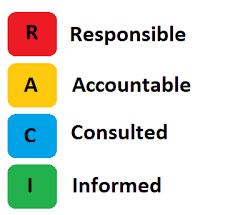
RACI stands for Responsible, Accountable, Consulted, Informed. Each task or deliverable is mapped against who does what, who signs off, who is consulted and who is just informed.
The roles of RACI
Here’s what each of the four roles represents:
-
Responsible (R): The person or people who actually perform the task or deliverable. They do the work. Multiple people can be “Responsible”.
-
Accountable (A): The person who is ultimately answerable for the correct completion of the task or decision. Often only one person should hold this per task. They approve the work and are the owner.
-
Consulted (C): Individuals or groups whose opinions or input are sought prior to completing the task. Two-way communication.
-
Informed (I): Stakeholders who need to be kept up to date on progress or outcomes. One-way communication.
Key features and benefits of RACI
-
Role clarity across tasks: Assigning R, A, C, I for each task means every deliverable has clear ownership and involvement.
-
Saves time by reducing confusion: Teams don’t waste time asking “Who’s doing this?” or “Whose sign-off is needed?”
-
Works for complex, cross-functional work: With multiple teams, functions, deliverables, RACI helps map involvement and communication flows.
-
Simplifies change & onboarding: By having a matrix, new team-members or stakeholders can rapidly see who is responsible for what.
-
Improves accountability & governance: The “A” role ensures someone is accountable, reducing diffusion of responsibility.
Limitations & cautions
-
RACI focuses on tasks, not decision-authority. While it clarifies “who does what”, it doesn’t inherently define “who decides what”.
-
If over-applied or mis-used, it can become bureaucratic (e.g., too many people in “Consulted” or “Informed”, or multiple “Accountable”).
-
It doesn’t always handle dynamic decisions or rapid change well; it’s more suited to structured, planned processes.
-
The matrix can become outdated if not maintained alongside project evolution.
RAPID vs RACI: Side-by-side comparison
Now that we’ve defined both frameworks, let’s compare them across several key dimensions.
| Feature | RAPID | RACI |
|---|---|---|
| Primary focus | Decision-making roles (who proposes, who approves, who executes) | Task/deliverable responsibilities (who does the work, who is accountable) |
| Ideal scenario | High-stakes decisions, complex stakeholder involvement, ambiguity in decision-authority | Projects with many tasks, cross-functional teams, need clear role mapping |
| Role clarity | Strongly defines “decider” and avoids diffusion of decision ownership | Strongly defines who is “responsible” and “accountable” for each task |
| Speed vs deliberation | Designed to help accelerate or at least structure decision processes | Designed to clarify tasks and workflows, not necessarily accelerate decisions |
| Depth of task breakdown | Less about task-level work; more about decision flow | Deeper task-level assignment and “who touches what” |
| Typical limitation | May ignore task details beyond the decision | May lack clarity on who can make the decision |
| Example use case | CEO must decide product strategy; multi-department input needed | Marketing, development, sales teams need to know who drafts, who signs off, who reviews on campaign tasks |
Key takeaways from the comparison
-
Think of RAPID when the decision itself is ambiguous (“Who is going to decide this major course?”)
-
Think of RACI when the work/deliverable is ambiguous (“Who is doing what and when?”)
-
They are not mutually exclusive—you might use RAPID for strategic decisions and RACI for task execution in the same project.
-
If you use the wrong framework (e.g., use RACI for a major decision) you may lack clarity about final decision-ownership; likewise, using RAPID for many granular tasks might result in overhead and confusion.
When to Use RAPID and When to Use RACI
Best use cases for RAPID
-
Product launches: When timing is critical and multiple stakeholders (R&D, marketing, operations, finance) must align quickly, RAPID ensures a clear “Decide” role and avoids paralysis by committee.
-
Crisis or urgent scenarios: When an organization faces a sudden challenge (e.g., reputational risk, major system outage) — RAPID gives a structured path to resolve swiftly.
-
Strategic, high-level decisions: Where the choice has large impact (enter new market, merge/acquire, change business model) and many inputs are needed, but someone must ultimately decide.
Best use cases for RACI
-
Cross-functional projects: When teams from multiple departments collaborate (marketing + product + compliance + legal), RACI neatly outlines who handles each aspect.
-
Long-term or multi-phase initiatives: When the project spans many months, deliverables shift, teams change — RACI helps maintain clarity and accountability.
-
Compliance or regulated processes: When tasks must be tracked tightly (e.g., regulatory approvals, audit trails), RACI’s clarity ensures nothing is missed.
Hybrid scenarios
You might start with a RAPID decision to choose a project path, then once the decision is made, shift into a RACI framework to map who executes each task. For example:
-
Use RAPID to decide on entering a new product line (Recommend, Input, Agree, Decide, Perform).
-
Once decision is taken, develop a RACI chart across all execution tasks: design, production, marketing, launch.
The frameworks complement each other: one ensures the decision-chain is clear, the other ensures the execution chain is clear.
How to Implement These Frameworks
Here are step-by-step guides to getting each up and running in your organization.
Implementing RAPID
-
Identify the decision: Define the decision that needs to be made (scope, timing, impact, stakeholders).
-
List roles: Determine who will be the Recommender, Agreeers (if needed), Performers, Input providers, and Decide. Note: the Decide role must be singular or clearly defined.
-
Clarify responsibilities: Document what each role is expected to do—what the Recommender will propose, what input providers must supply, what the decider will evaluate.
-
Set timeline / decision gates: Set when input is due, when the decision will be made, when implementation begins.
-
Communicate the framework: Ensure everyone knows their role and how the decision path works—so no one is surprised.
-
Execute: The Recommender leads the proposal, Input providers supply expertise, Agreeers sign off, the Decider decides, the Performer executes.
-
Review & follow-through: After implementation, review outcomes, accountability, lessons learned. Use the clarity of roles to assess what worked/what didn’t.
Implementing RACI
-
List project deliverables/tasks: Break the project into activities or milestones.
-
List stakeholders/roles: Identify all relevant people/groups involved.
-
Build the matrix: Create a table (tasks on one axis, roles on the other) and fill in R, A, C, I for each task. Ensure each task has at least one Responsible and one Accountable (where applicable).
-
Ensure clarity: Avoid having multiple Accountables for the same task; ensure Consulted and Informed roles are meaningful (not just listed for form’s sake).
-
Communicate and align: Share the RACI matrix with the team — everyone should know their assignments.
-
Use actively: As the project progresses, refer to the matrix in status meetings, decision points, hand-offs. Update it as tasks or roles change.
-
Review continually: Because projects can shift, revisit the RACI periodically to ensure relevance and accuracy.
Common Pitfalls and Tips for Success
Pitfalls
-
Assigning too many roles or making it overly complex (e.g., multiple Accountables or too many Consulteds) — creates confusion rather than clarity.
-
Treating the framework as “set-and-forget” rather than a living document — if roles shift, not updating leads to outdated role-definitions.
-
Using the wrong framework for the wrong purpose (e.g., using RACI when you actually need clear decision-authority).
-
Neglecting communication: just producing a matrix or chart doesn’t guarantee understanding—team buy-in still matters.
-
Blurring the “Decide” or “Accountable” roles — if people aren’t clear on who signs off, bottlenecks reappear.
Tips for Success
-
Limit the “Agree” role in RAPID: excessive sign-off layers defeat the purpose of speed.
-
For RACI, keep Accountable to one person per task where possible — it simplifies accountability.
-
Use visuals/templates: charts, tables or even color-coded spreadsheets help teams digest the framework.
-
Review and update regularly: especially in evolving or long projects.
-
Link frameworks with meetings/communication: e.g., in your next status meeting reference the RACI matrix (“Who is A for this task?”) or the RAPID decision process (“Has the Decider approved?”).
-
Educate the team: ensure people understand what each letter means (R, A, C, I / R, A, P, I, D). Don’t assume familiarity.
Bring Clarity and Confidence to Every Project
Managing a project without defined roles or quick decisions can feel chaotic and unproductive. Frameworks like RAPID and RACI bring structure to that chaos, helping teams align, act faster, and stay accountable.
RAPID streamlines decision-making by identifying who should recommend, approve, and execute — cutting through delays and confusion. Meanwhile, RACI is perfect for complex, cross-functional projects, ensuring every team member knows their responsibilities, who to consult, and who needs to stay informed.
With Corexta, applying these frameworks becomes simple. Its ready-to-use templates, real-time collaboration tools, and smart integrations turn scattered workflows into organized, high-performing systems.
Experience the difference clarity makes — start using Corexta today.
Conclusion
Effective projects and decisions don’t happen by accident — they happen when roles, responsibilities and decision-paths are clearly mapped out and communicated. The RAPID and RACI frameworks each offer powerful ways to bring clarity and accountability to organizations, but they serve different purposes:
-
Choose RAPID when the decision path is unclear, the stakes are high, multiple stakeholders must be engaged, and a clear “decider” must be identified.
-
Choose RACI when the project involves many deliverables, tasks, teams and hand-offs, and you need to map “who does what and who needs to be informed”.
Used well, these frameworks reduce wasted time, eliminate confusion, speed up execution, and enhance team alignment. Used poorly (or not at all), decision-making becomes murky, responsibilities overlap or get dropped, and projects stall.
In your next initiative, ask:
-
“Is the main issue a decision ownership problem or a task ownership problem?”
-
“Do we need a decider for a major strategic choice, or do we need a structure for ongoing task accountability?”
That question will help steer you to the right framework — and once selected, follow the steps above to implement it clearly. The result: clearer roles, smoother execution, and stronger outcomes.
Combine both frameworks if you have a full lifecycle: Use RAPID for the decision moment (“Should we launch this product?”) and RACI for the execution phase (“Here’s who creates design, who approves, who is informed during launch”).